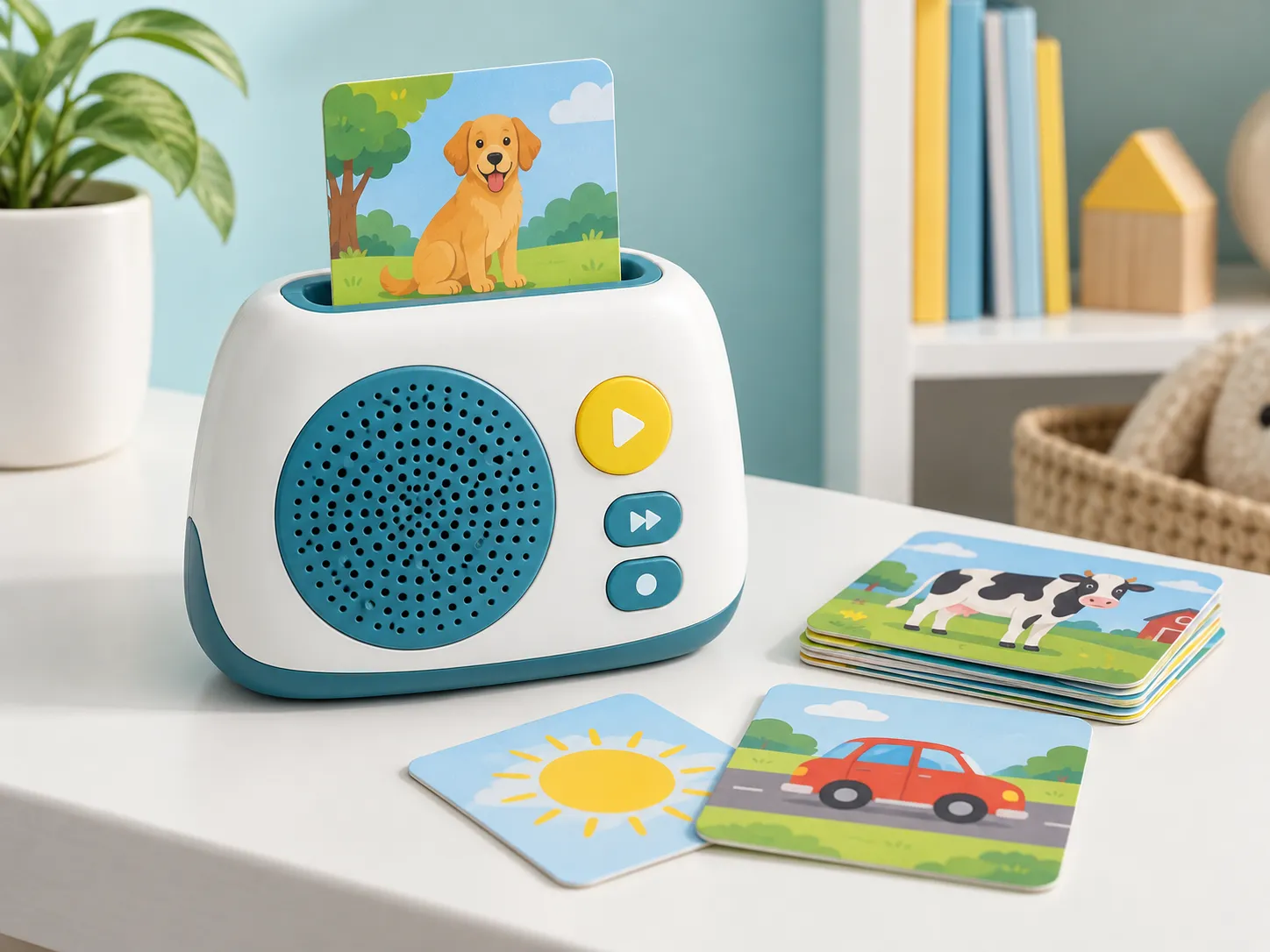
How to Build Expansion Card Packs for a Children’s Audio Player: Build expansion packs by defining a clear theme and age promise, reserving unique identifiers, controlling artwork and audio mappings, stating player compatibility, planning storage and replacements, validating all cards with supported firmware, and inspecting pack count, identity, language, packaging, and barcode before release.
Expansion packs can turn one hardware sale into a content platform, but only if buyers trust compatibility and can organize the library. Duplicate IDs, missing installed audio, unclear pack versions, weak storage, and inconsistent naming quickly damage that promise.
This guide is written for story-content brands, language-learning companies, publishers, retailers, subscription programs, and toy distributors. It addresses the questions that normally appear between the first concept discussion and a production-ready quotation: product application, customer requirements, content ownership, sample purpose, factory testing, shipment inspection, packaging, and market-specific documentation. It does not present universal specifications because insert-card audio player should be engineered around the final user, configuration, claims, sales market, and distribution plan.
For an overview of the available configuration and customization direction, review Cakub’s insert-card audio players product page. Buyers who are still comparing formats can also start with the interactive learning product range.
1. What should buyers understand first?
An expansion pack is a separately sold or distributed set of cards that adds stories, songs, vocabulary, lessons, routines, or other content to an existing player. It requires catalog governance, compatible recognition, audio availability, visible identity, packaging, and support throughout the player’s product life.
Practical buyer answer: Manage each pack like a small product release with its own requirement, artwork, content database, compatibility test, packaging, inspection, and support record.
The most reliable starting point is a one-page use-case description. State who uses the product, what physical action starts the interaction, what the product should do, what happens next, and how success is observed. This prevents a supplier from substituting a familiar standard product for a requirement that actually needs different electronics, files, construction, firmware, or packaging.
2. Where does this solution fit—and where does it not?
Expansion works when each pack has a recognizable purpose and the hardware platform reserves capacity for ongoing releases.
| Decision question | Good fit when | Reconsider when |
|---|---|---|
| Is the pack promise clear? | Theme, age, language, duration, learning value, and included card count are easy to understand. | Cards repeat existing content without a distinct reason to buy. |
| Is compatibility explicit? | Supported player versions and required updates are visible before purchase. | Customers discover incompatibility only after opening. |
| Can the library be organized? | Numbering, category color, index, storage, and replacement help families manage cards. | Packs create visually similar loose cards with no catalog system. |
3. Which specification decisions change the project?
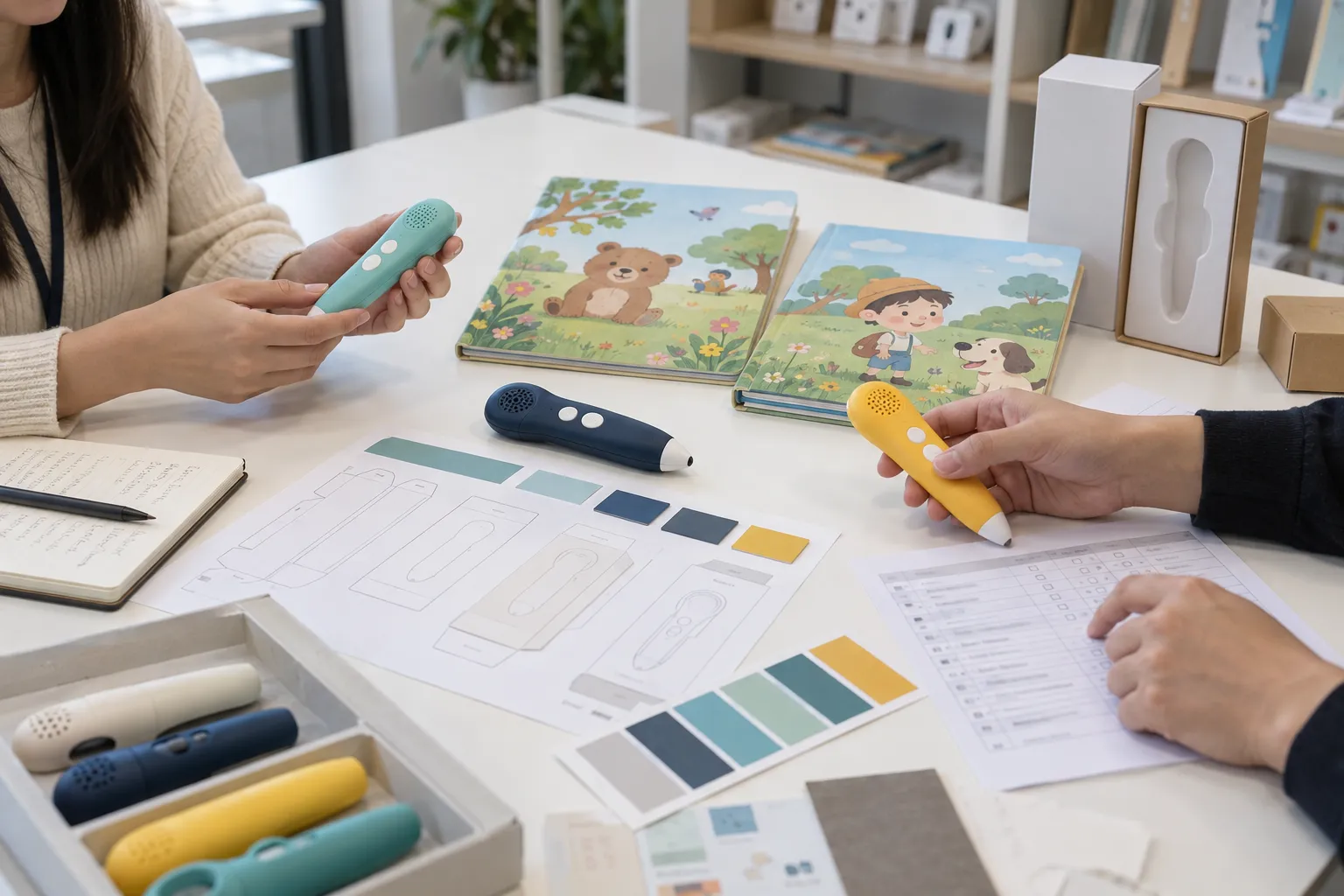
The content roadmap should be designed alongside identifier, firmware, packaging, and support capacity.
1. Pack proposition
Define theme, age, language, educational or entertainment purpose, card count, total duration, and price position. This decision should be closed before detailed quotation because it affects several downstream assumptions. For insert-card audio player, the useful question is not whether a feature is available in theory, but how it will be implemented, approved, repeated in production, and checked before shipment.
2. Catalog and IDs
Reserve pack codes, card numbers, machine identities, compatibility versions, replacements, samples, and future ranges. A supplier can only validate this point when the intended user action and acceptable response are observable. For insert-card audio player, the useful question is not whether a feature is available in theory, but how it will be implemented, approved, repeated in production, and checked before shipment.
3. Audio availability
Choose installed, downloadable, card-stored, or update-delivered content and define ownership and support. Treat this as a controlled product requirement rather than an informal preference in an email thread. For insert-card audio player, the useful question is not whether a feature is available in theory, but how it will be implemented, approved, repeated in production, and checked before shipment.
4. Artwork system
Use consistent fronts, backs, orientation, categories, visible numbers, language markers, legal copy, and accessibility. The approved sample should demonstrate this requirement with representative content and production-style materials. For insert-card audio player, the useful question is not whether a feature is available in theory, but how it will be implemented, approved, repeated in production, and checked before shipment.
5. Packaging and storage
Plan retail pack, protective fit, card index, barcode, shelf communication, shipping, and home storage. Document the decision in the specification, sample comments, and final inspection checklist so each team uses the same reference. For insert-card audio player, the useful question is not whether a feature is available in theory, but how it will be implemented, approved, repeated in production, and checked before shipment.
6. Release and support
Coordinate player firmware, content package, instructions, website information, customer service, replacement, and discontinuation. If the requirement is still open, ask the supplier to quote the alternatives separately instead of hiding the difference in one price. For insert-card audio player, the useful question is not whether a feature is available in theory, but how it will be implemented, approved, repeated in production, and checked before shipment.
| Decision area | What to define | Approval evidence |
|---|---|---|
| Pack proposition | Define theme, age, language, educational or entertainment purpose, card count, total duration, and price position. | Specification, approved sample, or controlled record |
| Catalog and IDs | Reserve pack codes, card numbers, machine identities, compatibility versions, replacements, samples, and future ranges. | Specification, approved sample, or controlled record |
| Audio availability | Choose installed, downloadable, card-stored, or update-delivered content and define ownership and support. | Specification, approved sample, or controlled record |
| Artwork system | Use consistent fronts, backs, orientation, categories, visible numbers, language markers, legal copy, and accessibility. | Specification, approved sample, or controlled record |
| Packaging and storage | Plan retail pack, protective fit, card index, barcode, shelf communication, shipping, and home storage. | Specification, approved sample, or controlled record |
| Release and support | Coordinate player firmware, content package, instructions, website information, customer service, replacement, and discontinuation. | Specification, approved sample, or controlled record |
Planning a multi-pack content roadmap?
Share your player version, planned themes, languages, card count, release cadence, packaging, and compatibility model.
4. What should the buyer prepare before requesting a quotation?
A useful quotation pack reduces assumptions without pretending every decision is final. It should distinguish confirmed requirements, preferred options, open questions, buyer-supplied files, supplier responsibilities, and items that will be approved through sampling. For insert-card audio player, prepare the following:
- Pack roadmap: List release order, theme, age, language, card count, audio duration, player compatibility, and target date.
- Catalog register: Assign pack and card numbers, machine IDs, replacement status, revision, barcode, and content package.
- Compatibility statement: Define supported player models, minimum firmware, update steps, offline behavior, and customer support.
- Library structure: List starter and expansion packs, card count, category, sequence, language, track duration, and future-release plan.
- Playback behavior: Define insertion response, navigation, pause, resume, repeat, volume, sleep, memory, and interruption rules.
- Market and launch plan: Provide user age, countries, forecast quantity, retail channel, packaging, launch date, and replenishment model.
Do not send a large folder without an index. Add a requirement sheet that lists every file, its revision, language, owner, intended use, and approval status. If the project contains many tracks, cards, pages, triggers, or modes, include a mapping table that connects the physical action to the expected response. This table becomes valuable during firmware review, factory testing, and shipment inspection.
5. How should development move from concept to shipment?
Use a repeatable pack-release process so every addition protects existing customers and catalog clarity.
- Confirm the requirement brief: Define pack promise, age, language, content, count, compatibility, release timing, price, packaging, and support. Record open questions, the responsible party, and the required approval evidence before moving forward.
- Create the controlled map: Connect pack, visible card, machine ID, artwork, audio, playlist, language, firmware requirement, barcode, and revision. Use controlled filenames and revision dates so artwork, audio, firmware, components, and packaging cannot drift apart.
- Review feasibility and risk: Review identifier capacity, installed content, update delivery, storage, artwork consistency, replacements, and lifecycle. Review the result against the intended user journey, not only against an isolated component demonstration.
- Build a purpose-defined prototype: Build a complete pilot pack and test it on the oldest and newest supported player configurations. Keep one approved reference and convert every comment into a measurable acceptance point.
- Approve a production-intent sample: Combine final-style all cards, IDs, artwork, audio, playlists, player compatibility, firmware, packaging, barcode, and instructions and close measurable comments before material release. Confirm that buyer-supplied files and factory-prepared files use the same version before releasing materials.
- Release controlled production files: Freeze the bill of materials, catalog register, artwork, ID map, audio manifest, firmware compatibility table, pack specification, packaging artwork, test method, and approval references. Do not compress the schedule by removing a validation gate; resolve the cause of delay and re-plan the critical path.
- Inspect and release the shipment: Sample across the order, reproduce representative user journeys, verify pack-out, and document disposition before dispatch. Before shipment, reproduce representative user actions and compare the packed product with the signed approval set.
The workflow should have visible gates. A concept sample proves feasibility; an engineering sample closes construction and function; a production-intent sample confirms controlled files, materials, firmware, audio, artwork, accessories, and packaging. Combining those purposes into one vague “sample” makes approval comments hard to interpret and makes schedule promises unreliable.
6. What should factory testing and shipment inspection cover?
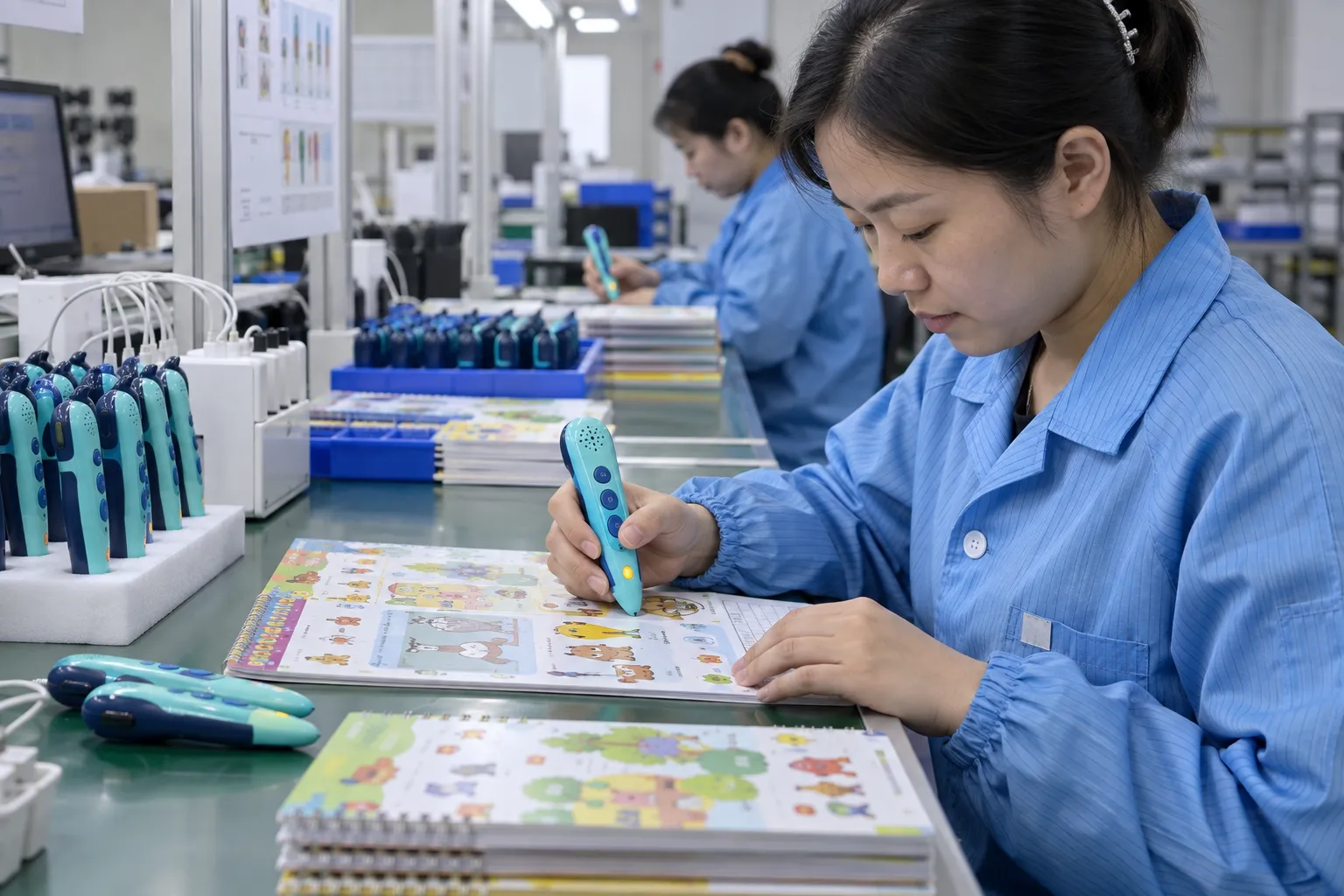
Expansion QA should verify both the new pack and its interaction with the installed player base.
| Control point | Practical check | Evidence |
|---|---|---|
| Cross-version compatibility | Test supported hardware and firmware combinations, update paths, offline behavior, and unsupported-player messaging. | Record result, defect category, and sample identity |
| Complete identity sweep | Read every card and compare visible number, ID, artwork, audio, language, sequence, and pack. | Record result, defect category, and sample identity |
| Pack count and assortment | Verify no missing, duplicate, wrong-language, wrong-version, or mixed-theme cards. | Record result, defect category, and sample identity |
| Retail communication | Check barcode, compatibility, language, age, count, claims, instructions, warnings, and customer-support reference. | Record result, defect category, and sample identity |
| Card recognition | Test all card identities, orientations, insertion depths, repeated use, and samples from different production positions. | Record result, defect category, and sample identity |
| Audio mapping | Compare card artwork, ID data, filename, language, sequence, and playback behavior with the approved map. | Record result, defect category, and sample identity |
| Player controls | Verify insertion feel, buttons, speaker clarity, volume, charging or batteries, memory, and low-power response. | Record result, defect category, and sample identity |
| Set completeness | Count cards and accessories, confirm pack labels, storage solution, barcode, instructions, and carton quantities. | Record result, defect category, and sample identity |
Testing frequency should be based on risk, process capability, component history, and the consequence of a failure. Some functions may justify a 100% production check, while appearance or packaging characteristics may be evaluated through a defined sampling plan. The ISO 28590 overview explains the role of acceptance sampling by attributes, but the buyer and inspection provider still need a written defect list, sampling basis, and accept/reject rules for the actual order.
Shipment inspection should use the approved product, controlled files, packing specification, label artwork, and purchase order as references. Inspectors should test content from different parts of the library rather than replaying one demonstration item. Allow time before the shipping deadline for containment, root-cause review, corrective action, and reinspection when needed.
See Cakub’s quality-control workflow for the broader sequence from incoming materials through shipment release, or review the factory capability page when evaluating production support.
7. How should safety and compliance planning be handled?
Compliance depends on intended use, age grading, materials, electronics, power source, wireless functions, sound output, accessories, packaging, claims, and destination market. Start planning before the final design because required tests, warnings, traceability marks, battery construction, or technical documentation can affect the product itself.
- U.S. CPSC toy safety guidance — use the current official text as a starting point for the final model and market.
- European Commission toy-safety information — use the current official text as a starting point for the final model and market.
- IEC 62115 electric-toy standard overview — use the current official text as a starting point for the final model and market.
Relevant official starting points for this topic include U.S. CPSC toy safety guidance, European Commission toy-safety information, IEC 62115 electric-toy standard overview. These links do not determine the complete test plan. Ask an accredited laboratory or qualified compliance adviser to review the final configuration and the markets where the product will be placed. Keep reports, declarations, bills of materials, label approvals, and production identities connected to the exact model and revision.
8. How can buyers compare supplier quotations fairly?
Expansion-pack quotations should identify card construction, identifier, print, lamination, audio and artwork status, content delivery, pack quantity, retail packaging, barcodes, testing, and assortment control.
Normalize quotations into the same structure: product configuration, included content volume, electronic functions, materials, accessories, retail packaging, master-carton basis, development charges, sample rounds, tooling, testing, documentation, quantity, currency, Incoterm, payment assumptions, and validity period. Highlight every exclusion. Two unit prices are not comparable when one includes programmed content, printed media, accessories, or inspection support and the other does not.
9. Common mistakes that create avoidable delay or rework
Allocating IDs pack by pack without a roadmap
The catalog can run into collisions, confusing ranges, and poor inspection traceability. The practical correction is to add an owner, reference file, approval point, and inspection method before the order enters mass production.
Assuming every player has new content
Installed and downloadable content models require explicit compatibility and update support. The practical correction is to add an owner, reference file, approval point, and inspection method before the order enters mass production.
Using packaging color as the only identity
Visible pack and card numbers help replacements, support, inspection, and customers with color-vision differences. The practical correction is to add an owner, reference file, approval point, and inspection method before the order enters mass production.
Testing only the newest player
Earlier supported units may have memory, firmware, recognition, or update constraints. The practical correction is to add an owner, reference file, approval point, and inspection method before the order enters mass production.
10. Frequently asked questions
Can expansion cards work without an internet connection?
Yes, when required audio is already in the player, stored through another architecture, or installed before use. The product should explain any download requirement clearly.
How should packs be numbered?
Use a stable catalog that supports category, language, edition, replacement, and revision without relying only on marketing names.
Can one card pack support several player models?
It can when recognition, firmware, content availability, controls, and compatibility are tested and communicated for each model.
What happens when a card is lost?
Visible identity, customer support, replacement policy, and catalog records can make individual or pack replacement practical.
How often should new packs launch?
Choose a cadence the content, audio, manufacturing, compatibility, marketing, and support teams can sustain with quality.
Conclusion: approve a repeatable product system
Expansion packs succeed when creative content sits on disciplined platform governance. Reserved IDs, controlled compatibility, clear cataloging, reliable updates, complete-pack inspection, and customer support protect repeat purchases.
A successful insert-card audio player project is not defined by a single attractive sample. It is defined by whether the approved user experience can be reproduced with controlled files, stable materials, clear workmanship criteria, suitable factory testing, traceable packaging, and a shipment-inspection method that reflects customer requirements. That is the standard buyers should use when comparing suppliers and deciding whether a project is ready for production.
Planning a custom insert-card audio player project?
Send your target user, product format, content scope, market, quantity range, packaging, and launch timing for a structured project review.