
How to Choose a Talking Pen Manufacturer: A Buyer’s Checklist
Evaluate hardware fit, audio workflow, printed books, quality controls, compliance planning, packaging, and shipment readiness.
Read the guidePractical, evidence-led guidance for choosing product formats, preparing OEM requirements, evaluating samples, and controlling production before shipment.
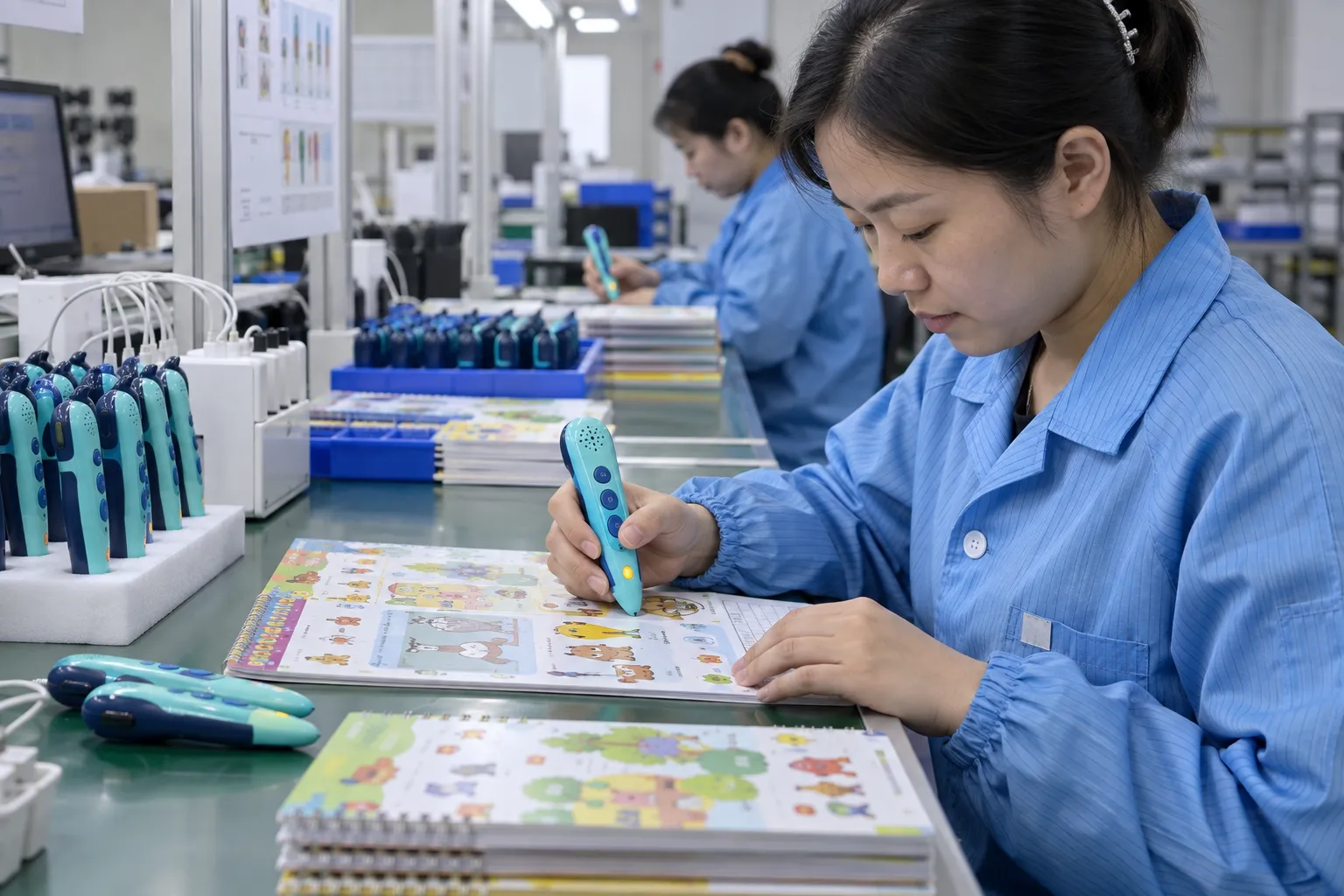
Each guide answers a real product-selection or supplier-evaluation question using clear comparisons, checklists, and project controls.
Evaluate hardware fit, audio workflow, printed books, quality controls, compliance planning, packaging, and shipment readiness.
Read the guide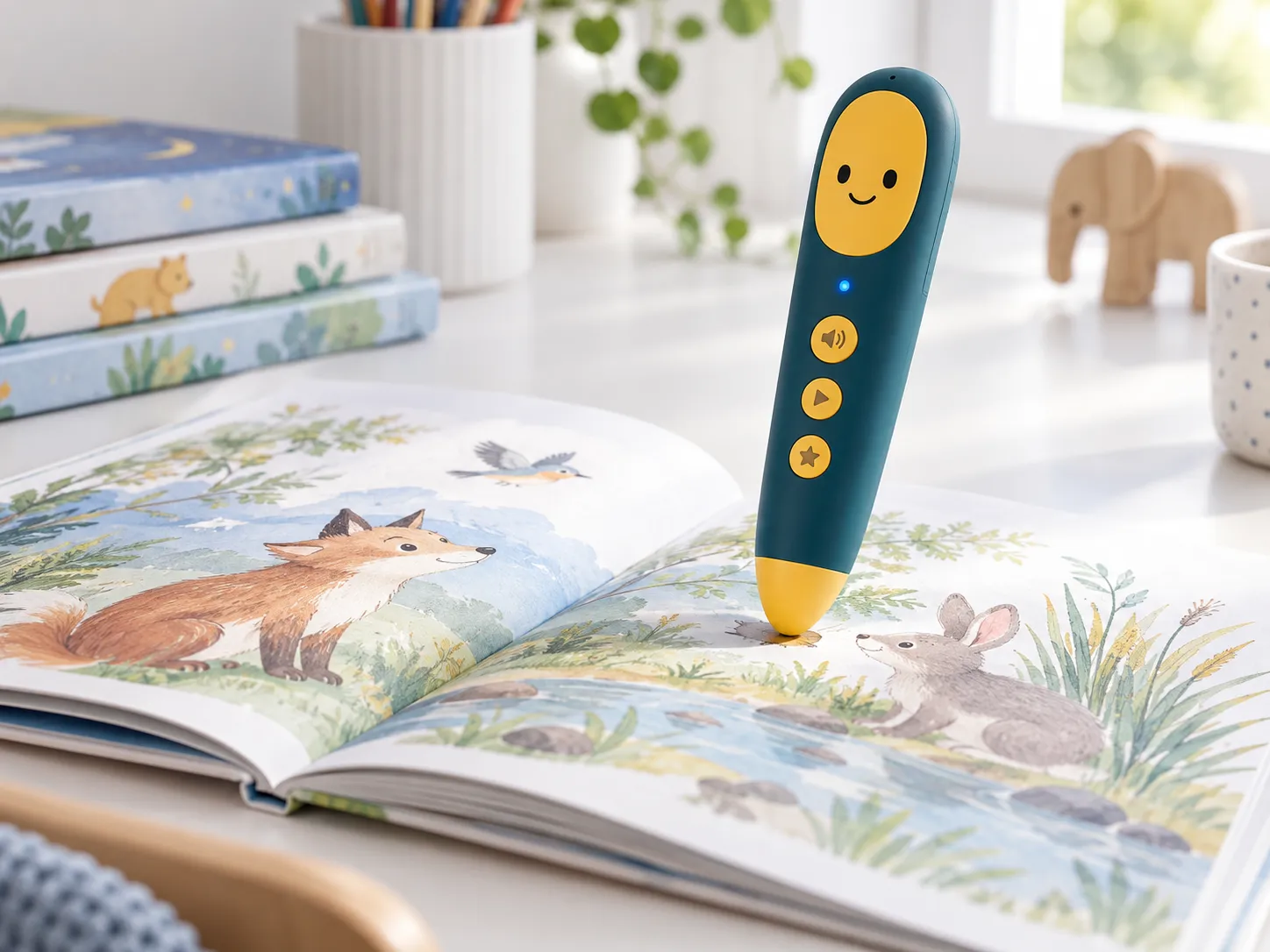
A procurement-focused comparison of three screen-free audio formats—how each works, where each fits, and what publishers and learning brands should confirm before requesting samples.
Read the guide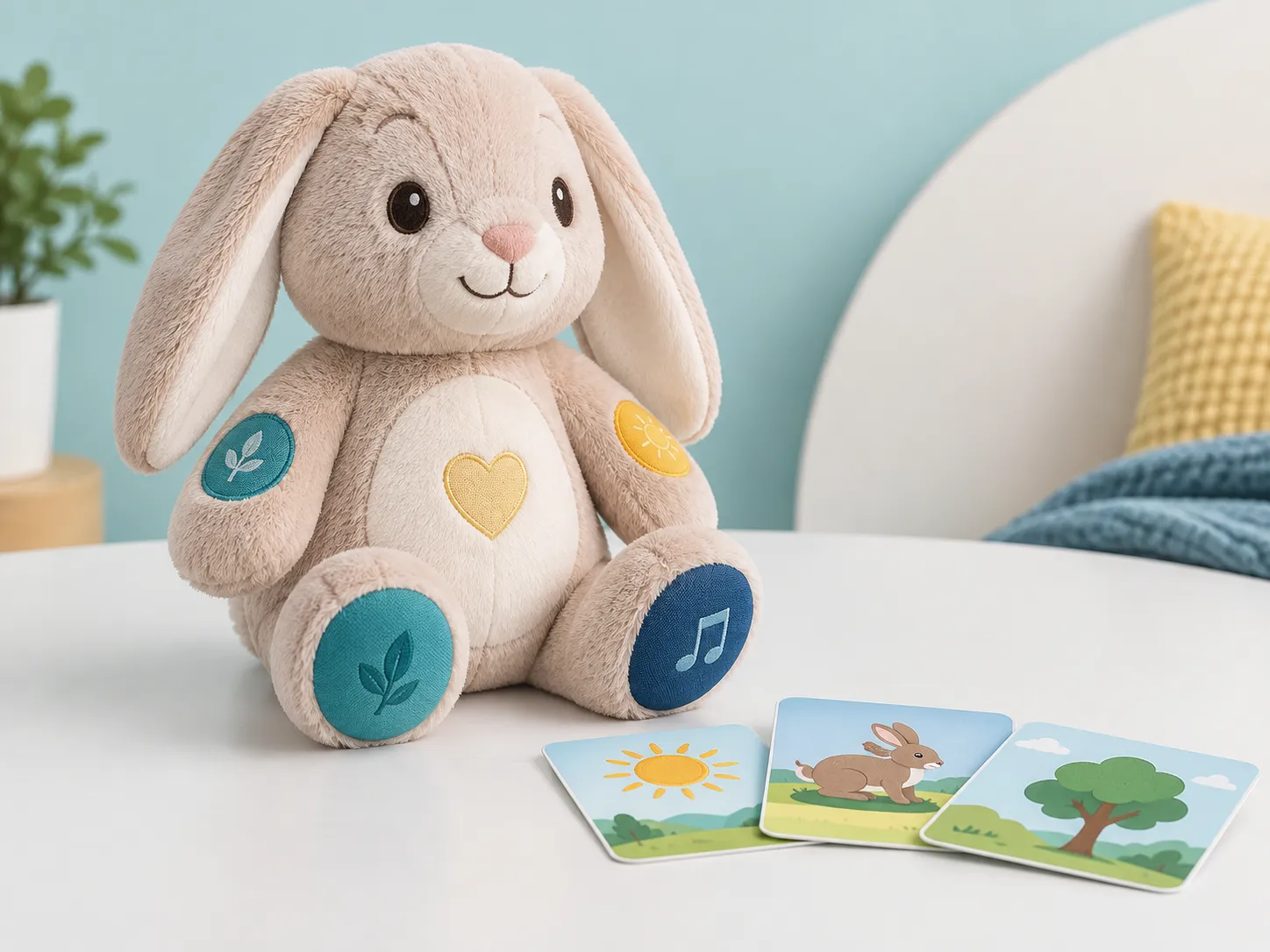
A structured route from character artwork and voice content to an integrated sample, controlled production, factory testing, and shipment-ready talking plush toys.
Read the guide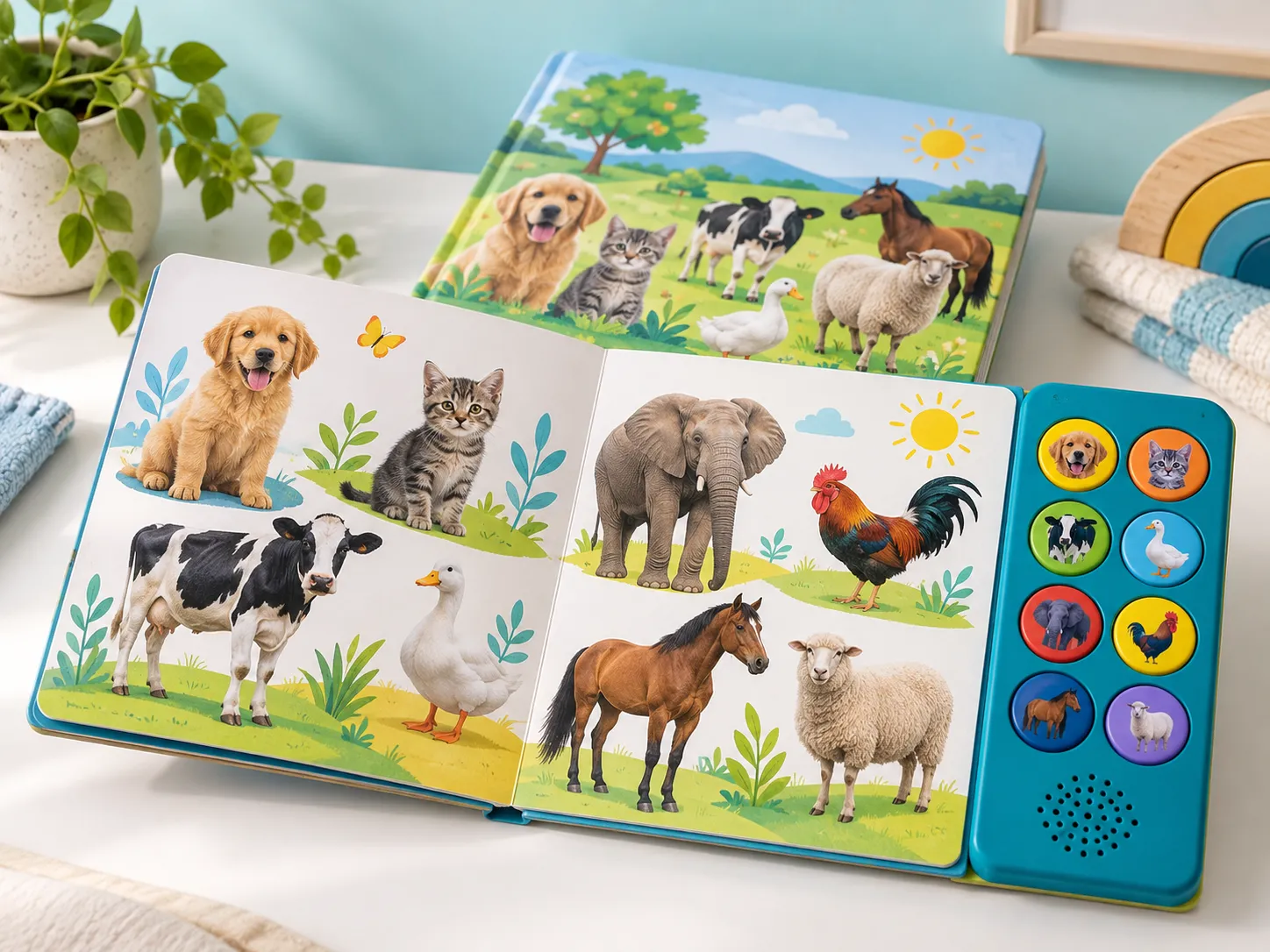
A practical guide for publishers and learning brands coordinating printed pages, button mapping, audio files, electronic modules, binding, testing, packaging, and production release.
Read the guideNew sourcing library
Use the category groups below to prepare requirements, compare technologies, review samples, and plan production controls.
Product category
A talking pen uses an optical sensor to read a compatible printed identification pattern, matches that identity to data stored in firmware or memory, and plays the assigned audio. Reliable performance depends on the pen, coded artwork, mapping database, audio files, print process, and testing method working together.
Read the guidePrepare talking-pen book files by defining activation zones, assigning controlled identifiers, keeping the code layer separate from editable artwork, linking every zone to an approved audio response, producing a coded print proof, and releasing artwork, mapping, firmware, and audio under one revision.
Read the guideTalking-pen audio files should use a controlled naming system, consistent technical format, approved loudness and trimming rules, traceable language and revision fields, and a mapping table connecting each activation ID to one intended response. Approve representative audio through the final speaker before programming the production library.
Read the guideDevelop a multilingual talking pen by choosing the edition or switching model, assigning separate language identities, controlling translated scripts and voices, estimating memory with real encoded files, defining fallback behavior, and testing every language through the same printed triggers and production hardware.
Read the guideTalking pen cost and MOQ are shaped by the hardware platform, tooling and appearance, memory, battery and charging design, functions, programmed audio volume, coded printed media, accessories, packaging, testing, and quantity by SKU. Compare quotations only after suppliers use the same requirement and Incoterm.
Read the guideA talking pen quality plan should control incoming components, approved files, first-piece assembly, coded-page recognition, audio and controls, power and charging, housing workmanship, programming identity, accessories, labels, retail packaging, and shipment sampling. Each check needs a method, frequency, acceptance rule, and record.
Read the guideEvaluate a talking pen sample against a controlled brief, representative user journeys, construction and workmanship criteria, content identity, power and audio behavior, packaging fit, and market-specific risks. Record every result as pass, fail, or open; assign an owner and due date; and never use an attractive demonstration sample as the only production standard.
Read the guideChoose the talking pen power system by defining expected play pattern, target runtime, charging or replacement behavior, child access controls, enclosure space, low-power response, destination markets, and transport method. Compare battery chemistry and capacity only after these system requirements are clear, then validate the final product with the applicable safety and shipment plan.
Read the guideSpecify talking pen audio quality through the intended listening distance, content type, language intelligibility, target volume steps, acceptable noise and distortion, speaker and enclosure configuration, approved master files, and low-power behavior. Use the same reference tracks and functional scenarios during prototype approval, line testing, and shipment inspection.
Read the guideDesign talking pen set packaging from the complete pack-out, retail channel, transport route, storage conditions, barcode and label needs, user unboxing sequence, and damage risks. Approve the inner fit, retail pack, master carton, packing method, and shipment inspection standard as one system, then validate with production-representative materials and packed samples.
Read the guideA useful talking pen RFQ defines the target user and market, complete product format, content and interaction map, power and audio behavior, materials and appearance, accessories and packaging, compliance responsibilities, sample stages, quantity by SKU, delivery basis, and required quotation breakdown. Mark confirmed, preferred, and open items separately so suppliers can quote alternatives without hiding assumptions.
Read the guideTalking pens can support preschool classroom activities when the interaction is simple, content is developmentally appropriate, audio remains clear at classroom volume, and teachers have a defined routine for introduction, sharing, storage, and follow-up. The product brief should connect the intended learner or visitor, activity sequence, content scope, adult role, physical setting, success evidence, replenishment model, and market requirements. Approve the complete user journey on representative hardware and media before scaling the program.
Read the guideA bilingual talking pen works best when language learning is designed into the content architecture rather than added by duplicating audio files. The product brief should connect the intended learner or visitor, activity sequence, content scope, adult role, physical setting, success evidence, replenishment model, and market requirements. Approve the complete user journey on representative hardware and media before scaling the program.
Read the guidePublishers should plan a talking pen as a long-lived content platform, not a one-book electronic novelty. The product brief should connect the intended learner or visitor, activity sequence, content scope, adult role, physical setting, success evidence, replenishment model, and market requirements. Approve the complete user journey on representative hardware and media before scaling the program.
Read the guideA talking pen homeschool kit should make the next useful activity obvious while allowing a child to replay audio independently and giving adults concise guidance for discussion and follow-up. The product brief should connect the intended learner or visitor, activity sequence, content scope, adult role, physical setting, success evidence, replenishment model, and market requirements. Approve the complete user journey on representative hardware and media before scaling the program.
Read the guideA distributor should launch a talking pen only after the local product configuration, content, documentation, demonstration, sales training, SKU plan, service model, and replenishment process are aligned. The product brief should connect the intended learner or visitor, activity sequence, content scope, adult role, physical setting, success evidence, replenishment model, and market requirements. Approve the complete user journey on representative hardware and media before scaling the program.
Read the guideFor a U.S. talking-pen toy, first determine its age grade and applicable children’s-product rules, arrange testing through a CPSC-accepted laboratory, prepare an importer-issued CPC where required, and make product and packaging traceable. The buyer should confirm the final configuration, target age, sales destination, responsible importer, and applicable rules before treating a supplier report or sample as release evidence. A practical decision file links CPSC-accepted laboratory results, importer-issued Children’s Product Certificate, tracking-label artwork, and lot register to the approved model and production lot.
Read the guideThe new EU Toy Safety Regulation entered into force in January 2026 but applies from August 1, 2030. Talking-pen buyers should continue meeting today’s requirements while building traceable product data for the future digital product passport. The buyer should confirm the final configuration, target age, sales destination, responsible importer, and applicable rules before treating a supplier report or sample as release evidence. A practical decision file links current technical-file index, model identities, materials data, supplier traceability, and a future passport-data plan to the approved model and production lot.
Read the guideA lithium-battery talking-pen shipment needs the exact cell and equipment configuration classified for its transport mode, with appropriate test evidence, packing, marks, documents, and carrier acceptance before the freight booking. The buyer should confirm the final configuration, target age, sales destination, responsible importer, and applicable rules before treating a supplier report or sample as release evidence. A practical decision file links cell and pack identities, UN 38.3 test summary where applicable, battery specification, transport classification, packaging, and carrier documents to the approved model and production lot.
Read the guideAudit the production route the order will use: incoming materials, controlled files, assembly, programming, first-piece sign-off, in-process checks, final function testing, pack-out, defect disposition, and traceability. The buyer should confirm the final configuration, target age, sales destination, responsible importer, and applicable rules before treating a supplier report or sample as release evidence. A practical decision file links process flow, approved BOM, incoming records, firmware control, test procedures, defect log, calibration and lot traceability to the approved model and production lot.
Read the guideA design change needs a documented impact assessment against every applicable requirement and the original test sample; retest affected aspects when the change could alter compliance. The buyer should confirm the final configuration, target age, sales destination, responsible importer, and applicable rules before treating a supplier report or sample as release evidence. A practical decision file links baseline test report, approved BOM and drawings, change notice, risk assessment, targeted test plan, and revised declarations or certificate to the approved model and production lot.
Read the guideA publisher should maintain a compatibility register that names every coded title, edition, language, identifier range, audio package, and minimum or maximum supported firmware version. For a B2B order, the decision should be supported by a title-edition-identifier-firmware compatibility register, a production-intent sample, a named approval owner, and a check that can be repeated before shipment. The approach changes with the final product, customer requirements, destination market, and operating model.
Read the guideA release-ready talking-pen firmware package needs an immutable version ID, compatible hardware and content ranges, a complete update test, recovery behavior, factory programming instructions, and an archived previous build. For a B2B order, the decision should be supported by a signed firmware build manifest and update/rollback test record, a production-intent sample, a named approval owner, and a check that can be repeated before shipment. The approach changes with the final product, customer requirements, destination market, and operating model.
Read the guideA useful talking-pen return process records the exact pen, book edition, firmware, battery state, failed point, and customer symptom before replacing parts or blaming the printer. For a B2B order, the decision should be supported by a return-intake form linked to pen build, book edition, lot, symptom, and reproduced result, a production-intent sample, a named approval owner, and a check that can be repeated before shipment. The approach changes with the final product, customer requirements, destination market, and operating model.
Read the guideA school talking-pen fleet should be specified as a managed classroom resource: identify each device, assign compatible books, set charging and cleaning routines, stock spares, and give teachers a short recovery path. For a B2B order, the decision should be supported by a device-and-book allocation register with charging, cleaning, and spare-unit procedures, a production-intent sample, a named approval owner, and a check that can be repeated before shipment. The approach changes with the final product, customer requirements, destination market, and operating model.
Read the guideChoose offset or digital printing only after testing the actual code layer on the intended paper, inks, finishes, artwork, and production-style equipment; price pilot and volume runs separately. For a B2B order, the decision should be supported by a print-method comparison sheet with coded proofs and recognition results, a production-intent sample, a named approval owner, and a check that can be repeated before shipment. The approach changes with the final product, customer requirements, destination market, and operating model.
Read the guideTest the pen and coded pages with children using both hands; observe natural grip, sensor angle, reach, button presses, wrist posture, and adult assistance before fixing housing and artwork. For a B2B order, the decision should be supported by a grip-and-page-access observation sheet linked to pen and book prototypes, a production-intent sample, a named approval owner, and a check that can be repeated before shipment. The approach changes with the final product, customer requirements, destination market, and operating model.
Read the guideChoose the target language variety and pronunciation policy before recording, then have a qualified reviewer compare every final mastered track with the approved script, print proof, and OID point. For a B2B order, the decision should be supported by a script-to-audio register with approved pronunciation notes, reviewer, take, and hotspot ID, a production-intent sample, a named approval owner, and a check that can be repeated before shipment. The approach changes with the final product, customer requirements, destination market, and operating model.
Read the guideA first-use kit should let a caregiver charge or power the pen, identify a compatible coded page, hear a clear success cue, select the intended language, and recover from a failed touch without installing an app. For a B2B order, the decision should be supported by a first-use journey card with power, content, language, feedback, and troubleshooting states, a production-intent sample, a named approval owner, and a check that can be repeated before shipment. The approach changes with the final product, customer requirements, destination market, and operating model.
Read the guideSize memory from the final encoded asset inventory plus firmware, file-system overhead, and an agreed update reserve; compare voice quality on the real pen speaker before choosing a codec setting. For a B2B order, the decision should be supported by an encoded-audio inventory with duration, codec, bitrate, file size, language, and reserved capacity, a production-intent sample, a named approval owner, and a check that can be repeated before shipment. The approach changes with the final product, customer requirements, destination market, and operating model.
Read the guideDefine each active area around the child’s likely touch, keep neighboring responses distinguishable, and test coded bound proofs at page edges, gutters, dark artwork, and crowded activity zones. For a B2B order, the decision should be supported by a spread-level hotspot map showing active area, code ID, audio, spacing, and edge tolerance, a production-intent sample, a named approval owner, and a check that can be repeated before shipment. The approach changes with the final product, customer requirements, destination market, and operating model.
Read the guideSpecify the actual charging input and supported cable behavior, state whether an adapter is included, and test the port, indicator, low-power response, and instructions as one user journey. For a B2B order, the decision should be supported by a charging-interface specification with cable, input, indicators, port construction, and pack contents, a production-intent sample, a named approval owner, and a check that can be repeated before shipment. The approach changes with the final product, customer requirements, destination market, and operating model.
Read the guideUse one controlled manifest as the release authority for every OID point and audio asset; lock IDs and filenames before programming and compare the installed package with the signed release. For a B2B order, the decision should be supported by a signed content manifest linking OID ID, page, script, master, encoded file, language, firmware, and checksum, a production-intent sample, a named approval owner, and a check that can be repeated before shipment. The approach changes with the final product, customer requirements, destination market, and operating model.
Read the guideCalibrate and verify the optical path as a system: sensor setting, lens condition, tip geometry, housing alignment, focal distance, and recognition on approved coded targets must all be controlled before shipment. For a B2B order, the decision should be supported by a calibrated reference target, sensor-setting record, lens-cleanliness standard, and recognition result by unit, a production-intent sample, a named approval owner, and a check that can be repeated before shipment. The approach changes with the final product, customer requirements, destination market, and operating model.
Read the guideApprove drop durability only after testing production-intent pens in relevant orientations and checking housing, cap, clip, controls, charging, audio, and OID recognition after every defined impact sequence. For a B2B order, the decision should be supported by an impact matrix recording orientation, surface, sample identity, cap and clip condition, function, and recognition result, a production-intent sample, a named approval owner, and a check that can be repeated before shipment. The approach changes with the final product, customer requirements, destination market, and operating model.
Read the guideDefine active, playing, idle, sleep, charging, low-battery, and storage states separately; measure current and transition behavior on the final hardware and firmware rather than estimating runtime from battery capacity alone. For a B2B order, the decision should be supported by a power-state table with measured current, transition timing, wake action, prompt, and content-resume rule, a production-intent sample, a named approval owner, and a check that can be repeated before shipment. The approach changes with the final product, customer requirements, destination market, and operating model.
Read the guideDefine acceptable behavior before laboratory or engineering ESD work: test relevant accessible points and operating states, record temporary and permanent effects, and verify safe, understandable recovery without assuming every reset is acceptable. For a B2B order, the decision should be supported by an ESD test plan linking contact points, operating states, observed response, recovery action, and firmware or hardware revision, a production-intent sample, a named approval owner, and a check that can be repeated before shipment. The approach changes with the final product, customer requirements, destination market, and operating model.
Read the guideA Quran reading pen OEM project connects an approved printed edition with licensed recitation and optional translation through controlled OID mapping. Publishers must manage text rights, audio approval, verse identity, language modes, memory, firmware, print proofs, product testing, packaging, and edition compatibility as one release.
Read the guideA pen-only Quran SKU is suitable when distributors can prove compatibility with a named book edition and content package. A complete set is safer for a new launch because the pen, book, firmware, audio, instructions, and packaging are approved together. Replacement sales need stricter version identification than full sets.
Read the guideTo set up a Quran reading pen, first confirm the correct book edition and content package, charge the device with the specified input, power it on, select the intended language or reciter, and test a coded starter point. Troubleshooting should separate power, compatibility, print recognition, audio, controls, and update faults.
Read the guideA Quran pen audio approval workflow connects each printed verse or function with a licensed, reviewed audio asset and a stable mapping ID. The release should record reciter, language, translation, script reference, filename, duration, revision, reviewer, approval status, mastering package, firmware, and printed proof.
Read the guideAn OID talking pen plays preapproved audio when it touches coded print, while an OCR scan pen attempts to recognize ordinary printed text and generate or retrieve speech. OID suits controlled books and activities; OCR suits broader text access. Buyers should choose by content control, supported print, user age, privacy, and accuracy needs.
Read the guideQuran reading pen quality control should verify the exact edition, verse mapping, reciter and translation modes, OID print recognition, audio identity, firmware, memory package, controls, charging, battery behavior, labels, accessories, packaging, and carton identity. Shipment samples should come from different cartons and production positions.
Read the guideAn educational talking pen should connect each printed touch point with a clear learning action such as hearing a phoneme, comparing pronunciation, repeating a word, choosing an answer, receiving feedback, or switching language. The learning flow, audio, OID map, firmware, page design, and testing must be developed together.
Read the guideA talking English book pen combines an approved English-learning sequence with coded print, mapped audio, pronunciation review, firmware behavior, and a compatible pen. Publishers should control the language variety, phonics method, scripts, filenames, touch zones, feedback, book editions, and production proofs before mass production.
Read the guideA private label talking pen can range from logo and packaging changes on an existing platform to a new housing, electronics, firmware, content system, and accessory set. MOQ, tooling, sample time, testing, and unit cost depend on which parts change, who owns the files, and whether the final configuration needs new evidence.
Read the guideTalking pen platform ownership should be defined asset by asset. The contract should state who owns, licenses, controls, stores, updates, and can transfer OID ranges, source artwork, mappings, audio masters, firmware, programming packages, update tools, industrial design, molds, test fixtures, documentation, and production records.
Read the guideTalking pen books combine a programmed optical pen with compatible coded print, approved audio, firmware, and a controlled content map. Publishers should source the pen and books as one product system because recognition, audio identity, print quality, version control, packaging, and shipment testing depend on each other.
Read the guideSpeaking pen books and talking pen books usually describe the same broad product category: a pen-shaped audio device activates content from compatible printed pages. The names do not define the recognition technology or compatibility. Buyers should compare the code system, book preparation, content ownership, firmware, update route, sample evidence, and supplier scope.
Read the guideChoose a smart talking pen when children need precise touch access across printed pages and the publisher plans a coded book library. Choose a card audio player when content should be selected by inserting or tapping durable cards. Choose a sound book when the audio controls should remain inside one title with the simplest setup.
Read the guideTalking pen age grading should follow the intended users, learning task, physical construction, foreseeable use, accessories, book format, and destination-market rules. A toddler product usually needs simpler interaction and stricter control of detachable parts than a primary-school product, but an older label cannot be used to avoid hazards created by the actual design and marketing.
Read the guideA talking pen starter set should give a new customer one validated path from unboxing to successful use. Expansion books should reuse the approved platform while carrying clear edition, language, code-range, and compatibility identities. The product line needs one item master that connects retail SKUs with books, firmware, programmed content, accessories, and support status.
Read the guideA talking pen project can require separate rights for text, illustrations, characters, translations, adaptations, narration performances, music, sound effects, trademarks, packaging, and digital source files. Publishers should document permitted products, territories, languages, term, channels, edits, subcontracting, updates, and ownership of final masters before production.
Read the guideA talking pen after-sales plan should distinguish setup problems, book incompatibility, content mismatch, charging faults, hardware defects, damage, lost units, and unsupported editions. Warranty rules, replacement SKUs, spare parts, evidence requests, retained references, repair boundaries, and supplier responsibilities should be agreed before the first shipment.
Read the guideTalking pen book localization requires more than translating visible text. Publishers must control source strings, language variants, pronunciation, voice recordings, audio duration, page layout, touch zones, filenames, mapping, firmware prompts, labels, instructions, packaging, and SKU identity. Each language should be tested as a complete physical product.
Read the guideA reliable talking pen sample timeline is built around decision gates, not a fixed promise of days. A concept proof validates the interaction, an engineering sample validates hardware and firmware, a production-intent sample validates released files and materials, and a pilot or first-lot review confirms that the factory can repeat the approved result. Timing depends on content readiness, industrial design, tooling, electronics, book construction, testing, and review speed.
Read the guideThere is no single worldwide talking pen certificate. The required evidence depends on product classification, intended age, design, battery, radio functions, accessories, claims, sales market, and the legal role of each operator. A defensible file links the exact production configuration to applicable requirements, laboratory reports, risk assessment, declarations, labels, traceability, instructions, supplier records, and change control.
Read the guideOID, RFID, and QR are different identity systems. An OID pen optically reads tiny prepared identifiers at point level on a printed surface. RFID reads an embedded or attached tag through radio frequency and usually identifies an item, card, or zone. A QR code is a visible two-dimensional code commonly scanned by a camera. The best choice depends on interaction granularity, user action, hardware, visibility, media construction, content updates, environment, and commercial model.
Read the guideA direct talking pen manufacturer can offer close control of electronics, firmware, assembly, testing, and change execution, while a trading or integration company may add value by coordinating printing, audio, packaging, compliance, and multiple factories. Neither label guarantees performance. Buyers should verify the contracting entity, actual production sites, engineering ownership, subcontracting, quality records, file control, audit access, commercial terms, and after-sales responsibility.
Read the guideProduct category
Choose a talking-plush sound module by matching the user action, number of sounds, playback rules, battery access, care claim, component placement, acoustic path, safety plan, and production method. Push and squeeze triggers are simple; sensors, multiple zones, recording, or connectivity require more engineering and validation.
Read the guidePrepare character artwork for a talking plush by supplying front, side, back, and key detail views; target dimensions and pose; color and material references; embroidery or print files; brand-critical features; electronics and speaker locations; labels; packaging; and a written hierarchy for resolving unavoidable 2D-to-3D differences.
Read the guideA washable talking plush normally needs either a removable electronics module with a controlled caregiver-access opening or a clearly limited surface-clean care claim supported by the final construction. A sealed module does not automatically make the complete toy machine washable; care language must match tested materials, electronics protection, openings, and reassembly risks.
Read the guideA talking-plush inspection should verify approved materials and components, seams and decorations, accessible parts, module retention, battery access, trigger and audio function, labels, instructions, packaging, and order identity. Safety and compliance testing must be based on the final age grading, construction, electronics, claims, and destination market.
Read the guideSpecify talking plush toy audio quality through the intended listening distance, content type, language intelligibility, target volume steps, acceptable noise and distortion, speaker and enclosure configuration, approved master files, and low-power behavior. Use the same reference tracks and functional scenarios during prototype approval, line testing, and shipment inspection.
Read the guideChoose the talking plush toy power system by defining expected play pattern, target runtime, charging or replacement behavior, child access controls, enclosure space, low-power response, destination markets, and transport method. Compare battery chemistry and capacity only after these system requirements are clear, then validate the final product with the applicable safety and shipment plan.
Read the guideDesign talking plush toy packaging from the complete pack-out, retail channel, transport route, storage conditions, barcode and label needs, user unboxing sequence, and damage risks. Approve the inner fit, retail pack, master carton, packing method, and shipment inspection standard as one system, then validate with production-representative materials and packed samples.
Read the guidetalking plush toy cost and MOQ depend on the selected platform, customization depth, character size, pattern complexity, fabric, embroidery, filling, module, triggers, speaker, battery, closures, and workmanship, content volume, packaging, test and documentation scope, SKU split, and material purchasing constraints. Buyers should request an itemized quotation with common assumptions and ask what operational constraint creates each minimum.
Read the guideTalking plush can support language activities when short, well-mapped audio invites interaction and the character remains part of conversation and play rather than replacing an adult or teacher. The product brief should connect the intended learner or visitor, activity sequence, content scope, adult role, physical setting, success evidence, replenishment model, and market requirements. Approve the complete user journey on representative hardware and media before scaling the program.
Read the guideLicensed talking plush requires one approval system that connects character construction, voice and music rights, scripts, triggers, electronics, territory, packaging, and production change control. The product brief should connect the intended learner or visitor, activity sequence, content scope, adult role, physical setting, success evidence, replenishment model, and market requirements. Approve the complete user journey on representative hardware and media before scaling the program.
Read the guideA museum talking plush should connect an authentic, carefully reviewed story to an easy retail demonstration and a product visitors can understand without staff giving a long explanation. The product brief should connect the intended learner or visitor, activity sequence, content scope, adult role, physical setting, success evidence, replenishment model, and market requirements. Approve the complete user journey on representative hardware and media before scaling the program.
Read the guideTalking plush can support classroom storytelling when audio is divided into short teacher-controllable cues with planned pauses for children to speak, predict, move, or act. The product brief should connect the intended learner or visitor, activity sequence, content scope, adult role, physical setting, success evidence, replenishment model, and market requirements. Approve the complete user journey on representative hardware and media before scaling the program.
Read the guideAn EU talking-plush program needs a documented safety assessment and conformity route for the actual toy, including soft-goods hazards and electronic functions, before CE marking and import release. The buyer should confirm the final configuration, target age, sales destination, responsible importer, and applicable rules before treating a supplier report or sample as release evidence. A practical decision file links risk assessment, model-specific test reports, materials and electronic-module records, declaration of conformity, and traceability labels to the approved model and production lot.
Read the guideA talking plush sound plan should control the whole audio chain—file master, amplifier, speaker, enclosure, fabric opening, user distance, and maximum setting—then use the applicable market test method for the exact toy. The buyer should confirm the final configuration, target age, sales destination, responsible importer, and applicable rules before treating a supplier report or sample as release evidence. A practical decision file links approved audio masters, speaker and enclosure specification, maximum-setting test method, lab assessment, and production sample records to the approved model and production lot.
Read the guideA robust toy-label plan is a matrix by product, destination, language, economic operator, warning basis, and traceability code; one generic worldwide box is rarely safe to approve without review. The buyer should confirm the final configuration, target age, sales destination, responsible importer, and applicable rules before treating a supplier report or sample as release evidence. A practical decision file links market-by-SKU label matrix, approved artwork, importer and manufacturer identities, batch-code plan, and instruction files to the approved model and production lot.
Read the guideUse the full Incoterms 2020 rule plus a named place, then define who controls freight, insurance, import clearance, taxes, and product-compliance documents. FCA, FOB, DAP, and DDP are not interchangeable price labels. The buyer should confirm the final configuration, target age, sales destination, responsible importer, and applicable rules before treating a supplier report or sample as release evidence. A practical decision file links named Incoterms 2020 rule and place, sales contract, freight assumptions, insurance plan, customs roles, and delivery milestones to the approved model and production lot.
Read the guideEvery material or component substitution should be assessed against the approved function, safety evidence, appearance, cost, lead time, and market file before it enters mass production. The buyer should confirm the final configuration, target age, sales destination, responsible importer, and applicable rules before treating a supplier report or sample as release evidence. A practical decision file links approved BOM with supplier part numbers, engineering-change request, comparison sample, risk review, test-impact decision, and effective lot to the approved model and production lot.
Read the guideChoose embroidered or attached plastic features according to age, character fidelity, cleaning plan, tactile feel, construction, and applicable safety assessment; do not treat one choice as automatically safe for every toy. For a B2B order, the decision should be supported by a feature-by-feature character construction drawing and approved sample, a production-intent sample, a named approval owner, and a check that can be repeated before shipment. The approach changes with the final product, customer requirements, destination market, and operating model.
Read the guideBefore recording a talking plush, list every script, voice performance, composition, master recording, and effect, then document who owns it and which products, territories, languages, channels, and dates are authorized. For a B2B order, the decision should be supported by an audio asset manifest with rights, permitted uses, territories, term, and approver, a production-intent sample, a named approval owner, and a check that can be repeated before shipment. The approach changes with the final product, customer requirements, destination market, and operating model.
Read the guideTest trigger positions in a production-style plush body with representative users and handling: record discovery, activation effort, false presses, audio audibility, and variation after sewing and stuffing. For a B2B order, the decision should be supported by a trigger-location map with observed activation attempts and force-test record, a production-intent sample, a named approval owner, and a check that can be repeated before shipment. The approach changes with the final product, customer requirements, destination market, and operating model.
Read the guideA shared sound board can serve several talking-plush characters if each sellable SKU keeps its own pattern, trigger position, audio package, label, barcode, rights record, and inspection reference. For a B2B order, the decision should be supported by a character-SKU matrix linking pattern, module, audio, packaging, barcode, and rights, a production-intent sample, a named approval owner, and a check that can be repeated before shipment. The approach changes with the final product, customer requirements, destination market, and operating model.
Read the guideAssess speech clarity in the fully stuffed character, not only the loose sound module. Compare fur length, stuffing distribution, speaker direction, cavity, and protective layers while preserving the intended feel and safety review. For a B2B order, the decision should be supported by a fabric-stuffing-speaker reference sample with recorded speech-intelligibility observations, a production-intent sample, a named approval owner, and a check that can be repeated before shipment. The approach changes with the final product, customer requirements, destination market, and operating model.
Read the guideDecide early whether the module is removable, technician-accessible, or sealed; test the complete closure and service procedure against age grading, care claims, cost, and expected product life. For a B2B order, the decision should be supported by a service-opening drawing with closure, tool, age, care, and replacement procedure, a production-intent sample, a named approval owner, and a check that can be repeated before shipment. The approach changes with the final product, customer requirements, destination market, and operating model.
Read the guideDefine quiet mode as a clear, testable behavior—not merely a lower speaker setting. Specify how adults set it, how children activate content, what happens after inactivity, and how the toy signals low battery or mute. For a B2B order, the decision should be supported by a bedtime-state map covering volume, activation, sleep timer, power, and recovery, a production-intent sample, a named approval owner, and a check that can be repeated before shipment. The approach changes with the final product, customer requirements, destination market, and operating model.
Read the guidePlace a tactile or visual cue directly over a reproducible trigger zone, then observe children finding and activating it in a finished, stuffed prototype with representative fabric and embroidery. For a B2B order, the decision should be supported by a trigger-cue placement map with fabric, embroidery, activation force, and usability observations, a production-intent sample, a named approval owner, and a check that can be repeated before shipment. The approach changes with the final product, customer requirements, destination market, and operating model.
Read the guideMeasure sleep, standby, activation, playback, and shutdown current on the finished module, then model battery life from a documented use pattern and verify it on production-intent toys. For a B2B order, the decision should be supported by a power-state table and measured duty-cycle worksheet linked to hardware and firmware, a production-intent sample, a named approval owner, and a check that can be repeated before shipment. The approach changes with the final product, customer requirements, destination market, and operating model.
Read the guideDesign each outfit and accessory as part of the finished toy configuration; review attachment, size, age grading, trigger and speaker clearance, dressing effort, pack count, and replacement policy. For a B2B order, the decision should be supported by an accessory matrix with material, attachment, age, trigger clearance, pack, and replacement identity, a production-intent sample, a named approval owner, and a check that can be repeated before shipment. The approach changes with the final product, customer requirements, destination market, and operating model.
Read the guideValidate any compressed pack on the finished talking plush: simulate the intended duration and transit conditions, then assess recovery, seam condition, filling, module position, trigger force, audio, and retail presentation. For a B2B order, the decision should be supported by a pack-out and recovery protocol with time, handling, appearance, and functional acceptance, a production-intent sample, a named approval owner, and a check that can be repeated before shipment. The approach changes with the final product, customer requirements, destination market, and operating model.
Read the guideWrite care instructions from a tested method on the finished toy. Check representative stains, rubbing, color transfer, drying, embroidery or print, seams, trigger feel, and electronics after repeated cleaning. For a B2B order, the decision should be supported by a care-method record linked to fabric, decoration, module construction, label, and post-cleaning checks, a production-intent sample, a named approval owner, and a check that can be repeated before shipment. The approach changes with the final product, customer requirements, destination market, and operating model.
Read the guideRoute wires away from seams, sharp edges, stuffing tools, and high-flex joints; provide appropriate strain relief and connector protection, then inspect and function-test the complete stuffed body. For a B2B order, the decision should be supported by a routing diagram with wire length, anchor points, connector orientation, protected zones, and inspection photographs, a production-intent sample, a named approval owner, and a check that can be repeated before shipment. The approach changes with the final product, customer requirements, destination market, and operating model.
Read the guideControl needles at source with accountable issue and return, complete fragment reconciliation, defined affected-product quarantine, verified detection or search methods, and records tied to the production line and time window. For a B2B order, the decision should be supported by a line-specific needle policy, issuance log, breakage record, search and quarantine procedure, and equipment verification log, a production-intent sample, a named approval owner, and a check that can be repeated before shipment. The approach changes with the final product, customer requirements, destination market, and operating model.
Read the guideTreat every material or supplier substitution as an engineering and compliance decision: compare composition, construction, finish, color, mass, supplier, intended use, and existing evidence before deciding what finished-product review or retesting is required. For a B2B order, the decision should be supported by a material-change dossier linking old and new specifications, supplier evidence, risk review, samples, and retest disposition, a production-intent sample, a named approval owner, and a check that can be repeated before shipment. The approach changes with the final product, customer requirements, destination market, and operating model.
Read the guideMap realistic moisture paths through fabric, seams, sound openings, trigger zones, and battery access; protect electronics without sealing in condensation or undermining acoustics, service, or truthful cleaning claims. For a B2B order, the decision should be supported by a moisture-path map with barrier construction, openings, module-removal rule, cleaning instruction, and inspection criteria, a production-intent sample, a named approval owner, and a check that can be repeated before shipment. The approach changes with the final product, customer requirements, destination market, and operating model.
Read the guideProduct category
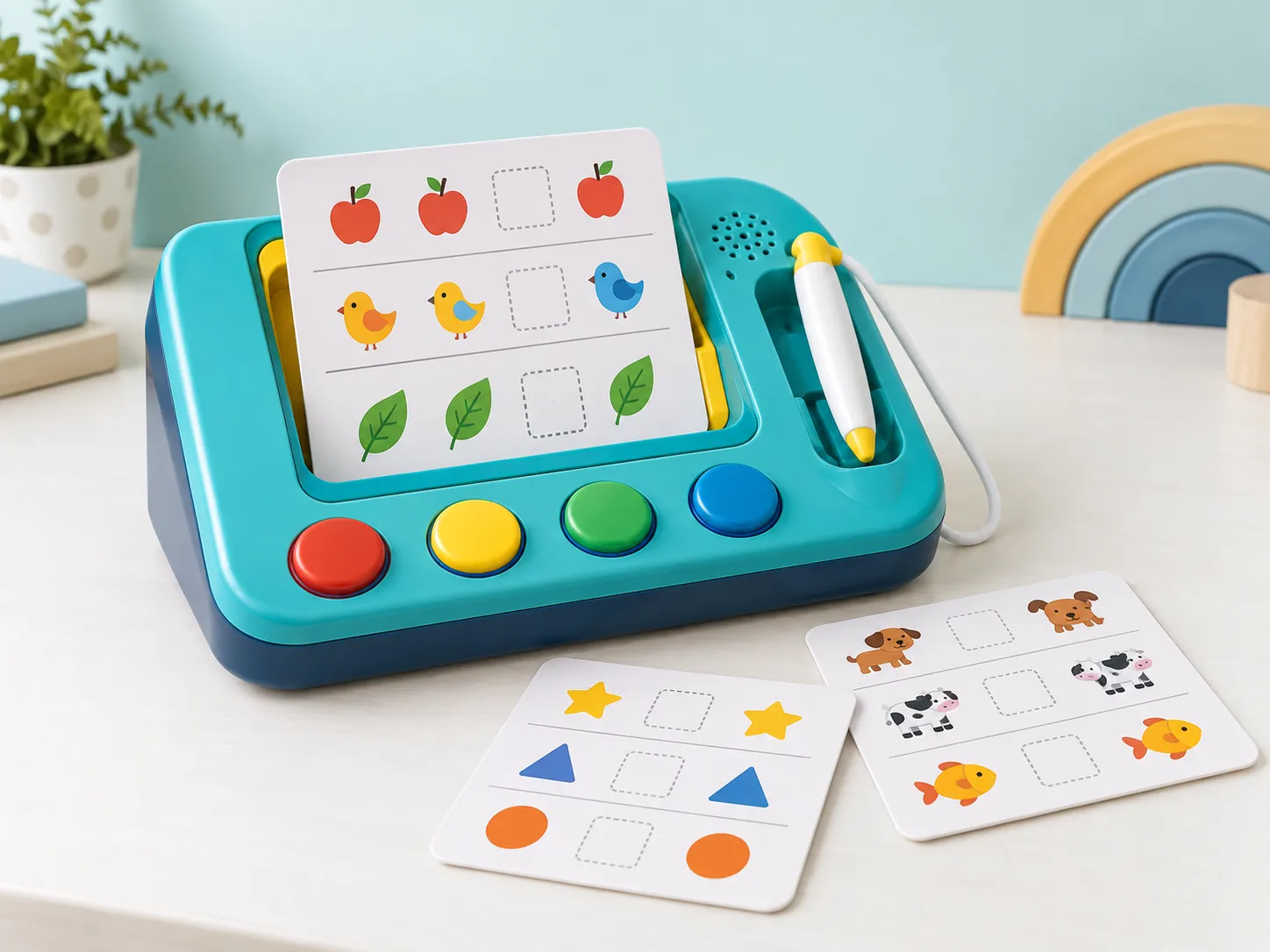
A logic-thinking learning device is a screen-free electronic product that presents a physical question or task, recognizes the child’s answer, and provides audio, light, or mechanical feedback. Manufacturing coordinates learning content, answer keys, recognition hardware, firmware logic, physical cards or boards, enclosure, testing, and pack-out.
Read the guideChoose a screen-free logic device when physical manipulation, simple dedicated controls, repeatable classroom or home use, and offline operation are central. Choose a tablet app when dynamic content, rich visuals, rapid software updates, user accounts, or detailed analytics are essential. Hybrid programs can use both if each has a distinct role.
Read the guideDesign learning-machine cards with one controlled record per activity containing the question objective, artwork revision, recognition identity, valid answer or sequence, distractors, correct and incorrect feedback, hint, retry rule, level, language, and inspection method. Test the card and firmware together before scaling the library.
Read the guideAn OEM logic-learning device should progress through requirement definition, content and state mapping, proof-of-concept electronics, industrial and mechanical design, firmware prototype, tooling and engineering validation, production-intent approval, pilot build, controlled mass production, and shipment inspection. Each gate should have measurable approval evidence.
Read the guideEvaluate a logic learning device sample against a controlled brief, representative user journeys, construction and workmanship criteria, content identity, power and audio behavior, packaging fit, and market-specific risks. Record every result as pass, fail, or open; assign an owner and due date; and never use an attractive demonstration sample as the only production standard.
Read the guidelogic learning device cost and MOQ depend on the selected platform, customization depth, answer-recognition method, input parts, enclosure and tooling, PCB, firmware states, lights, speaker, power, activity media, and storage, content volume, packaging, test and documentation scope, SKU split, and material purchasing constraints. Buyers should request an itemized quotation with common assumptions and ask what operational constraint creates each minimum.
Read the guideChoose answer-recognition technology by defining how a child responds, how many unique activities are required, whether content must expand, acceptable orientation and alignment, feedback speed, durability, power, enclosure space, and cost. Mechanical, conductive, magnetic, optical, RFID, and other electronic methods each solve different combinations of those requirements; test with representative correct, incorrect, incomplete, and misaligned inputs before committing.
Read the guideLocalize a logic learning device by separating language-independent product logic from language-specific scripts, audio, artwork, answer keys, fonts, packaging, and market information. Use stable content IDs, a translation glossary, controlled filename and mapping rules, native-language review, in-device functional QA, and a release matrix for every SKU. Do not assume text translation alone completes localization.
Read the guideA screen-free logic device can fit preschool curriculum when physical actions are developmentally appropriate, feedback is understandable, difficulty progresses gradually, and teachers can observe and extend children’s thinking. The product brief should connect the intended learner or visitor, activity sequence, content scope, adult role, physical setting, success evidence, replenishment model, and market requirements. Approve the complete user journey on representative hardware and media before scaling the program.
Read the guideLogic devices can support after-school STEM sessions when challenges encourage testing and explanation, feedback helps learners revise, and facilitators can adjust difficulty and group structure. The product brief should connect the intended learner or visitor, activity sequence, content scope, adult role, physical setting, success evidence, replenishment model, and market requirements. Approve the complete user journey on representative hardware and media before scaling the program.
Read the guideChoose logic activities by the combined demands of understanding instructions, perceiving information, manipulating pieces, remembering rules, forming an answer, interpreting feedback, and regulating frustration—not by topic name or age label alone. The product brief should connect the intended learner or visitor, activity sequence, content scope, adult role, physical setting, success evidence, replenishment model, and market requirements. Approve the complete user journey on representative hardware and media before scaling the program.
Read the guidea logic learning device and worksheets or flashcards solve different parts of the buyer’s objective. The device can provide immediate mapped feedback and reusable input, while printed formats can offer lower technical complexity, flexible facilitation, and easy content changes. Compare them by user action, content type, adult role, portability, update model, manufacturing system, quality controls, packaging, and lifecycle economics rather than asking which format is universally better.
Read the guideAustralian buyers should determine whether the logic device is a toy and whether the mandatory standard for toys up to 36 months or button/coin-battery standards apply to the exact configuration. The buyer should confirm the final configuration, target age, sales destination, responsible importer, and applicable rules before treating a supplier report or sample as release evidence. A practical decision file links age assessment, applicable ACCC mandatory-standard mapping, representative test results, battery design records, and packaging artwork to the approved model and production lot.
Read the guideAge grading should reflect who is likely to use the product and its actual play pattern; small-parts decisions must then be tested on the complete logic-device set, including pieces that can detach during foreseeable use. The buyer should confirm the final configuration, target age, sales destination, responsible importer, and applicable rules before treating a supplier report or sample as release evidence. A practical decision file links age-assessment rationale, component-size drawings, use-and-abuse test results, labels, and final piece inventory to the approved model and production lot.
Read the guideA useful landed-cost model includes more than factory unit price: add development allocation, market testing, pack dimensions, freight, insurance, import duty, taxes, brokerage, inland delivery, and an explicit assumption for defects or returns. The buyer should confirm the final configuration, target age, sales destination, responsible importer, and applicable rules before treating a supplier report or sample as release evidence. A practical decision file links normalized supplier quote, HS classification basis, origin, freight and insurance quote, duty/tax assumptions, and per-SKU volume model to the approved model and production lot.
Read the guideClosed-answer tasks are easier for a simple device to score reliably; open-ended tasks can support richer reasoning but should not promise automated judgment beyond what the sensors can observe. For a B2B order, the decision should be supported by an activity-state map showing valid answers, sensing limits, hints, and feedback, a production-intent sample, a named approval owner, and a check that can be repeated before shipment. The approach changes with the final product, customer requirements, destination market, and operating model.
Read the guideA useful logic-device progression changes one or two demands at a time, defines what a child must already know, and uses hints that reveal a next step without simply giving the answer. For a B2B order, the decision should be supported by a level-by-level task matrix with prerequisites, accepted responses, hints, and reset rules, a production-intent sample, a named approval owner, and a check that can be repeated before shipment. The approach changes with the final product, customer requirements, destination market, and operating model.
Read the guideA useful pilot observes children completing representative tasks on a production-intent prototype, records confusion and recovery, separates adult help from independent use, and turns findings into design changes. For a B2B order, the decision should be supported by a pilot protocol with task scripts, observation sheet, consent process, and issue log, a production-intent sample, a named approval owner, and a check that can be repeated before shipment. The approach changes with the final product, customer requirements, destination market, and operating model.
Read the guideReplacement media should have stable part numbers, compatible device and content ranges, clear ordering units, and a check that a substitute retains the intended physical and learning function. For a B2B order, the decision should be supported by a part-number and compatibility list for every replaceable card, token, cable, and storage component, a production-intent sample, a named approval owner, and a check that can be repeated before shipment. The approach changes with the final product, customer requirements, destination market, and operating model.
Read the guideUse redundant shape, texture, position, and audio cues where they serve the activity; test identification and answer correction with representative children before claiming an inclusive design. For a B2B order, the decision should be supported by a tactile-feature and feedback map linked to activity and age range, a production-intent sample, a named approval owner, and a check that can be repeated before shipment. The approach changes with the final product, customer requirements, destination market, and operating model.
Read the guideIf a logic device is marketed for group play, define who can input, how turns are indicated, how shared feedback is given, and how the activity resumes after a mistake or interruption. For a B2B order, the decision should be supported by a turn-state diagram and facilitator card for shared play, a production-intent sample, a named approval owner, and a check that can be repeated before shipment. The approach changes with the final product, customer requirements, destination market, and operating model.
Read the guideFor each important state, pair color with a second meaningful cue such as pattern, location, shape, speech, or tone; verify the combination does not accidentally reveal the puzzle answer. For a B2B order, the decision should be supported by a response-state table mapping each light, sound, shape, and printed cue, a production-intent sample, a named approval owner, and a check that can be repeated before shipment. The approach changes with the final product, customer requirements, destination market, and operating model.
Read the guideChoose the least complex progress mechanism that supports the learning task: printed check cards, level tokens, local memory, or teacher records. Define identity, reset, sharing, and privacy before adding cloud features. For a B2B order, the decision should be supported by a progress-state and reset specification for physical or local-device records, a production-intent sample, a named approval owner, and a check that can be repeated before shipment. The approach changes with the final product, customer requirements, destination market, and operating model.
Read the guideDefine the full tolerance stack from token molding and identifier placement through device guides and sensor location; test worst-case production-style pieces in multiple devices and orientations. For a B2B order, the decision should be supported by a token-interface drawing with critical dimensions, identifiers, orientation, sensor margin, and wear results, a production-intent sample, a named approval owner, and a check that can be repeated before shipment. The approach changes with the final product, customer requirements, destination market, and operating model.
Read the guideOffer teacher authoring only when the platform can expose a safe, understandable template and validation route; define what teachers may edit, how answers are encoded, and which support boundaries remain. For a B2B order, the decision should be supported by an authoring template, validation checklist, answer-key map, and supported-device release note, a production-intent sample, a named approval owner, and a check that can be repeated before shipment. The approach changes with the final product, customer requirements, destination market, and operating model.
Read the guideDefine exactly what a short reset, full reset, card change, timeout, and power cycle do; keep classroom scoring understandable and avoid retaining personal progress unless the program truly needs it. For a B2B order, the decision should be supported by a state-transition table for start, answer, hint, score, reset, timeout, and power interruption, a production-intent sample, a named approval owner, and a check that can be repeated before shipment. The approach changes with the final product, customer requirements, destination market, and operating model.
Read the guideBuild packing control around a visual SKU manifest, controlled staging, line clearance, count or scan checks, and finished-set audits; verify content function as well as piece quantity. For a B2B order, the decision should be supported by a SKU-level pack manifest with component image, count, revision, barcode, and packing sequence, a production-intent sample, a named approval owner, and a check that can be repeated before shipment. The approach changes with the final product, customer requirements, destination market, and operating model.
Read the guideDecide whether pieces should work in multiple orientations or be physically keyed; combine geometry, visual and tactile cues, recognition logic, and understandable feedback so the wrong action does not damage the product or feel arbitrary. For a B2B order, the decision should be supported by an orientation map documenting valid poses, blocked poses, cues, force, feedback, and tolerance, a production-intent sample, a named approval owner, and a check that can be repeated before shipment. The approach changes with the final product, customer requirements, destination market, and operating model.
Read the guideUse controlled reference pieces and a validated fixture to set or verify sensor thresholds under the released firmware; define limits, failed-unit disposition, retest authority, and periodic fixture checks. For a B2B order, the decision should be supported by a controlled calibration fixture, reference-piece set, software version, limit table, unit record, and retest rule, a production-intent sample, a named approval owner, and a check that can be repeated before shipment. The approach changes with the final product, customer requirements, destination market, and operating model.
Read the guideDefine timing from physical action to acknowledgement, content playback, scoring, and readiness for the next action; test slow, fast, repeated, partial, and corrected inputs on production-intent hardware. For a B2B order, the decision should be supported by a timing specification covering sensing, debounce, acknowledgement, audio, lights, scoring, timeout, and reset, a production-intent sample, a named approval owner, and a check that can be repeated before shipment. The approach changes with the final product, customer requirements, destination market, and operating model.
Read the guideState exactly how the device and pieces may be cleaned, then test the named method repeatedly on production materials, labels, print, sensors, seams, and electronics; do not imply disinfection without supporting evidence. For a B2B order, the decision should be supported by a cleaning compatibility matrix linking approved method, materials, contact time, drying, repetition, and inspection points, a production-intent sample, a named approval owner, and a check that can be repeated before shipment. The approach changes with the final product, customer requirements, destination market, and operating model.
Read the guideProduct category
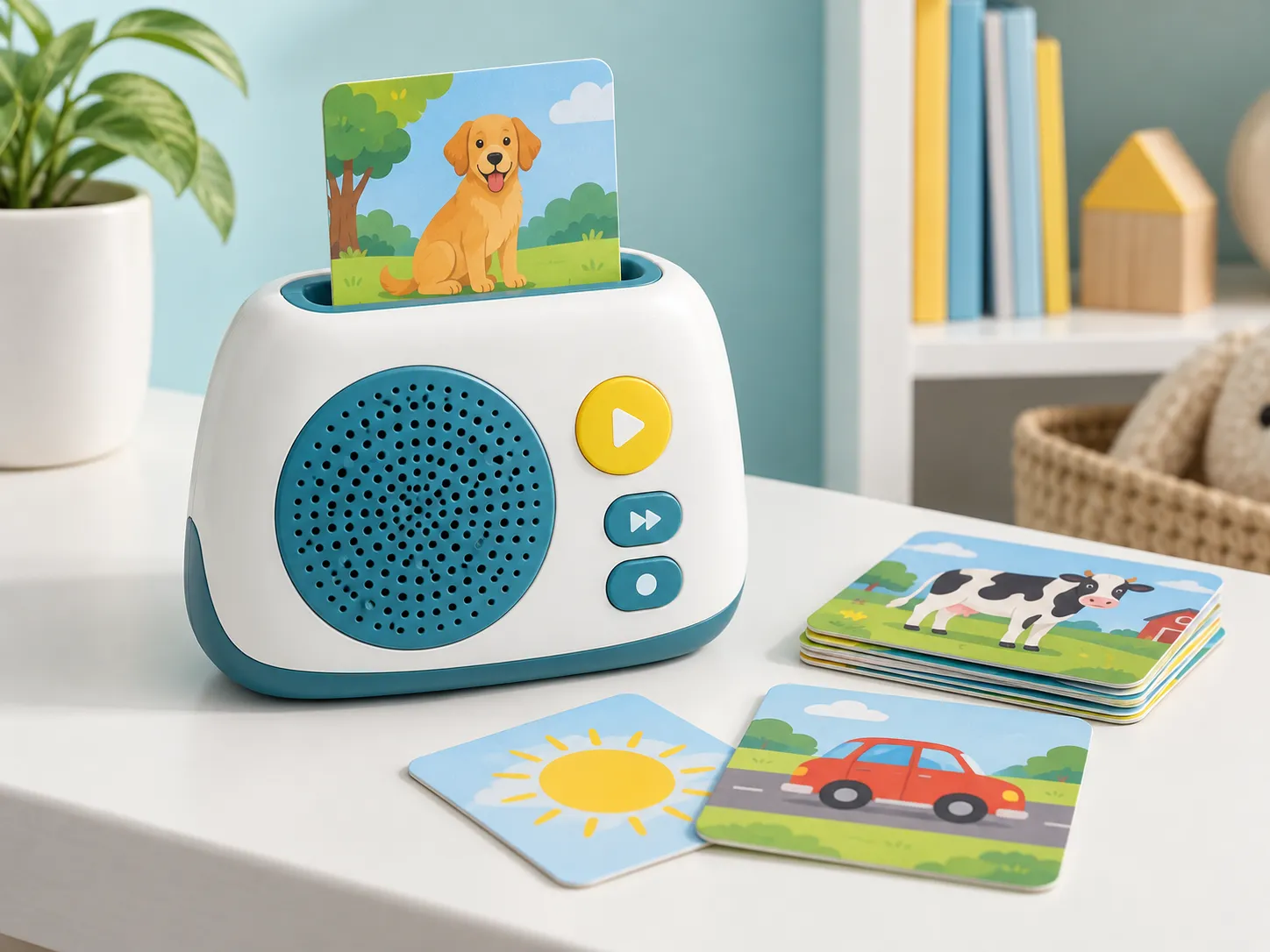
Develop a custom insert-card audio player by defining what each card represents, selecting a recognition method, mapping card IDs to controlled audio, specifying navigation and power behavior, validating card insertion and playback in an integrated prototype, and releasing the player, cards, firmware, content, storage, and packaging as one system.
Read the guideRFID offers contactless identity and flexible card orientation but adds tags, reader design, and possible radio compliance considerations. Contact or resistive methods can be economical but depend on clean alignment and wear control. Optical methods can integrate identity into print but require suitable artwork, sensing, and surface conditions. Select by library capacity, card construction, insertion behavior, cost, durability, and market.
Read the guideBuild expansion packs by defining a clear theme and age promise, reserving unique identifiers, controlling artwork and audio mappings, stating player compatibility, planning storage and replacements, validating all cards with supported firmware, and inspecting pack count, identity, language, packaging, and barcode before release.
Read the guideCard-player quality control should verify player and card identity, every sampled card-to-audio mapping, insertion and recognition margin, playback states, controls, speaker, power, card construction, set completeness, compatibility labels, retail packaging, and carton assortment. Use controlled manifests rather than memory or artwork alone.
Read the guideChoose the insert-card audio player power system by defining expected play pattern, target runtime, charging or replacement behavior, child access controls, enclosure space, low-power response, destination markets, and transport method. Compare battery chemistry and capacity only after these system requirements are clear, then validate the final product with the applicable safety and shipment plan.
Read the guideA useful insert-card audio player RFQ defines the target user and market, complete product format, content and interaction map, power and audio behavior, materials and appearance, accessories and packaging, compliance responsibilities, sample stages, quantity by SKU, delivery basis, and required quotation breakdown. Mark confirmed, preferred, and open items separately so suppliers can quote alternatives without hiding assumptions.
Read the guideChoose a card audio player update method by deciding who performs the update, whether internet or a computer is acceptable, how cards identify content, where audio is stored, how files are authenticated and versioned, how failed updates recover, and how old cards remain compatible. Options include factory-preloaded libraries, card-bound storage, USB or memory-card transfer, app-assisted loading, and wireless delivery; each changes hardware, firmware, support, privacy, and QA.
Read the guideChoose audio-player card construction from the child’s handling, reader slot and recognition technology, target stiffness, edge and corner safety, print durability, moisture and abrasion exposure, embedded identifier, storage method, and production tolerance. Approve material stack, finished dimensions, thickness, finish, color, identifier position, warpage, and functional life on production-representative cards.
Read the guideA bedtime card player should make caregiver-selected audio easy to start and predictable to stop, with calm content, simple controls, suitable volume behavior, and no claim that a device can guarantee sleep. The product brief should connect the intended learner or visitor, activity sequence, content scope, adult role, physical setting, success evidence, replenishment model, and market requirements. Approve the complete user journey on representative hardware and media before scaling the program.
Read the guideA bilingual card player should use a stable identity and release system so each physical card consistently resolves to the intended language, track, artwork, and learning action. The product brief should connect the intended learner or visitor, activity sequence, content scope, adult role, physical setting, success evidence, replenishment model, and market requirements. Approve the complete user journey on representative hardware and media before scaling the program.
Read the guideA card-audio subscription should be designed first as a reliable content-release and fulfillment system; recurring revenue is not credible without compatible packs, strong standalone value, controlled rights, and customer support. The product brief should connect the intended learner or visitor, activity sequence, content scope, adult role, physical setting, success evidence, replenishment model, and market requirements. Approve the complete user journey on representative hardware and media before scaling the program.
Read the guideShared card-audio collections need institutional controls for labeling, compatibility, volume, charging, cleaning, storage, card count, replacement, and content curation in addition to ordinary product quality. The product brief should connect the intended learner or visitor, activity sequence, content scope, adult role, physical setting, success evidence, replenishment model, and market requirements. Approve the complete user journey on representative hardware and media before scaling the program.
Read the guideCanadian card-player buyers should assess the complete player-and-card set against the Toys Regulations and relevant packaging requirements, then verify age classification, small parts, electrical hazards, and the retail label. The buyer should confirm the final configuration, target age, sales destination, responsible importer, and applicable rules before treating a supplier report or sample as release evidence. A practical decision file links age-classification rationale, Canadian requirement matrix, final-set test evidence, packaging and warning artwork, and importer records to the approved model and production lot.
Read the guideA Children’s Product Certificate should be based on relevant CPSC-accepted testing for the finished children’s product and should identify each applicable rule. The importer of a foreign-made product, not the test laboratory, is responsible for issuing its CPC. The buyer should confirm the final configuration, target age, sales destination, responsible importer, and applicable rules before treating a supplier report or sample as release evidence. A practical decision file links applicable-rule matrix, CPSC-accepted test reports, importer-issued CPC, component-change history, and lot identifiers to the approved model and production lot.
Read the guideBefore adding Bluetooth, Wi-Fi, RFID, or NFC, identify whether the final card player intentionally transmits radio signals and then scope the applicable U.S. FCC and EU radio-equipment requirements for its final configuration. The buyer should confirm the final configuration, target age, sales destination, responsible importer, and applicable rules before treating a supplier report or sample as release evidence. A practical decision file links radio-module identity, antenna layout, firmware features, equipment-authorization or RED assessment records, privacy map, and label plan to the approved model and production lot.
Read the guideThere is no reliable universal HS code for all talking pens, sound books, plush toys, and card players. Classification depends on the actual product, its function, retail-set composition, and the importing jurisdiction. The buyer should confirm the final configuration, target age, sales destination, responsible importer, and applicable rules before treating a supplier report or sample as release evidence. A practical decision file links complete product description, photos, component and function breakdown, retail-set contents, proposed tariff heading, and broker or customs ruling to the approved model and production lot.
Read the guideA mixed-SKU shipment needs a stratified inspection plan: identify each language and card-set variant, verify its firmware and physical contents, then reconcile retail packs and master cartons before release. The buyer should confirm the final configuration, target age, sales destination, responsible importer, and applicable rules before treating a supplier report or sample as release evidence. A practical decision file links approved SKU matrix, firmware/content manifests, inspection sampling plan, defect definitions, carton map, and release report to the approved model and production lot.
Read the guideA card-player platform should allocate identifiers centrally, reserve ranges for future decks, and test printed or embedded IDs against the exact audio map and firmware release. For a B2B order, the decision should be supported by a reserved card-ID register linked to artwork, audio, language, and firmware, a production-intent sample, a named approval owner, and a check that can be repeated before shipment. The approach changes with the final product, customer requirements, destination market, and operating model.
Read the guideReplacement cards should be sold or supplied under controlled part and edition identities; the buyer must know whether a single card, mini-pack, or full deck can be replaced and which player versions support it. For a B2B order, the decision should be supported by a replacement-card catalog with deck, card, edition, ID, player range, and order unit, a production-intent sample, a named approval owner, and a check that can be repeated before shipment. The approach changes with the final product, customer requirements, destination market, and operating model.
Read the guideAn offline content release should carry a versioned manifest, exact card-to-track map, supported hardware and firmware list, installation instructions, integrity check, recovery path, and acceptance tests on real cards. For a B2B order, the decision should be supported by a signed content-package manifest with card map, checksum, supported player builds, and release notes, a production-intent sample, a named approval owner, and a check that can be repeated before shipment. The approach changes with the final product, customer requirements, destination market, and operating model.
Read the guideA starter set should deliver a complete first-use experience and make the expansion path obvious; expansion packs should be identifiable, compatible, and valuable without duplicating unnecessary hardware. For a B2B order, the decision should be supported by a bundle-and-SKU matrix showing hardware, cards, languages, accessories, barcodes, and compatible expansions, a production-intent sample, a named approval owner, and a check that can be repeated before shipment. The approach changes with the final product, customer requirements, destination market, and operating model.
Read the guideDecide whether each card has one language, whether the device switches languages, or whether separate decks are sold; then test the mode cue, persistence, audio map, and packaging together. For a B2B order, the decision should be supported by a card-language-mode matrix linked to audio, artwork, firmware, and pack identity, a production-intent sample, a named approval owner, and a check that can be repeated before shipment. The approach changes with the final product, customer requirements, destination market, and operating model.
Read the guidePrototype pacing with real narration and the intended card interaction. Define when a story begins, pauses, resumes, repeats, and ends before quoting memory and firmware. For a B2B order, the decision should be supported by a story-state map with script timing, pause points, replay, resume, and card-removal behavior, a production-intent sample, a named approval owner, and a check that can be repeated before shipment. The approach changes with the final product, customer requirements, destination market, and operating model.
Read the guideDesign card storage as part of the playable system: label each deck and card, make counting practical, protect recognition surfaces, and connect missing-card reports to a replacement route. For a B2B order, the decision should be supported by a deck-storage and checkout plan linked to card IDs, edition, count, and service stock, a production-intent sample, a named approval owner, and a check that can be repeated before shipment. The approach changes with the final product, customer requirements, destination market, and operating model.
Read the guideClear the story, script adaptation, voice performance, music, and master recording for the intended product and markets; deliver a versioned master-file package with a usable rights register. For a B2B order, the decision should be supported by a rights-and-master manifest tied to track IDs, territories, languages, and sellable decks, a production-intent sample, a named approval owner, and a check that can be repeated before shipment. The approach changes with the final product, customer requirements, destination market, and operating model.
Read the guideTest recognition on fully printed and laminated production-style cards. Control the complete layer stack, thickness, flatness, edge finish, identifier position, and any visual coating that affects the reading method. For a B2B order, the decision should be supported by a card-construction specification with layer stack, identifier position, thickness, flatness, finish, and reader results, a production-intent sample, a named approval owner, and a check that can be repeated before shipment. The approach changes with the final product, customer requirements, destination market, and operating model.
Read the guideControl slot width, guides, insertion depth, orientation cues, sensing position, and card thickness as one tolerance stack; test repeated use with production-style cards and realistic off-angle attempts. For a B2B order, the decision should be supported by a slot-interface drawing and repeated-use record covering force, alignment, wear, and recovery, a production-intent sample, a named approval owner, and a check that can be repeated before shipment. The approach changes with the final product, customer requirements, destination market, and operating model.
Read the guideDesign the travel kit around a complete carry-and-use journey: secure a limited card set, protect the slot and controls, state charging needs, manage volume, and make pack contents easy to count. For a B2B order, the decision should be supported by a travel-bundle map for player, cards, power, accessories, case, labels, and return count, a production-intent sample, a named approval owner, and a check that can be repeated before shipment. The approach changes with the final product, customer requirements, destination market, and operating model.
Read the guideUse a controlled ID source and a write-then-verify process tied to artwork and deck identity; reject duplicates and unreadable cards before packing, then play representative physical cards on released players. For a B2B order, the decision should be supported by an encoding batch record linking card ID, artwork, deck, language, equipment, operator, and verification result, a production-intent sample, a named approval owner, and a check that can be repeated before shipment. The approach changes with the final product, customer requirements, destination market, and operating model.
Read the guideChoose whether cards are reversible or keyed, then coordinate card geometry, printed and tactile cues, slot lead-in, sensing position, insertion force, recognition timing, wrong-way feedback, and easy extraction. For a B2B order, the decision should be supported by an insertion-state map with supported orientation, cues, force, partial states, rejection behavior, and extraction method, a production-intent sample, a named approval owner, and a check that can be repeated before shipment. The approach changes with the final product, customer requirements, destination market, and operating model.
Read the guideTreat speaker and headphone output as separate modes: define startup and remembered level, volume steps, maximum behavior, detection and transition, compatible accessories, warnings, and qualified measurement for the final hardware and content. For a B2B order, the decision should be supported by an output-mode specification with levels, steps, startup state, detection, limiting, measurement setup, and instructions, a production-intent sample, a named approval owner, and a check that can be repeated before shipment. The approach changes with the final product, customer requirements, destination market, and operating model.
Read the guideDefine the state in which the player leaves the factory, how it is isolated or put into shipping mode, expected storage duration, wake action, first-charge instruction, and measurable quiescent-current acceptance. For a B2B order, the decision should be supported by a power-state plan with measured quiescent current, initial charge, isolation or shipping mode, wake method, storage assumptions, and inspection evidence, a production-intent sample, a named approval owner, and a check that can be repeated before shipment. The approach changes with the final product, customer requirements, destination market, and operating model.
Read the guideTest every new expansion pack against each player generation and supported firmware named on packaging; reserve identifier ranges, verify content mapping, document update requirements, and give support a version lookup. For a B2B order, the decision should be supported by a compatibility matrix linking card pack, identifier range, content release, player generation, firmware, language, and test result, a production-intent sample, a named approval owner, and a check that can be repeated before shipment. The approach changes with the final product, customer requirements, destination market, and operating model.
Read the guideProduct category
Choose a sound-book module by matching button count and placement, user age, audio duration, memory, playback rules, speaker path, battery access, book construction, retail format, safety plan, and production method. A side-panel module is easy to see and assemble; page-integrated buttons can support contextual interaction but require tighter alignment and construction control.
Read the guidePrepare a sound-book production package with controlled trim and module dielines, page order, bleed and safe areas, button and speaker positions, artwork revisions, a button-to-audio map, mastered files, binding notes, battery and label artwork, packaging files, and a signed production-intent proof. Release print and electronics data together.
Read the guideChoose a board sound book for thicker pages, younger users, fewer durable spreads, and robust tactile handling. Choose paper pages when higher page count, lighter weight, flexible editorial layouts, or older readers matter. The module, binding, button architecture, battery access, packaging, and age-specific safety plan must fit the selected construction.
Read the guideA sound-book release plan should verify final-material compliance, electrical and battery construction, button and audio mapping, print and binding quality, component retention, page durability, labels, instructions, retail packaging, and shipment sampling. Testing must reflect the final age grading, configuration, claims, and destination market.
Read the guideChoose the children’s sound book power system by defining expected play pattern, target runtime, charging or replacement behavior, child access controls, enclosure space, low-power response, destination markets, and transport method. Compare battery chemistry and capacity only after these system requirements are clear, then validate the final product with the applicable safety and shipment plan.
Read the guideSpecify sound book audio quality through the intended listening distance, content type, language intelligibility, target volume steps, acceptable noise and distortion, speaker and enclosure configuration, approved master files, and low-power behavior. Use the same reference tracks and functional scenarios during prototype approval, line testing, and shipment inspection.
Read the guideEvaluate a sound book sample against a controlled brief, representative user journeys, construction and workmanship criteria, content identity, power and audio behavior, packaging fit, and market-specific risks. Record every result as pass, fail, or open; assign an owner and due date; and never use an attractive demonstration sample as the only production standard.
Read the guideDesign sound book packaging from the complete pack-out, retail channel, transport route, storage conditions, barcode and label needs, user unboxing sequence, and damage risks. Approve the inner fit, retail pack, master carton, packing method, and shipment inspection standard as one system, then validate with production-representative materials and packed samples.
Read the guidesound book cost and MOQ depend on the selected platform, customization depth, trim size, page count, board or paper, printing, lamination, die cutting, binding, button count, sound module, speaker, battery, and audio duration, content volume, packaging, test and documentation scope, SKU split, and material purchasing constraints. Buyers should request an itemized quotation with common assumptions and ask what operational constraint creates each minimum.
Read the guideEarly-language sound books work best when each button has a clear visual purpose, brief intelligible audio, accurate language review, and an invitation for adult-child interaction rather than passive repeated playback. The product brief should connect the intended learner or visitor, activity sequence, content scope, adult role, physical setting, success evidence, replenishment model, and market requirements. Approve the complete user journey on representative hardware and media before scaling the program.
Read the guideA museum or branded sound book should combine verified content, clear rights, intuitive page-to-audio interaction, portable retail presentation, and a controlled reprint record. The product brief should connect the intended learner or visitor, activity sequence, content scope, adult role, physical setting, success evidence, replenishment model, and market requirements. Approve the complete user journey on representative hardware and media before scaling the program.
Read the guideFor preschool classrooms, choose sound books with clear page-button relationships, short teacher-controllable audio, durable construction, understandable power access, and routines for shared handling and storage. The product brief should connect the intended learner or visitor, activity sequence, content scope, adult role, physical setting, success evidence, replenishment model, and market requirements. Approve the complete user journey on representative hardware and media before scaling the program.
Read the guideChoose sound-book format by the combined physical, language, attention, interaction, and safety demands of the actual book—not by applying one age label to every board thickness or button module. The product brief should connect the intended learner or visitor, activity sequence, content scope, adult role, physical setting, success evidence, replenishment model, and market requirements. Approve the complete user journey on representative hardware and media before scaling the program.
Read the guidea sound book and a talking-pen publishing system solve different parts of the buyer’s objective. A sound book is self-contained and easy to demonstrate, while a talking pen can support deeper point-level interaction and a multi-title expansion library. Compare them by user action, content type, adult role, portability, update model, manufacturing system, quality controls, packaging, and lifecycle economics rather than asking which format is universally better.
Read the guideA GB sound-book importer should confirm whether the product is a toy, identify applicable safety rules, check the relevant CE or UKCA route, and verify the declaration, technical file, importer details, and shipment traceability. The buyer should confirm the final configuration, target age, sales destination, responsible importer, and applicable rules before treating a supplier report or sample as release evidence. A practical decision file links safety assessment, applicable test results, declaration of conformity, marking artwork, importer identity, and batch records to the approved model and production lot.
Read the guideEU sound-book buyers should document the exact battery configuration and its child-access, electrical, chemical, replacement, charging, and transport implications as part of the finished toy assessment. The buyer should confirm the final configuration, target age, sales destination, responsible importer, and applicable rules before treating a supplier report or sample as release evidence. A practical decision file links battery specification, compartment drawings, electrical and toy test reports, instructions, labels, and technical-file index to the approved model and production lot.
Read the guideButton-cell sound books require a market-specific review of child access, foreseeable misuse, warnings, and any spare-cell packaging; a single generic “battery safe” claim is inadequate. The buyer should confirm the final configuration, target age, sales destination, responsible importer, and applicable rules before treating a supplier report or sample as release evidence. A practical decision file links battery-access assessment, toy-scope decision, market-specific test reports, warning artwork, and cell-packaging records to the approved model and production lot.
Read the guideSound-book recall readiness starts before launch: encode a useful lot identity, link finished books to critical component and retailer shipments, retain complaint records, and rehearse containment. The buyer should confirm the final configuration, target age, sales destination, responsible importer, and applicable rules before treating a supplier report or sample as release evidence. A practical decision file links lot-code scheme, component and assembly records, shipment-to-retailer map, complaint log, retained samples, and escalation procedure to the approved model and production lot.
Read the guideA reliable sound book needs a controlled relationship among printed artwork, board thickness, page die-cut, switch position, spine geometry, wiring or conductive path, and the audio map. For a B2B order, the decision should be supported by a page-switch-module interface drawing and production-intent endurance record, a production-intent sample, a named approval owner, and a check that can be repeated before shipment. The approach changes with the final product, customer requirements, destination market, and operating model.
Read the guideBefore mastering audio for a sound book, identify each underlying work and recording, its owner, licensed uses, territory, term, language, quantity if relevant, and renewal or replacement route. For a B2B order, the decision should be supported by a rights manifest for script, composition, performance, master, sound effect, image, language, and territory, a production-intent sample, a named approval owner, and a check that can be repeated before shipment. The approach changes with the final product, customer requirements, destination market, and operating model.
Read the guideSpecify the board, coating, lamination, ink, binding, and module attachment for performance; make any FSC or recycled-content claim only when the applicable supply-chain evidence and labeling approval support it. For a B2B order, the decision should be supported by a material specification and claim-evidence file linked to certified suppliers and approved artwork, a production-intent sample, a named approval owner, and a check that can be repeated before shipment. The approach changes with the final product, customer requirements, destination market, and operating model.
Read the guideTreat each reprint as a controlled product release: compare printed artwork, switch positions, audio script and masters, module program, material substitutions, labels, and compatibility before purchase-order approval. For a B2B order, the decision should be supported by a title-edition-release matrix for artwork, page switch, track map, audio master, module, and carton, a production-intent sample, a named approval owner, and a check that can be repeated before shipment. The approach changes with the final product, customer requirements, destination market, and operating model.
Read the guideChoose page-turn activation for a guided sequence only when page position can be detected reliably; choose buttons when children need repeatable control over specific sounds, and test both in a bound prototype. For a B2B order, the decision should be supported by a page-state and sound-trigger map with mechanical sample observations, a production-intent sample, a named approval owner, and a check that can be repeated before shipment. The approach changes with the final product, customer requirements, destination market, and operating model.
Read the guideSpecify how adults select volume and stop playback, how the book responds when closed or idle, and how it signals mute or low battery; test the complete routine in realistic low-light conditions. For a B2B order, the decision should be supported by a night-use control-state sheet for volume, stop, sleep, and restart behavior, a production-intent sample, a named approval owner, and a check that can be repeated before shipment. The approach changes with the final product, customer requirements, destination market, and operating model.
Read the guideTest the full bound book through representative opening and handling cycles, then inspect both print construction and electronic response; a bare module test cannot prove spine durability. For a B2B order, the decision should be supported by a binding-cross-section and flex-test record linked to the approved module and page construction, a production-intent sample, a named approval owner, and a check that can be repeated before shipment. The approach changes with the final product, customer requirements, destination market, and operating model.
Read the guideTreat a retail demo as its own controlled configuration: decide which sound point shoppers can use, how the sample is powered, how staff reset it, and how saleable stock stays distinguishable. For a B2B order, the decision should be supported by a demo-pack specification with sample track, power plan, display security, and reset instructions, a production-intent sample, a named approval owner, and a check that can be repeated before shipment. The approach changes with the final product, customer requirements, destination market, and operating model.
Read the guideEvaluate activation in the fully bound book with representative children and production-style materials; control switch support, printed target, tactile response, and variation rather than relying on the bare switch rating. For a B2B order, the decision should be supported by a button-location and force reference linked to finished book construction and usability observations, a production-intent sample, a named approval owner, and a check that can be repeated before shipment. The approach changes with the final product, customer requirements, destination market, and operating model.
Read the guideMap each physical switch to its track, then test center, edge, repeated, simultaneous, page-flex, and power-state inputs on the bound book; isolate whether failures come from mechanics, wiring, or firmware. For a B2B order, the decision should be supported by a switch-to-track matrix with debounce, simultaneous-input, flex, and diagnostic results, a production-intent sample, a named approval owner, and a check that can be repeated before shipment. The approach changes with the final product, customer requirements, destination market, and operating model.
Read the guideValidate the finished bound and packed book against the expected distribution environment. Measure page and cover change, inspect binding and finishes, allow documented recovery, and retest every representative sound function. For a B2B order, the decision should be supported by a material, pack, conditioning, recovery, warpage, and function test record, a production-intent sample, a named approval owner, and a check that can be repeated before shipment. The approach changes with the final product, customer requirements, destination market, and operating model.
Read the guideDecide whether the battery is user-replaceable, serviceable, or sealed; review applicable electrical-waste and battery responsibilities by market, then align construction, labels, instructions, and support. For a B2B order, the decision should be supported by a market-specific end-of-life and service matrix covering battery, module, markings, instructions, and responsible party, a production-intent sample, a named approval owner, and a check that can be repeated before shipment. The approach changes with the final product, customer requirements, destination market, and operating model.
Read the guideDefine an activation window that includes artwork, print registration, die cutting, board assembly, lamination, and switch tolerance; verify production-intent sheets and finished bound books against common datums. For a B2B order, the decision should be supported by a layered registration drawing with artwork center, switch center, activation window, converting datums, and inspection limits, a production-intent sample, a named approval owner, and a check that can be repeated before shipment. The approach changes with the final product, customer requirements, destination market, and operating model.
Read the guideDesign the isolation tab with controlled material, position, retention, removal force, visible instruction, and fragment-free extraction; test electrical isolation and first activation on packed production-intent books. For a B2B order, the decision should be supported by a tab specification with material, dimensions, insertion depth, pull feature, force, instruction, pack orientation, and functional check, a production-intent sample, a named approval owner, and a check that can be repeated before shipment. The approach changes with the final product, customer requirements, destination market, and operating model.
Read the guideMap every active button and keep transport loads away from those zones using controlled orientation, cavity, tray, spacer, board, or battery-isolation design; verify the complete retail and master pack under the approved distribution test plan. For a B2B order, the decision should be supported by a pack-out drawing with active-zone clearance, tray or spacer construction, stacking direction, battery state, and verification checks, a production-intent sample, a named approval owner, and a check that can be repeated before shipment. The approach changes with the final product, customer requirements, destination market, and operating model.
Read the guideDesign the cavity as part of the book structure: control remaining board width, layer orientation, module clearance, adhesive pattern, edge support, binding distance, cover finish, and press path, then test finished bound books. For a B2B order, the decision should be supported by a cavity drawing with layer stack, wall width, module clearance, adhesive coverage, edge treatment, and inspection section, a production-intent sample, a named approval owner, and a check that can be repeated before shipment. The approach changes with the final product, customer requirements, destination market, and operating model.
Read the guideProduct category
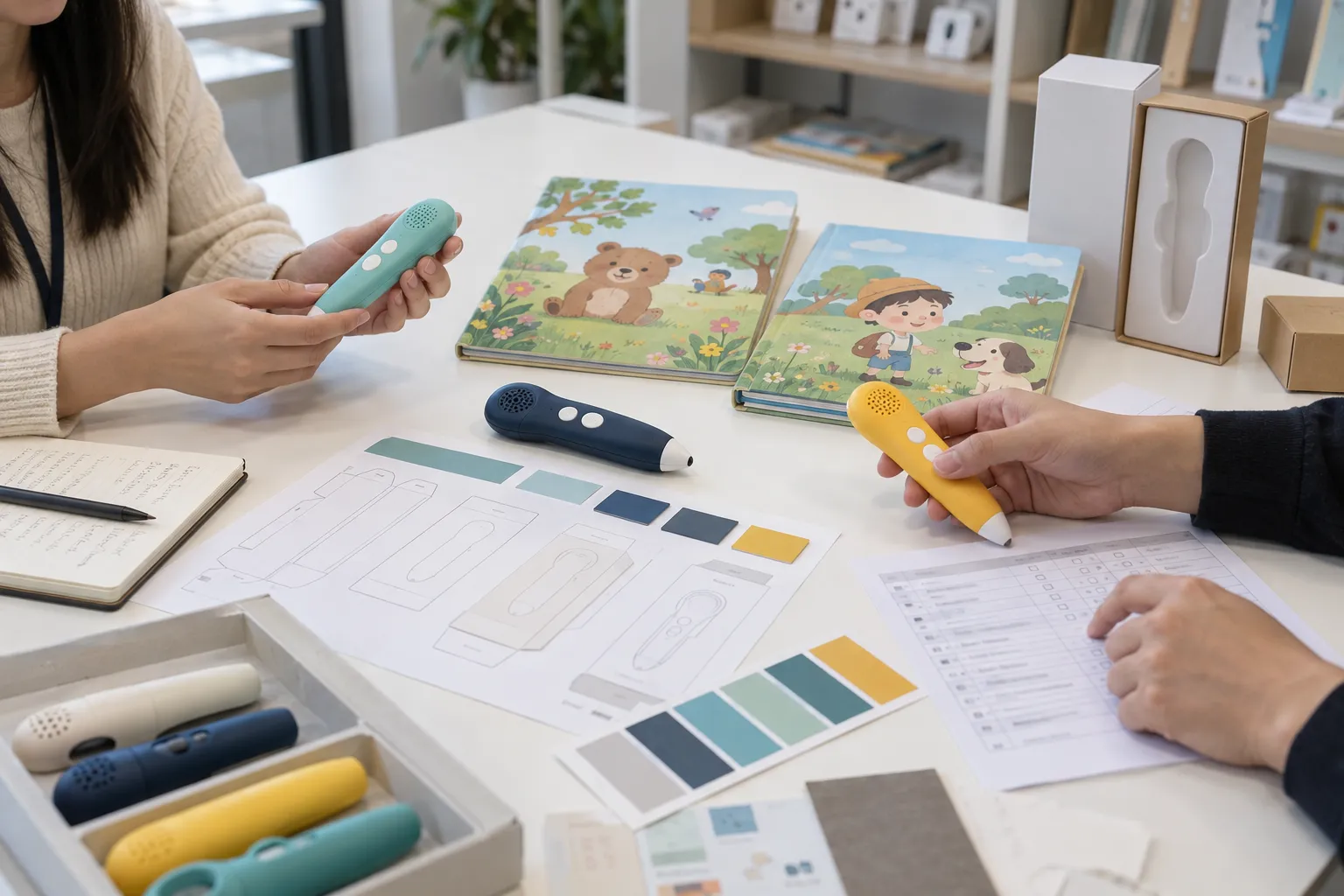
Before custom development, agree which party owns or licenses each design and content asset, what editable files will be delivered, which tools or third-party components are excluded, and how the buyer can maintain the product if the supplier changes. For a B2B order, the decision should be supported by a deliverables-and-rights schedule naming each source file, format, owner, access rule, and transfer trigger, a production-intent sample, a named approval owner, and a check that can be repeated before shipment. The approach changes with the final product, customer requirements, destination market, and operating model.
Read the guideGive each sellable configuration a controlled SKU record and apply GS1 GTIN rules to determine when a new trade-item identity is required; link it to product, content, edition, language, packaging, and support compatibility. For a B2B order, the decision should be supported by a SKU-GTIN-variant matrix linked to hardware, content, language, pack, market, and release, a production-intent sample, a named approval owner, and a check that can be repeated before shipment. The approach changes with the final product, customer requirements, destination market, and operating model.
Read the guideState the users and learning task, identify barriers in sensing, action, feedback, language, and adult support, then set observable acceptance criteria for representative prototypes. For a B2B order, the decision should be supported by a user-task and access-needs brief with representative test scenarios and named approval owners, a production-intent sample, a named approval owner, and a check that can be repeated before shipment. The approach changes with the final product, customer requirements, destination market, and operating model.
Read the guideStart with the learning interaction. Choose a battery-free kit when physical manipulation, conversation, and printed guidance meet the goal; use electronics when audio, recognition, or adaptive feedback provides value that justifies power and service. For a B2B order, the decision should be supported by a format decision matrix for learning action, feedback, power, content updates, care, and total ownership cost, a production-intent sample, a named approval owner, and a check that can be repeated before shipment. The approach changes with the final product, customer requirements, destination market, and operating model.
Read the guideApprove multiple identified samples only after the production-intent configuration is frozen; state what each sample controls, link it to digital files and specifications, and manage storage, access, condition, and supersession. For a B2B order, the decision should be supported by a signed sample register with physical unit IDs, revision, approval scope, photos, files, storage, and expiry or replacement rule, a production-intent sample, a named approval owner, and a check that can be repeated before shipment. The approach changes with the final product, customer requirements, destination market, and operating model.
Read the guideRun a pilot under production-intent conditions when the project has meaningful new tooling, construction, content programming, or pack-out risk; define quantity from learning goals and release mass production only after critical actions close. For a B2B order, the decision should be supported by a pilot-run plan and closure report covering inputs, output, defects, capability, rework, and open actions, a production-intent sample, a named approval owner, and a check that can be repeated before shipment. The approach changes with the final product, customer requirements, destination market, and operating model.
Read the guideAn AQL plan must define the lot and random sample, current sampling standard and agreement, critical-major-minor defect catalogue, functional checks, acceptance and rejection numbers, escalation, and disposition before inspection begins. For a B2B order, the decision should be supported by an inspection instruction defining lot, sample selection, inspection level, AQL or zero-acceptance controls, defect classes, checks, and disposition, a production-intent sample, a named approval owner, and a check that can be repeated before shipment. The approach changes with the final product, customer requirements, destination market, and operating model.
Read the guideUse one engineering change order to connect every affected BOM item, drawing, tool, firmware, audio, artwork, label, SKU, test report, sample, inventory lot, instruction, and effective production point; do not approve changes only through email. For a B2B order, the decision should be supported by an ECO record with reason, old and new revision, affected items, risk, evidence, inventory disposition, approvals, effectivity, and verification, a production-intent sample, a named approval owner, and a check that can be repeated before shipment. The approach changes with the final product, customer requirements, destination market, and operating model.
Read the guide