How it works
Children complete matching, sequencing, counting, or observation tasks and receive immediate audio or light-based feedback.
Activity-based learning machines planned around logic games, matching tasks, number skills, and progressive challenge levels.
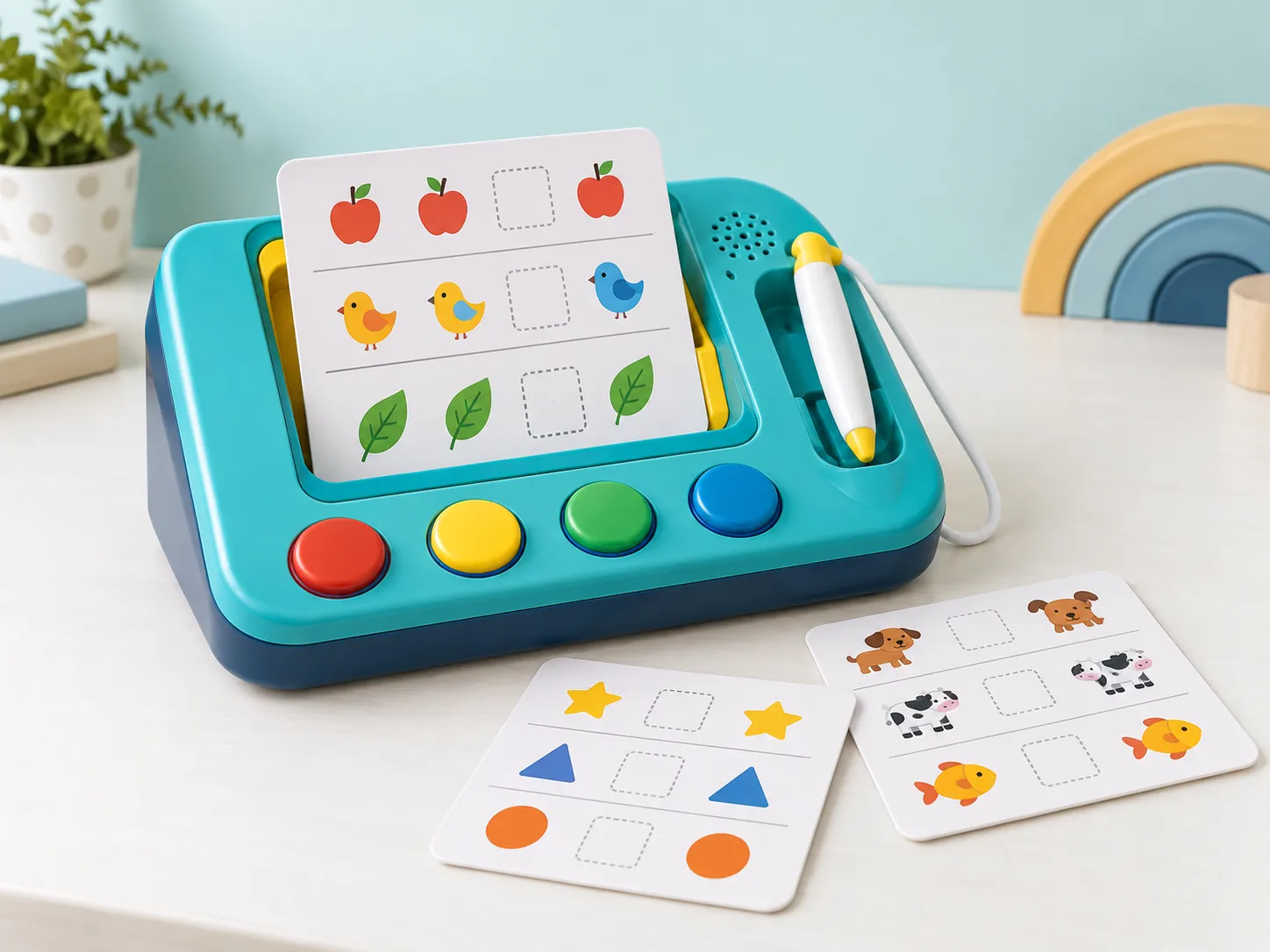
Preschool curricula, STEM activity programs, educational retail, and home learning
Device controls, activity media, answer logic, audio prompts, progression, and packaging
Learning goals, age group, task formats, language, content ownership, and target cost
Product description
A logic-learning machine is most useful when the physical interaction, activity cards, prompts, answer method, and feedback rules support a clear educational objective. Adding functions without a lesson structure can make the product harder to use and harder to validate.
We translate the buyer’s curriculum or activity concept into a product brief covering cards or worksheets, buttons or stylus interaction, audio prompts, feedback states, content levels, housing, and packaging.
Children complete matching, sequencing, counting, or observation tasks and receive immediate audio or light-based feedback.
Preschool logic, early mathematics, visual recognition, memory exercises, STEM introductions, and home-learning sets.
Learning objectives, activity examples, age group, answer logic, feedback rules, languages, content levels, and pack-out.
Define skills, difficulty levels, activity sequence, answer types, replay rules, and how children receive feedback.
Compare card, button, stylus, touch, or mixed interactions against age, motor skills, durability, and content needs.
Plan instructions, encouragement, correct and incorrect responses, volume behavior, languages, and track control.
Coordinate activity cards, printed assets, numbering, storage, manuals, replacement logic, and retail pack-out.
Use this framework to make supplier discussions, quotations, samples, and approvals more comparable.
| Decision area | What to define | Why it matters |
|---|---|---|
| Learning goal | Skills, age range, outcomes, difficulty progression | Keeps functions tied to a real teaching objective |
| Task format | Matching, sequencing, counting, observation, memory, classification | Determines input method and feedback logic |
| Content set | Number of cards or activities, language versions, revision plan | Guides tooling, files, memory, and packaging |
| Feedback | Audio prompts, lights, scoring, retry rules, reward sequence | Shapes the learning loop and electronics |
| Controls | Power, volume, navigation, answer input, caregiver access | Affects usability, housing, and inspection |
| Pack-out | Activity storage, instructions, accessories, retail box | Prevents missing parts and supports repeat use |
Define target skills, task types, difficulty, content volume, and expected feedback.
Match cards, buttons, stylus, indicators, and controls to the age group and activity flow.
Use real prompts and sample tasks to review comprehension, response behavior, and physical handling.
Release approved activity files, audio, behavior rules, appearance, pack-out, and inspection points.
Share your market, books, functions, content status, quantity range, packaging, and timing. We’ll use them to organize the questions that need answers before sampling.
Send Your RequirementsThese answers provide a planning basis. Final scope should always be confirmed for the exact product and destination market.
Yes. Share the learning objectives, representative activities, artwork format, answer logic, language plan, and content ownership so feasibility can be reviewed.
There is no universal number. A focused progression suited to the target age is more useful than a large unstructured content count. Prototype testing should confirm comprehension and difficulty.
Potentially. Language switching affects audio volume, file structure, controls, memory planning, manuals, and testing, so it should be defined at the beginning of the project.
Send your current requirements, even if some details are still open. A structured first review can identify the missing decisions before they delay sampling.