How it works
The optical reader identifies compatible OID activation points and plays the mapped audio assigned to each page, picture, word, or activity.
Develop a custom talking pen, audio reading pen, or point reading pen around your books, languages, learning flow, branding, packaging, and target market.
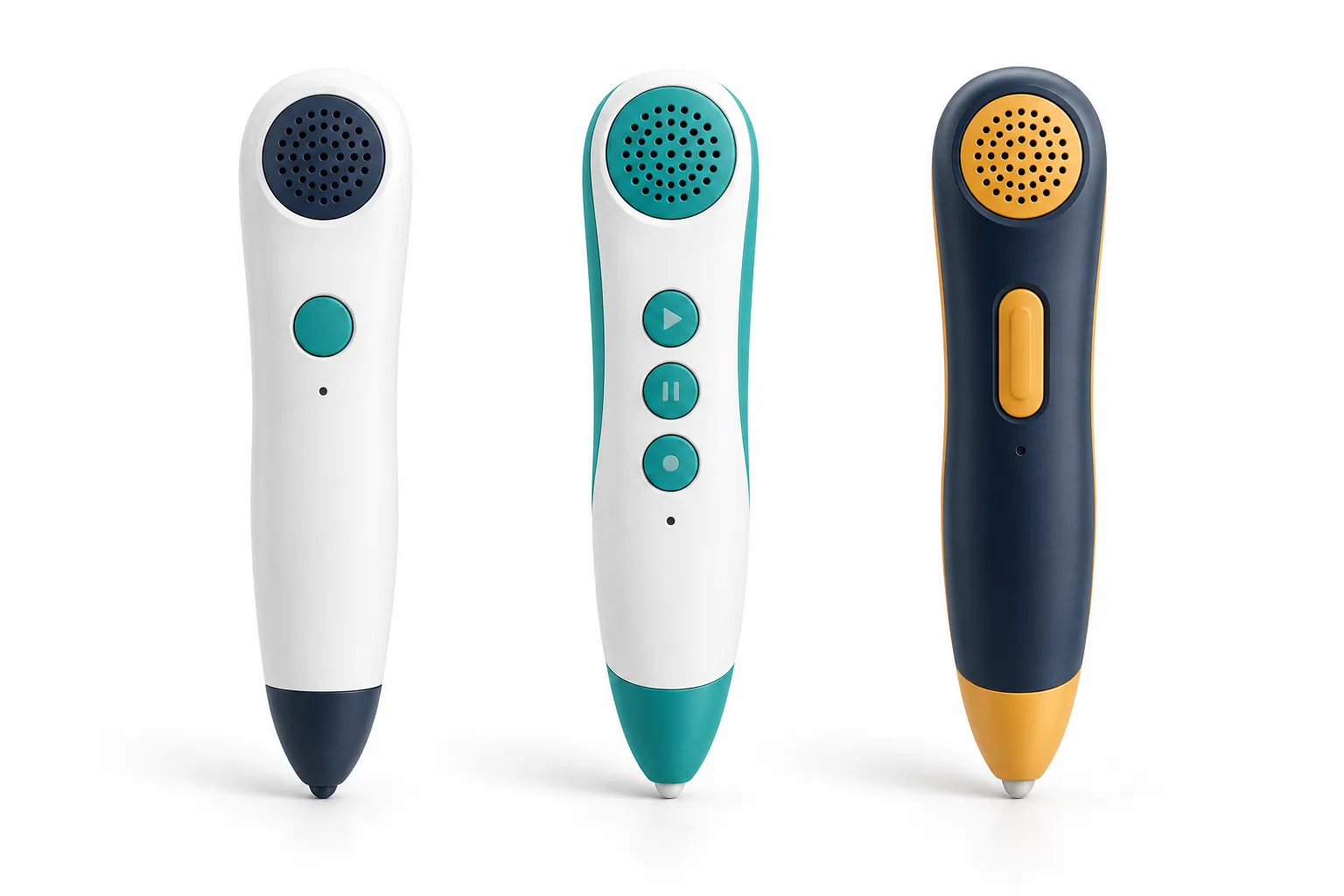
Publishers, language brands, curriculum owners, and educational distributors
Pen hardware, mapped audio, compatible print files, accessories, and packaging
Target market, age group, functions, content scope, quantity range, and timing
Product description
A custom talking pen is an educational audio device that recognizes coded points on compatible printed pages and plays the assigned word, sentence, instruction, song, or sound. The complete product combines the pen hardware, OID-coded books, mapped audio, firmware behavior, accessories, packaging, and controlled production files.
A useful OEM specification begins with the child’s interaction: what happens after a page is tapped, which controls are needed, how many talking pen books and languages are planned, and how the product will be sold and supported. Those decisions shape the sensor, memory, audio organization, printed dot-code files, charging, housing, packaging, and inspection criteria.
The optical reader identifies compatible OID activation points and plays the mapped audio assigned to each page, picture, word, or activity.
Talking pen books, early literacy, phonics, bilingual learning, classroom activities, reference sets, and multi-title publishing programs.
Book artwork, audio or scripts, target age, languages, controls, expected title library, branding, and packaging requirements.
Plan point-reading behavior, hotspot size, book identification, sensor response, and recognition checks using representative printed pages.
Add repeat, recording, phonics prompts, language switching, activity modes, or book-selection logic only when the learning design needs them.
Structure audio libraries, file names, OID page mapping, language variants, and revision control around the publisher’s workflow.
Coordinate housing color, logo application, accessories, inserts, retail packaging, and export cartons for the intended sales channel.
Use this framework to make supplier discussions, quotations, samples, and approvals more comparable.
| Decision area | What to define | Why it matters |
|---|---|---|
| Use case | Target age, subject, reading environment, activity flow | Prevents unnecessary functions and clarifies safety and usability priorities |
| Controls | Power, volume, repeat, record, language, book selection | Determines interface complexity and housing requirements |
| Content | Languages, audio duration, title count, update method | Guides memory planning and file-management workflow |
| Power | Battery approach, charging interface, usage pattern | Affects user experience, packaging, transport, and test planning |
| Talking pen books | Book size, page files, OID activation points, printer coordination | Recognition depends on the complete pen-and-print system |
| Packaging | Accessories, manual, tray, retail box, master carton | Protects the product and supports the target sales channel |
Clarify the reader, destination market, talking pen books, controls, languages, quantity, pack-out, and launch window.
Compare suitable talking pen platforms and make memory, charging, control, tooling, and cost trade-offs visible before sampling.
Review the pen with representative OID pages, mapped audio, controls, accessories, and early packaging.
Freeze approved hardware, OID files, audio package, appearance, accessories, checks, and shipment requirements.
Share your market, books, functions, content status, quantity range, packaging, and timing. We’ll use them to organize the questions that need answers before sampling.
Send Your RequirementsThese answers provide a planning basis. Final scope should always be confirmed for the exact product and destination market.
Yes. A custom program can coordinate the talking pen hardware, OID dot-code print files, mapped audio, firmware behavior, and integrated sample approval around your titles.
A talking pen normally recognizes prepared OID-coded areas in compatible books and plays pre-mapped audio. A scan reading pen may use OCR to scan ordinary printed text. Buyers should confirm which system matches their publishing workflow and learning activity.
The answer depends on the lesson flow. Repeat, recording, phonics prompts, language switching, and guided activities can be useful, but each function should be justified by the intended learner, content, and classroom or home use.
Color, logo treatment, accessories, inserts, and packaging can be reviewed as part of an OEM talking pen program. Feasibility, quantity, artwork, and production method should be confirmed before quotation.
Send your current requirements, even if some details are still open. A structured first review can identify the missing decisions before they delay sampling.