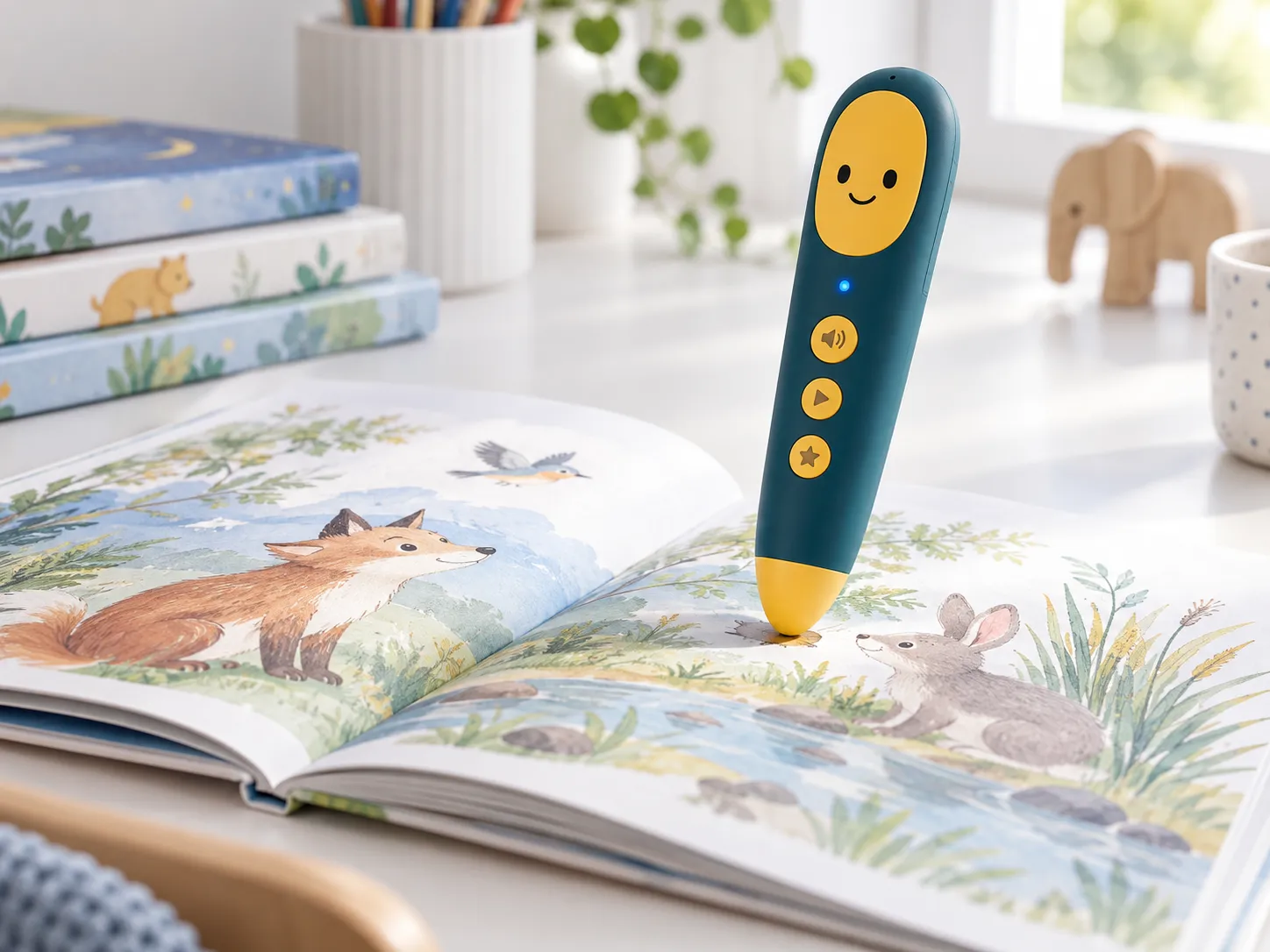
The best talking pen manufacturer is not necessarily the factory with the lowest unit price or the longest feature list. It is the supplier that can translate your learning concept into a controlled combination of hardware, audio files, printed dot-code materials, packaging, inspection criteria, and shipping documentation—while making risks visible before mass production.
Talking pens look simple from the outside. A child touches a printed page, and the pen plays the corresponding sound. For a publisher or education brand, however, that single action depends on several systems working together: the optical reading module, printed code, audio database, firmware logic, controls, speaker, battery, housing, and content-file workflow. A weakness in any one layer can create missed recognition, incorrect audio, rework, delays, or costly returns.
This checklist is written for buyers who are comparing OEM or ODM suppliers for educational books, early-learning programs, language products, or retail learning sets. It does not assume that every project needs the same configuration. Instead, it shows what to clarify, what evidence to request, and where a professional supplier should ask you better questions.
1. Define the learning program before requesting a price
A useful quotation starts with the application. If you request only “a talking pen price,” suppliers will make different assumptions about memory, battery, buttons, audio volume, accessories, printing, packaging, and inspection. The prices will look comparable, but the scope will not be comparable.
Begin with a short requirement brief that describes who will use the product, where it will be sold, and what the child should be able to do. A preschool picture-book set may prioritize simple controls, robust housing, predictable volume, and easy pairing. A language-learning program may need repeat, recording, mode switching, headphone output, or a larger content library. A classroom product may need a charging and file-management plan that differs from a retail gift set.
Minimum information for a first supplier discussion
- Target market and sales channel: country or region, retail, school, subscription, or direct-to-consumer.
- Intended user: age range, supervised or independent use, and expected session length.
- Printed product: book size, page count, number of titles, print partner, and artwork status.
- Learning functions: point-and-listen, repeat, recording, quizzes, modes, volume controls, or headphones.
- Content scope: languages, approximate audio count, total duration, naming structure, and update frequency.
- Commercial plan: sample deadline, estimated order range, launch window, packaging type, and replenishment expectation.
A strong manufacturer will use this brief to identify open decisions. If a supplier provides a final-looking quote without asking about the books, files, market, or packaging, treat that speed cautiously. It may indicate that critical work is excluded or that the factory expects the buyer to solve integration problems later.
2. Compare the talking pen platform, not just the appearance
Industrial design matters because children need a comfortable, intuitive product. Yet the visible shell is only one part of the decision. Buyers should compare the full platform: reading performance, audio output, controls, power, storage, file management, firmware behavior, and compatibility with the intended printed materials.
Recognition and reading behavior
Ask the supplier to demonstrate recognition on representative printed pages rather than a single perfect sample. Test near page edges, across light and dark artwork, at natural holding angles, and during repeated use. The correct goal is not an impressive laboratory demonstration; it is consistent behavior in the way a child will actually hold and move the pen.
Discuss the printable code layer early with both the manufacturer and printer. Confirm file formats, artwork handoff, proofing method, compatible print process, tolerances, and who owns final prepress approval. A hardware sample cannot validate a book file that has not been prepared using the agreed workflow.
Audio clarity and control logic
Listen for speech intelligibility, not simply loudness. Voice content should remain clear at the planned volume levels, and music or effects should not mask instructional language. Test startup sounds, prompts, error sounds, low-power behavior, and the transitions between modes. Button labels, icons, click feel, and firmware behavior should tell one coherent story.
Power, charging, and storage decisions
Battery and charging choices affect runtime, weight, transport, user instructions, service strategy, and compliance planning. Avoid comparing headline battery capacity alone. Ask how the battery is secured, charged, protected, and checked during production. Confirm what cable or charger is included and whether that inclusion changes the packaging or test scope.
For content storage, define the actual audio library instead of choosing memory by instinct. File format, bitrate, number of languages, prompts, future titles, and update method all affect the requirement. Leave controlled headroom, but do not pay for unused capacity because a specification sheet made “more memory” sound automatically better.
Have a book concept but no hardware specification?
Share the user, functions, content size, target market, and launch window. That is enough to organize a more useful first discussion.
3. Audit the audio and print-file workflow
Many talking pen delays begin outside the assembly line. Audio arrives with inconsistent names, revised artwork is not synchronized with the mapping table, or an approved voice file is replaced without version control. A manufacturer should be able to explain how files move from the buyer’s team into a sample, a pilot build, and the final production image.
Ask for a concrete file map
A practical mapping sheet should connect the printed activation area, code or identifier, audio filename, language, function, and revision. The exact format can vary, but the relationships should be unambiguous. A team member unfamiliar with the project should be able to trace why touching a specific page region plays a specific file.
Define naming rules before recording hundreds of files. Include title, page or activity, language, sequence, and revision information in a consistent pattern. Avoid filenames such as “final-new-2.mp3.” When multiple stakeholders review content, use one approved source of truth and record changes.
Test the complete sample, not separate pieces
A speaker test does not prove book recognition, and a digital proof does not prove the printed result. The approval sample should combine representative printed pages, the intended firmware behavior, mapped audio, actual controls, and the agreed housing. Use a written approval record that identifies the sample version and any remaining deviations.
During shipment inspection, select pages and functions from different parts of the library. Test startup, random recognition points, mode changes, volume, repeat or record behavior, charging, and shutdown. The plan should be detailed enough that an inspector can repeat it without relying on memory.
4. Verify how quality is defined and recorded
“100% QC” is not a quality plan. It does not say what was checked, how it was checked, what passed, what failed, or how results were recorded. Ask the manufacturer to separate incoming checks, in-process controls, functional testing, appearance criteria, packaging verification, and final shipment inspection.

Turn expectations into observable criteria
Quality requirements work best when they describe an observable result. “Good sound” is subjective; “specified reference audio plays clearly without rattle, interruption, or unexpected distortion at each approved volume level” is more actionable. “Nice appearance” should become a documented limit sample or written criteria for color, scratches, gaps, printing, and contamination.
For talking pens, a project-specific inspection plan may include:
- Optical recognition on a defined set of printed points and page conditions.
- Correct audio mapping and language for sampled content locations.
- Speaker clarity, volume-step behavior, and absence of abnormal noise.
- Button response, indicator lights, startup, shutdown, and mode logic.
- Charging behavior, connector fit, battery status, and included accessories.
- Housing fit, surface finish, tip condition, markings, and color consistency.
- Packaging contents, labels, manuals, quantity, carton marks, and protection.
Ask what happens when a check fails
The reaction plan matters as much as the inspection list. Who isolates affected units? How is the cause investigated? Is rework traceable? Which changes require buyer approval? How is the corrected result rechecked? A credible answer should describe responsibility and records, not merely promise that the problem will be fixed.
Shipment inspection should happen when the goods and packaging are sufficiently complete to evaluate the real order. If inspection occurs too early, important pack-out defects remain invisible. If it occurs after the shipment deadline leaves no recovery time, the process creates pressure to accept exceptions. Build inspection and correction time into the launch plan.
5. Treat compliance as a market-specific workstream
Talking pens may be evaluated under toy, electrical, battery, chemical, labeling, and other requirements depending on design, age grading, claims, included accessories, and destination. No supplier should promise universal compliance from a product photograph. The test plan must be confirmed for the actual configuration and market.
For the United States, the U.S. Consumer Product Safety Commission explains that ASTM F963 is a mandatory consumer product safety standard for children’s toys under federal rules. Buyers can start with the official CPSC toy safety business guidance, then confirm the current applicable sections, certification responsibilities, age grading, and laboratory plan for their product.
For the European market, requirements are changing over time, so buyers should use the current official information rather than copy an old checklist. The European Commission maintains a toy safety portal covering legislation and guidance. Electrical toy safety may also involve IEC 62115; the IEC publication page describes its scope. These links are starting points, not a substitute for advice from an accredited laboratory or compliance professional.
Evidence to request before production
Ask which exact model and configuration each report covers, including battery, charger or cable, materials, firmware-relevant behavior, and accessories where applicable. Check issue dates, laboratory identity, standard edition, photos, model references, and whether the report actually matches the product being quoted. A report for a visually similar pen is not automatically evidence for your version.
Agree who is responsible for samples, technical files, labels, warnings, user instructions, declarations, and importer information. Changes after testing—materials, battery, electronics, housing, or packaging—may affect the assessment. Establish a change-control rule so cost savings or component substitutions are not made silently.
6. Compare quotations on total project scope
A responsible comparison separates one-time development work, sample charges, tooling, unit price, accessories, packaging, printing-related work, testing, inspection, freight terms, and payment terms. Otherwise, the lowest headline price can become the highest landed project cost after exclusions appear.
| Quotation area | What to clarify | Common hidden mismatch |
|---|---|---|
| Hardware | Exact model, functions, color, memory, battery, accessories | Different configurations quoted under the same product name |
| Content | Audio mapping, language count, file preparation, revisions | Buyer assumes integration is included; supplier quotes hardware only |
| Printed materials | Dot-code file work, proofs, printing responsibility, page count | Book preparation or printing excluded |
| Packaging | Structure, artwork, inserts, labels, carton standard | Price based on generic packaging instead of retail pack-out |
| Quality | Inspection stages, test coverage, acceptance method, reports | “QC included” without project-specific criteria |
| Compliance | Market, standard scope, laboratory, model coverage, documents | Existing report does not cover the final configuration |
| Delivery | Incoterm, production basis, approval gates, shipment timing | Lead time begins later than the buyer assumes |
Minimum order quantity should also be discussed in context. A lower MOQ may carry higher per-unit costs or limit customization. A higher MOQ may unlock color, packaging, or tooling economics but increase inventory risk. Ask the supplier to show which decisions change at different quantity ranges rather than treating MOQ as a single negotiation point.
Lead time should be presented as a sequence: requirement confirmation, industrial design or color work, file preparation, first sample, sample revision, pilot approval, material preparation, production, inspection, and shipment. This is more reliable than a single number that starts only after every file and deposit is complete.
7. Questions to ask every shortlisted manufacturer
- Which talking pen platform best fits our use case, and what trade-offs rule out the others?
- What information do you need before issuing a comparable quotation?
- How are audio files, activation points, languages, and revisions mapped and approved?
- What does the printer need, and who checks the production-ready book files?
- Which parts of the sample represent final production, and which are temporary?
- What incoming, in-process, functional, appearance, and packaging checks will be recorded?
- How is a failed check contained, corrected, and verified?
- Which reports apply to the exact configuration, and what additional testing is expected for our market?
- How are material, battery, component, firmware, and packaging changes controlled after approval?
- What is excluded from the price, and which buyer actions can delay the schedule?
Pay attention to the quality of the questions you receive in return. Experienced project teams usually probe the target user, content status, printing partner, market, timing, and approval process. They explain dependencies and distinguish confirmed facts from assumptions. They do not hide uncertainty behind a catalog sheet.
Frequently asked questions
How many samples should a buyer expect?
There is no universal number. A straightforward program may move from an early functional sample to a production-confirmation sample. More customized hardware, packaging, or complex multilingual content may require additional rounds. Define the purpose and approval criteria for each sample so revisions do not become an open-ended loop.
Should the buyer provide finished audio before sampling?
Not always. Representative audio can validate early workflow and function, while final content develops in parallel. However, production approval should use controlled files that represent the real library structure, languages, prompts, and encoding choices.
Is an existing test report enough?
Only if a qualified reviewer confirms that it covers the relevant model, configuration, components, standards, market, and current requirements. Treat reports as specific evidence, not universal certificates.
What is the biggest avoidable risk?
Approving the pen, books, audio, and packaging as separate items without validating the complete system. Integration failures often appear only when real printed pages, mapped content, firmware, controls, accessories, and retail packaging come together.
Conclusion: choose the team that makes the work visible
A strong talking pen manufacturer makes the project easier to understand. The team should clarify assumptions, show dependencies, define approval gates, document file versions, translate quality expectations into checks, and explain what still needs validation. That transparency is more valuable than a long feature list or a promise that everything is possible.
Use the checklist above to compare suppliers on the complete program. Start with the learning experience, then align hardware, content, printing, compliance planning, packaging, inspection, and logistics. When those parts are planned together, the sample becomes more informative, the quotation becomes more comparable, and shipment inspection becomes a confirmation of agreed work rather than a search for surprises.
Ready to frame your talking pen project?
Send the target market, book format, desired functions, content scope, estimated quantity, and timing. We’ll help turn the idea into a structured requirement list.