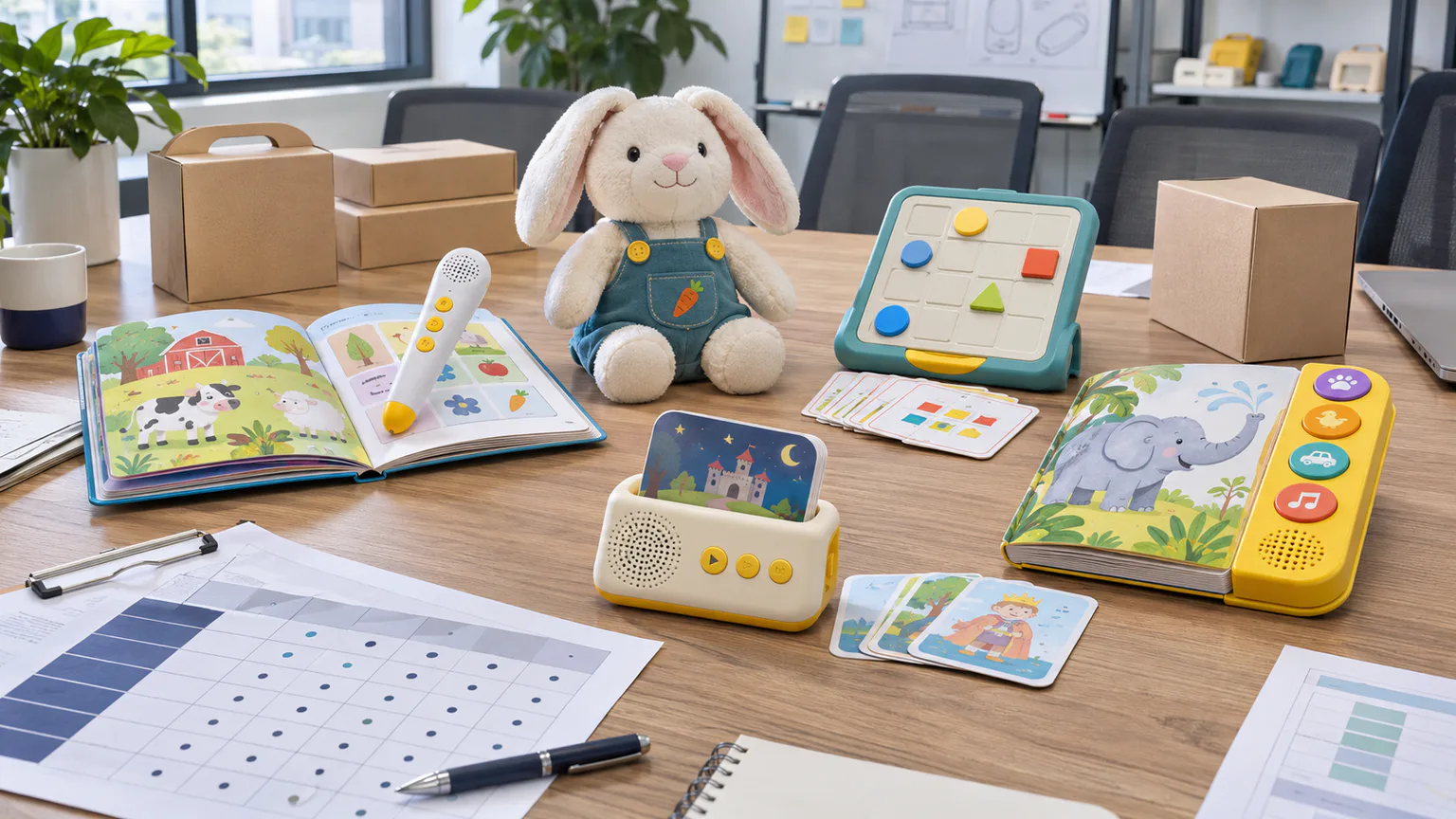
How to Shortlist Educational Toys Manufacturers for a Custom OEM Program: Shortlist educational toy manufacturers by matching their proven product system to your learning concept, content workflow, electronics, printed media, sample gates, quality controls, packaging, destination-market plan, and repeat-order needs. A useful shortlist compares like-for-like scope and evidence; it does not rank suppliers by catalog size, headline MOQ, or unit price alone.
The phrase “educational toy manufacturer” covers very different capabilities. One supplier may excel at molded electronics, another at soft goods, another at printed books, and another at system integration. For a custom program, the buyer must determine which disciplines are genuinely controlled, which are coordinated through partners, and which remain the buyer’s responsibility.
This guide is written for educational brands, publishers, distributors, retail buyers, and sourcing teams. It addresses the questions that normally appear between the first concept discussion and a production-ready quotation: product application, customer requirements, content ownership, sample purpose, factory testing, shipment inspection, packaging, and market-specific documentation. It does not present universal specifications because interactive toy OEM should be engineered around the final user, configuration, claims, sales market, and distribution plan.
For an overview of the available configuration and customization direction, review Cakub’s oem procurement product page. Buyers who are still comparing formats can also start with the interactive learning product range.
1. What should buyers understand first?
An interactive educational toy manufacturer converts a defined learning or play experience into a repeatable combination of hardware, firmware, audio, printed or soft components, accessories, labels, packaging, and inspection records. The relevant capability is not simply factory ownership; it is the ability to control the complete approved configuration and explain every handoff.
Practical buyer answer: Build a shortlist around product-category fit, then issue the same requirement pack and evidence questions to every candidate. Normalize scope before comparing cost, MOQ, sample timing, or production lead time.
The most reliable starting point is a one-page use-case description. State who uses the product, what physical action starts the interaction, what the product should do, what happens next, and how success is observed. This prevents a supplier from substituting a familiar standard product for a requirement that actually needs different electronics, files, construction, firmware, or packaging.
2. Where does this solution fit—and where does it not?
A multi-product educational brand may need one coordinating partner or several specialist suppliers. The right structure depends on technical overlap, content governance, launch sequence, and the buyer’s ability to manage interfaces.
| Decision question | Good fit when | Reconsider when |
|---|---|---|
| Does the supplier understand the user journey? | The team can translate a child’s action into hardware, content, feedback, safety, and test requirements. | The discussion remains limited to color, logo, and a catalog model number. |
| Can the complete product be sampled? | Electronics, audio, print or soft goods, accessories, and packaging can be reviewed as one production-intent set. | Different components are approved separately with no integrated verification. |
| Can repeat orders be controlled? | BOMs, source files, firmware, content maps, artwork, labels, and reference samples have revision identities. | The supplier relies on memory, chat history, or an unmarked physical sample. |
3. Which specification decisions change the project?
The shortlist should test how each candidate manages the interfaces where educational products most often fail.
1. Product-category specialization
Confirm whether the candidate’s repeatable capability covers talking pens, audio players, logic devices, talking plush, sound books, or the exact combination required. This decision should be closed before detailed quotation because it affects several downstream assumptions. For interactive toy OEM, the useful question is not whether a feature is available in theory, but how it will be implemented, approved, repeated in production, and checked before shipment.
2. Learning and content integration
Ask who converts scripts, audio, answer logic, OID mappings, card identities, button maps, and language versions into controlled production data. A supplier can only validate this point when the intended user action and acceptable response are observable. For interactive toy OEM, the useful question is not whether a feature is available in theory, but how it will be implemented, approved, repeated in production, and checked before shipment.
3. Engineering and sample ownership
Define who owns feasibility review, prototypes, tooling, firmware, mechanical files, sample comments, deviations, and final approval evidence. Treat this as a controlled product requirement rather than an informal preference in an email thread. For interactive toy OEM, the useful question is not whether a feature is available in theory, but how it will be implemented, approved, repeated in production, and checked before shipment.
4. Quality-control system
Request product-specific incoming, in-process, functional, appearance, packaging, and shipment checks with a reaction plan for failures. The approved sample should demonstrate this requirement with representative content and production-style materials. For interactive toy OEM, the useful question is not whether a feature is available in theory, but how it will be implemented, approved, repeated in production, and checked before shipment.
5. Compliance preparation
Identify destination markets, age grading, product claims, responsible economic operators, laboratory scope, labels, records, and change-control responsibilities. Document the decision in the specification, sample comments, and final inspection checklist so each team uses the same reference. For interactive toy OEM, the useful question is not whether a feature is available in theory, but how it will be implemented, approved, repeated in production, and checked before shipment.
6. Commercial transparency
Normalize development charges, tooling, unit scope, content work, print, accessories, packaging, tests, inspections, Incoterm, payment basis, exclusions, and validity. If the requirement is still open, ask the supplier to quote the alternatives separately instead of hiding the difference in one price. For interactive toy OEM, the useful question is not whether a feature is available in theory, but how it will be implemented, approved, repeated in production, and checked before shipment.
| Decision area | What to define | Approval evidence |
|---|---|---|
| Product-category specialization | Confirm whether the candidate’s repeatable capability covers talking pens, audio players, logic devices, talking plush, sound books, or the exact combination required. | Specification, approved sample, or controlled record |
| Learning and content integration | Ask who converts scripts, audio, answer logic, OID mappings, card identities, button maps, and language versions into controlled production data. | Specification, approved sample, or controlled record |
| Engineering and sample ownership | Define who owns feasibility review, prototypes, tooling, firmware, mechanical files, sample comments, deviations, and final approval evidence. | Specification, approved sample, or controlled record |
| Quality-control system | Request product-specific incoming, in-process, functional, appearance, packaging, and shipment checks with a reaction plan for failures. | Specification, approved sample, or controlled record |
| Compliance preparation | Identify destination markets, age grading, product claims, responsible economic operators, laboratory scope, labels, records, and change-control responsibilities. | Specification, approved sample, or controlled record |
| Commercial transparency | Normalize development charges, tooling, unit scope, content work, print, accessories, packaging, tests, inspections, Incoterm, payment basis, exclusions, and validity. | Specification, approved sample, or controlled record |
Match each product family with the correct manufacturing discipline
A broad sourcing search should lead to a specialist review. Compare the system requirements for custom reading pens, interactive talking plush, logic-learning devices, story card audio players, and interactive sound books before deciding whether one supplier can coordinate the portfolio.
Need a comparable supplier shortlist?
Send the product families, user age, markets, content status, quantity ranges, packaging expectations, and launch sequence.
4. What should the buyer prepare before requesting a quotation?
A useful quotation pack reduces assumptions without pretending every decision is final. It should distinguish confirmed requirements, preferred options, open questions, buyer-supplied files, supplier responsibilities, and items that will be approved through sampling. For interactive toy OEM, prepare the following:
- Portfolio brief: List every proposed SKU, user, interaction, content format, language, shared component, accessory, and planned launch wave.
- Responsibility matrix: Separate buyer, supplier, printer, content studio, laboratory, inspection company, and logistics responsibilities.
- Evidence request: Ask for relevant workflow examples, sample stages, file controls, test methods, change records, and shipment documentation without requesting confidential customer data.
Do not send a large folder without an index. Add a requirement sheet that lists every file, its revision, language, owner, intended use, and approval status. If the project contains many tracks, cards, pages, triggers, or modes, include a mapping table that connects the physical action to the expected response. This table becomes valuable during firmware review, factory testing, and shipment inspection.
5. How should development move from concept to shipment?
A disciplined sourcing process narrows suppliers through evidence before expensive customization begins.
- Confirm the requirement brief: Define the product application, learning outcome, user age, markets, content, quantity, packaging, launch sequence, and required supplier scope. Record open questions, the responsible party, and the required approval evidence before moving forward.
- Create the controlled map: Map every hardware, firmware, content, print, soft-goods, packaging, compliance, approval, and shipment responsibility to an owner. Use controlled filenames and revision dates so artwork, audio, firmware, components, and packaging cannot drift apart.
- Review feasibility and risk: Compare category experience, file control, prototype evidence, production controls, laboratory planning, capacity assumptions, and commercial exclusions. Review the result against the intended user journey, not only against an isolated component demonstration.
- Build a purpose-defined prototype: Issue the same representative challenge and requirement pack to shortlisted suppliers, then compare the questions, proposed architecture, evidence, and risks. Keep one approved reference and convert every comment into a measurable acceptance point.
- Approve a production-intent sample: Combine final-style product configuration, content, source files, materials, firmware, print or soft goods, accessories, labels, and packaging and close measurable comments before material release. Confirm that buyer-supplied files and factory-prepared files use the same version before releasing materials.
- Release controlled production files: Freeze the bill of materials, BOM, drawings, firmware register, content maps, artwork, labels, inspection plan, and responsibility matrix, packaging artwork, test method, and approval references. Do not compress the schedule by removing a validation gate; resolve the cause of delay and re-plan the critical path.
- Inspect and release the shipment: Sample across the order, reproduce representative user journeys, verify pack-out, and document disposition before dispatch. Before shipment, reproduce representative user actions and compare the packed product with the signed approval set.
The workflow should have visible gates. A concept sample proves feasibility; an engineering sample closes construction and function; a production-intent sample confirms controlled files, materials, firmware, audio, artwork, accessories, and packaging. Combining those purposes into one vague “sample” makes approval comments hard to interpret and makes schedule promises unreliable.
6. What should factory testing and shipment inspection cover?
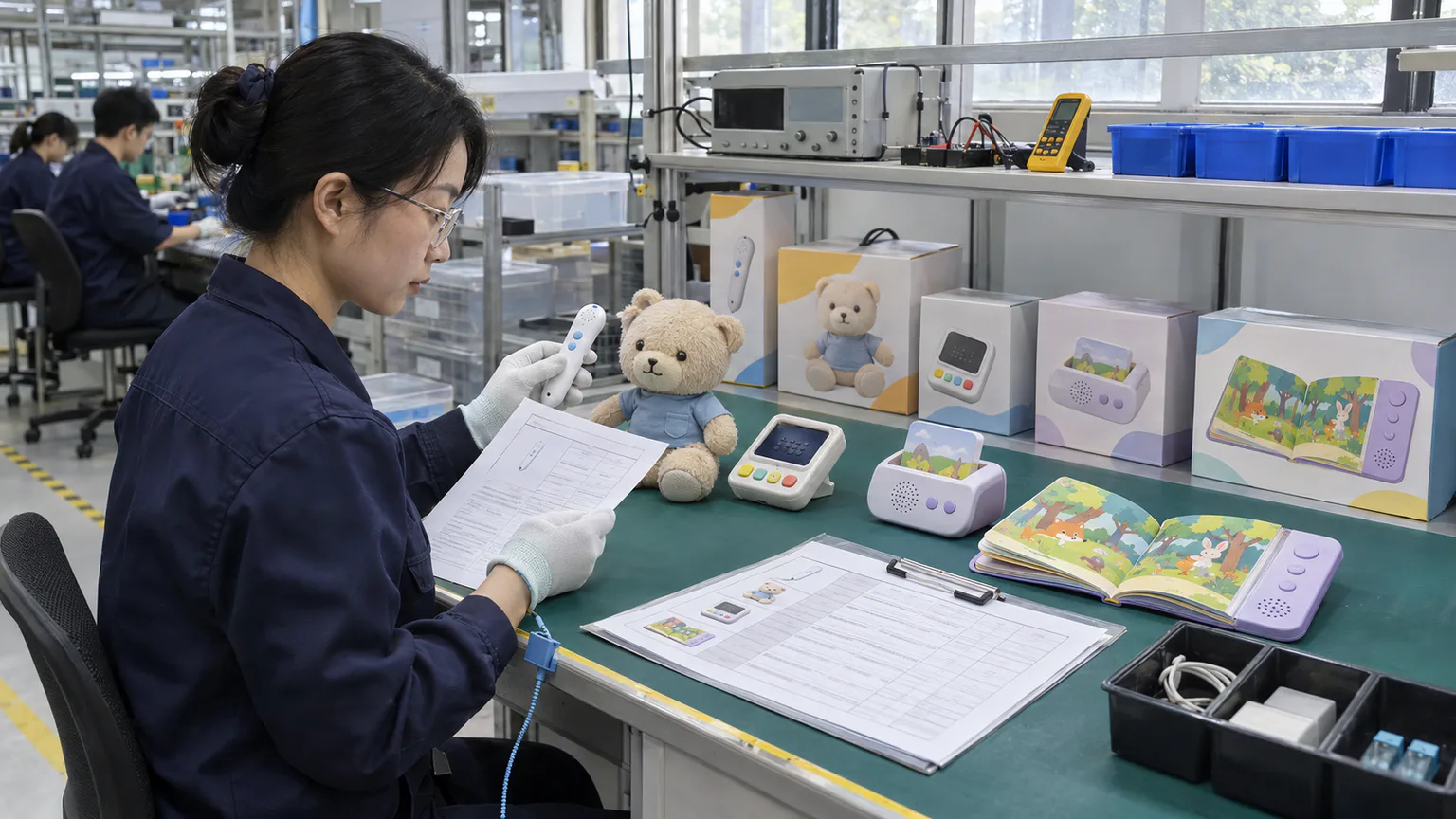
Supplier qualification should test the proposed product workflow, not rely on general factory photographs or unrelated certificates.
| Control point | Practical check | Evidence |
|---|---|---|
| Requirement interpretation | Give each candidate the same representative user journey and assess whether questions expose content, technical, safety, and commercial dependencies. | Record result, defect category, and sample identity |
| Integrated sample evidence | Review whether the proposed sample combines production-style hardware, content, materials, print or soft goods, labels, and packaging. | Record result, defect category, and sample identity |
| Control-plan evidence | Trace selected requirements into incoming checks, line fixtures, functional tests, defect criteria, records, and failed-lot response. | Record result, defect category, and sample identity |
| Repeat-order traceability | Ask how the supplier identifies approved versions, substitute components, engineering changes, production lots, cartons, and retained references. | Record result, defect category, and sample identity |
Testing frequency should be based on risk, process capability, component history, and the consequence of a failure. Some functions may justify a 100% production check, while appearance or packaging characteristics may be evaluated through a defined sampling plan. The ISO 28590 overview explains the role of acceptance sampling by attributes, but the buyer and inspection provider still need a written defect list, sampling basis, and accept/reject rules for the actual order.
Shipment inspection should use the approved product, controlled files, packing specification, label artwork, and purchase order as references. Inspectors should test content from different parts of the library rather than replaying one demonstration item. Allow time before the shipping deadline for containment, root-cause review, corrective action, and reinspection when needed.
See Cakub’s quality-control workflow for the broader sequence from incoming materials through shipment release, or review the factory capability page when evaluating production support.
7. How should safety and compliance planning be handled?
Compliance depends on intended use, age grading, materials, electronics, power source, wireless functions, sound output, accessories, packaging, claims, and destination market. Start planning before the final design because required tests, warnings, traceability marks, battery construction, or technical documentation can affect the product itself.
- U.S. CPSC toy safety guidance — use the current official text as a starting point for the final model and market.
- European Commission toy-safety information — use the current official text as a starting point for the final model and market.
- IEC 62115 electric-toy standard overview — use the current official text as a starting point for the final model and market.
- NAEYC technology and media guidance — use the current official text as a starting point for the final model and market.
Relevant official starting points for this topic include U.S. CPSC toy safety guidance, European Commission toy-safety information, IEC 62115 electric-toy standard overview, NAEYC technology and media guidance. These links do not determine the complete test plan. Ask an accredited laboratory or qualified compliance adviser to review the final configuration and the markets where the product will be placed. Keep reports, declarations, bills of materials, label approvals, and production identities connected to the exact model and revision.
8. How can buyers compare supplier quotations fairly?
Request one quotation matrix for every candidate so identical rows expose missing content work, tooling, accessories, tests, documents, packaging, inspections, freight assumptions, and buyer dependencies.
Normalize quotations into the same structure: product configuration, included content volume, electronic functions, materials, accessories, retail packaging, master-carton basis, development charges, sample rounds, tooling, testing, documentation, quantity, currency, Incoterm, payment assumptions, and validity period. Highlight every exclusion. Two unit prices are not comparable when one includes programmed content, printed media, accessories, or inspection support and the other does not.
9. Common mistakes that create avoidable delay or rework
Selecting by the longest catalog
A large catalog does not prove control of the exact interactive system, content workflow, or market documentation required. The practical correction is to add an owner, reference file, approval point, and inspection method before the order enters mass production.
Using one generic RFQ for unlike products
Talking pens, plush, logic devices, card players, and sound books have different file, test, construction, and packaging risks. The practical correction is to add an owner, reference file, approval point, and inspection method before the order enters mass production.
Accepting compliance claims without scope
A logo or certificate name is not evidence that the final model, materials, electronics, age, claims, and destination market are covered. The practical correction is to add an owner, reference file, approval point, and inspection method before the order enters mass production.
Comparing price before exclusions
A low quote can omit programming, print preparation, accessories, packaging, tests, tooling, or inspection support. The practical correction is to add an owner, reference file, approval point, and inspection method before the order enters mass production.
10. Frequently asked questions
How many educational toy manufacturers should a buyer shortlist?
There is no universal number. Retain enough qualified candidates to compare architecture, scope, evidence, commercial assumptions, and communication quality without creating an unmanageable sampling exercise.
Is an OEM or ODM supplier better for a first launch?
Choose by the required differentiation. A configured platform can reduce development work; deeper ODM changes may support stronger differentiation but require more engineering, testing, tooling, time, and approval control.
Should one supplier produce every product family?
Only when the supplier can demonstrate suitable category capability and control the interfaces. Specialist suppliers may be stronger, but the buyer then needs a clear integration and responsibility plan.
What evidence can replace a customer reference?
Review relevant process evidence: requirement templates, file registers, anonymous sample stages, control plans, test fixtures, defect examples, change records, and shipment-report formats.
When should price enter the decision?
Set a commercial range early, but compare final quotations only after the configuration, content, packaging, quality, documentation, quantity, and delivery basis are normalized.
Conclusion: approve a repeatable product system
The best shortlist is a risk-control tool. Select educational toy manufacturers that can make the proposed user experience, product data, sample evidence, production controls, and commercial scope visible before the order becomes difficult to change.
A successful interactive toy OEM project is not defined by a single attractive sample. It is defined by whether the approved user experience can be reproduced with controlled files, stable materials, clear workmanship criteria, suitable factory testing, traceable packaging, and a shipment-inspection method that reflects customer requirements. That is the standard buyers should use when comparing suppliers and deciding whether a project is ready for production.
Planning a custom interactive toy OEM project?
Send your target user, product format, content scope, market, quantity range, packaging, and launch timing for a structured project review.