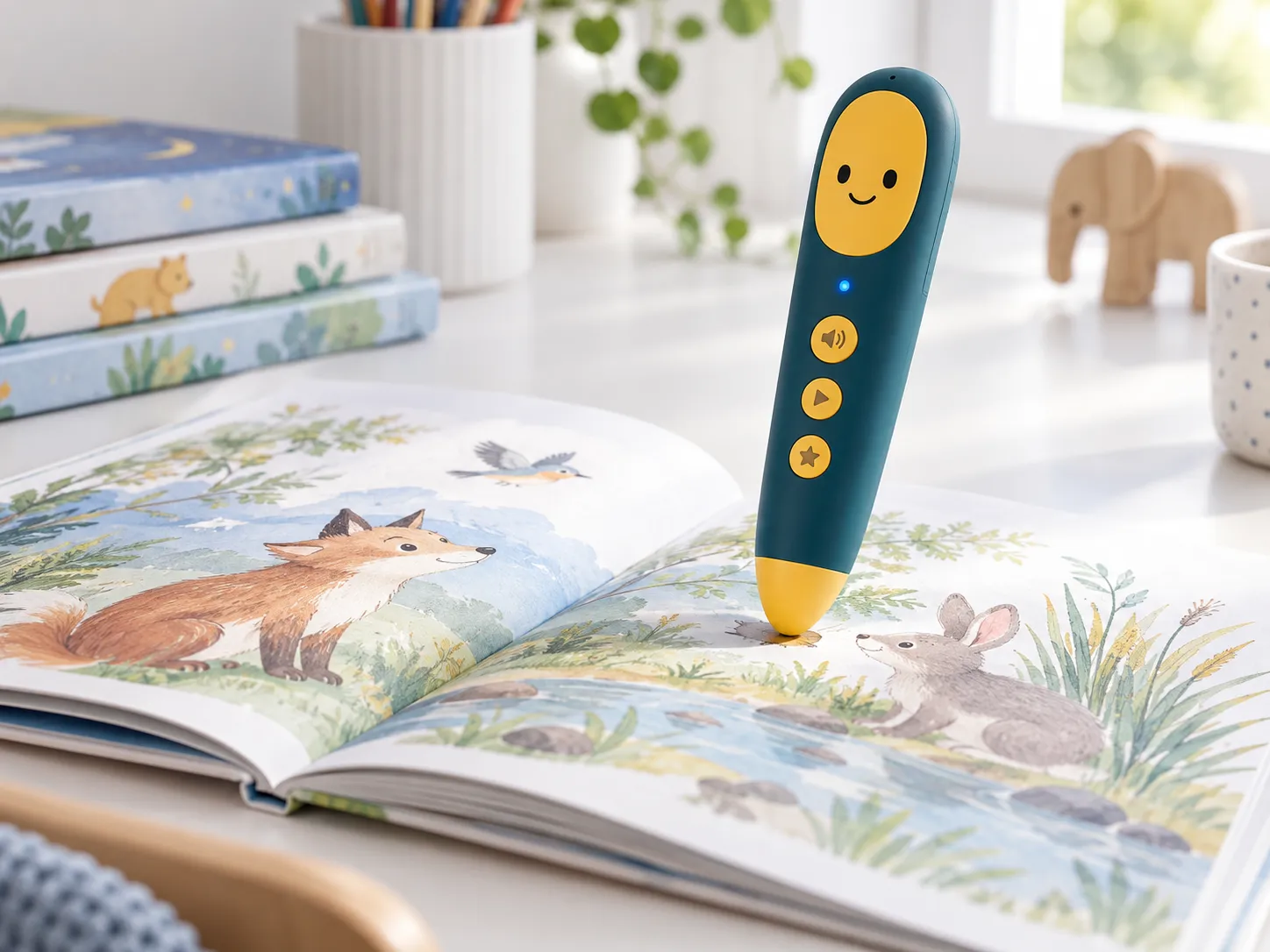
How to Prepare OID Dot-Code Files for Talking Pen Books: Prepare talking-pen book files by defining activation zones, assigning controlled identifiers, keeping the code layer separate from editable artwork, linking every zone to an approved audio response, producing a coded print proof, and releasing artwork, mapping, firmware, and audio under one revision.
Many talking-pen delays begin after the illustrations appear finished. The visible book may be complete, but the interactive layer still needs activation zones, identifiers, audio mapping, function icons, print controls, and approval evidence. Treating OID preparation as a final prepress effect can create recognition gaps and late artwork changes.
This guide is written for educational publishers, language-learning brands, curriculum developers, toy distributors, and sourcing teams. It addresses the questions that normally appear between the first concept discussion and a production-ready quotation: product application, customer requirements, content ownership, sample purpose, factory testing, shipment inspection, packaging, and market-specific documentation. It does not present universal specifications because talking-pen should be engineered around the final user, configuration, claims, sales market, and distribution plan.
For an overview of the available configuration and customization direction, review Cakub’s talking pens product page. Buyers who are still comparing formats can also start with the interactive learning product range.
1. What should buyers understand first?
An OID production package is a controlled set of artwork, machine-readable code data, activation-zone geometry, content mappings, function definitions, and output instructions. The exact technology varies by platform, so the supplier or authorized workflow provider should confirm how code is generated, placed, trapped, exported, printed, and verified.
Practical buyer answer: Keep the interactive layer traceable. An inspector should be able to start from a printed activation area, identify its mapping record, locate the approved audio file, and confirm the expected device behavior.
The most reliable starting point is a one-page use-case description. State who uses the product, what physical action starts the interaction, what the product should do, what happens next, and how success is observed. This prevents a supplier from substituting a familiar standard product for a requirement that actually needs different electronics, files, construction, firmware, or packaging.
2. Where does this solution fit—and where does it not?
A formal dot-code workflow is required when printed position determines content. The more pages, languages, games, and future titles involved, the more valuable controlled allocation and automated checks become.
| Decision question | Good fit when | Reconsider when |
|---|---|---|
| Are activation zones stable? | Page layout and touch areas can be frozen before code generation. | Artwork will continue moving icons and page elements after mapping. |
| Is the print process known? | Printer, screening, colors, finishes, and proof method can be reviewed with the platform owner. | Final production conditions are unknown or cannot be sampled. |
| Can mappings be audited? | Each zone has an ID, filename, language, function, revision, and owner. | Mappings exist only in screenshots or informal email comments. |

3. Which specification decisions change the project?
Prepress decisions determine whether the final page remains attractive while producing reliable recognition under ordinary child use.
1. Activation-zone geometry
Define boundaries, minimum practical size, spacing, edge behavior, overlaps, and how illustrations with several objects are divided. This decision should be closed before detailed quotation because it affects several downstream assumptions. For talking-pen, the useful question is not whether a feature is available in theory, but how it will be implemented, approved, repeated in production, and checked before shipment.
2. Identifier hierarchy
Allocate ranges by title, page, language, mode, function, and future expansion without reusing live codes. A supplier can only validate this point when the intended user action and acceptable response are observable. For talking-pen, the useful question is not whether a feature is available in theory, but how it will be implemented, approved, repeated in production, and checked before shipment.
3. Layer structure
Separate editable art, text, dielines, code pattern, technical marks, and non-printing notes with locked naming conventions. Treat this as a controlled product requirement rather than an informal preference in an email thread. For talking-pen, the useful question is not whether a feature is available in theory, but how it will be implemented, approved, repeated in production, and checked before shipment.
4. Color and screening
Confirm how the code pattern interacts with CMYK values, dark areas, special colors, varnish, lamination, and print resolution. The approved sample should demonstrate this requirement with representative content and production-style materials. For talking-pen, the useful question is not whether a feature is available in theory, but how it will be implemented, approved, repeated in production, and checked before shipment.
5. Proof approval
Use output that represents production screening and finishing, then test all risk areas with the intended pen. Document the decision in the specification, sample comments, and final inspection checklist so each team uses the same reference. For talking-pen, the useful question is not whether a feature is available in theory, but how it will be implemented, approved, repeated in production, and checked before shipment.
6. Change control
When artwork moves, determine which zones, mappings, proofs, firmware, audio indexes, and inspection files must be revised. If the requirement is still open, ask the supplier to quote the alternatives separately instead of hiding the difference in one price. For talking-pen, the useful question is not whether a feature is available in theory, but how it will be implemented, approved, repeated in production, and checked before shipment.
| Decision area | What to define | Approval evidence |
|---|---|---|
| Activation-zone geometry | Define boundaries, minimum practical size, spacing, edge behavior, overlaps, and how illustrations with several objects are divided. | Specification, approved sample, or controlled record |
| Identifier hierarchy | Allocate ranges by title, page, language, mode, function, and future expansion without reusing live codes. | Specification, approved sample, or controlled record |
| Layer structure | Separate editable art, text, dielines, code pattern, technical marks, and non-printing notes with locked naming conventions. | Specification, approved sample, or controlled record |
| Color and screening | Confirm how the code pattern interacts with CMYK values, dark areas, special colors, varnish, lamination, and print resolution. | Specification, approved sample, or controlled record |
| Proof approval | Use output that represents production screening and finishing, then test all risk areas with the intended pen. | Specification, approved sample, or controlled record |
| Change control | When artwork moves, determine which zones, mappings, proofs, firmware, audio indexes, and inspection files must be revised. | Specification, approved sample, or controlled record |
Have book artwork ready for interactivity?
Send a representative spread and audio index. We can identify the file, mapping, and proof questions to close before quotation.
4. What should the buyer prepare before requesting a quotation?
A useful quotation pack reduces assumptions without pretending every decision is final. It should distinguish confirmed requirements, preferred options, open questions, buyer-supplied files, supplier responsibilities, and items that will be approved through sampling. For talking-pen, prepare the following:
- Layered artwork: Provide editable source files, fonts or outlined text, linked images, dielines, and a clean content index.
- Activation brief: Mark every touchable area and describe normal, repeat, quiz, navigation, and language behavior.
- Print information: State printing method, printer responsibility, paper or board, finishes, binding, and expected proof route.
- Market and age grading: List destination countries, intended user age, sales channel, product claims, and any buyer-specific compliance manual.
- Commercial range: Provide forecast quantity, launch quantity, packaging format, delivery window, and preferred shipping basis.
- Ownership and approvals: Identify who owns artwork and audio, who approves firmware behavior, and who signs the production-intent sample.
Do not send a large folder without an index. Add a requirement sheet that lists every file, its revision, language, owner, intended use, and approval status. If the project contains many tracks, cards, pages, triggers, or modes, include a mapping table that connects the physical action to the expected response. This table becomes valuable during firmware review, factory testing, and shipment inspection.
5. How should development move from concept to shipment?
The safest sequence freezes the visible layout before final code generation, then proves the code through the intended print and finishing process.
- Confirm the requirement brief: Identify titles, pages, languages, functions, touch areas, printing route, and approval responsibilities. Record open questions, the responsible party, and the required approval evidence before moving forward.
- Create the controlled map: Build a zone-and-ID table that links artwork location, code, filename, language, and device response. Use controlled filenames and revision dates so artwork, audio, firmware, components, and packaging cannot drift apart.
- Review feasibility and risk: Review zone size, spacing, dark artwork, page edges, folds, finishing, and identifier capacity with prepress and firmware teams. Review the result against the intended user journey, not only against an isolated component demonstration.
- Build a purpose-defined prototype: Produce representative coded print proofs that include crowded zones, dark colors, edges, functions, and several pages. Keep one approved reference and convert every comment into a measurable acceptance point.
- Approve a production-intent sample: Combine final-style final artwork, code layers, zone map, audio index, proof pages, pen firmware, and binding sample and close measurable comments before material release. Confirm that buyer-supplied files and factory-prepared files use the same version before releasing materials.
- Release controlled production files: Freeze the bill of materials, artwork packages, code layers, identifier register, mapping table, print settings, packaging artwork, test method, and approval references. Do not compress the schedule by removing a validation gate; resolve the cause of delay and re-plan the critical path.
- Inspect and release the shipment: Sample across the order, reproduce representative user journeys, verify pack-out, and document disposition before dispatch. Before shipment, reproduce representative user actions and compare the packed product with the signed approval set.
The workflow should have visible gates. A concept sample proves feasibility; an engineering sample closes construction and function; a production-intent sample confirms controlled files, materials, firmware, audio, artwork, accessories, and packaging. Combining those purposes into one vague “sample” makes approval comments hard to interpret and makes schedule promises unreliable.
6. What should factory testing and shipment inspection cover?
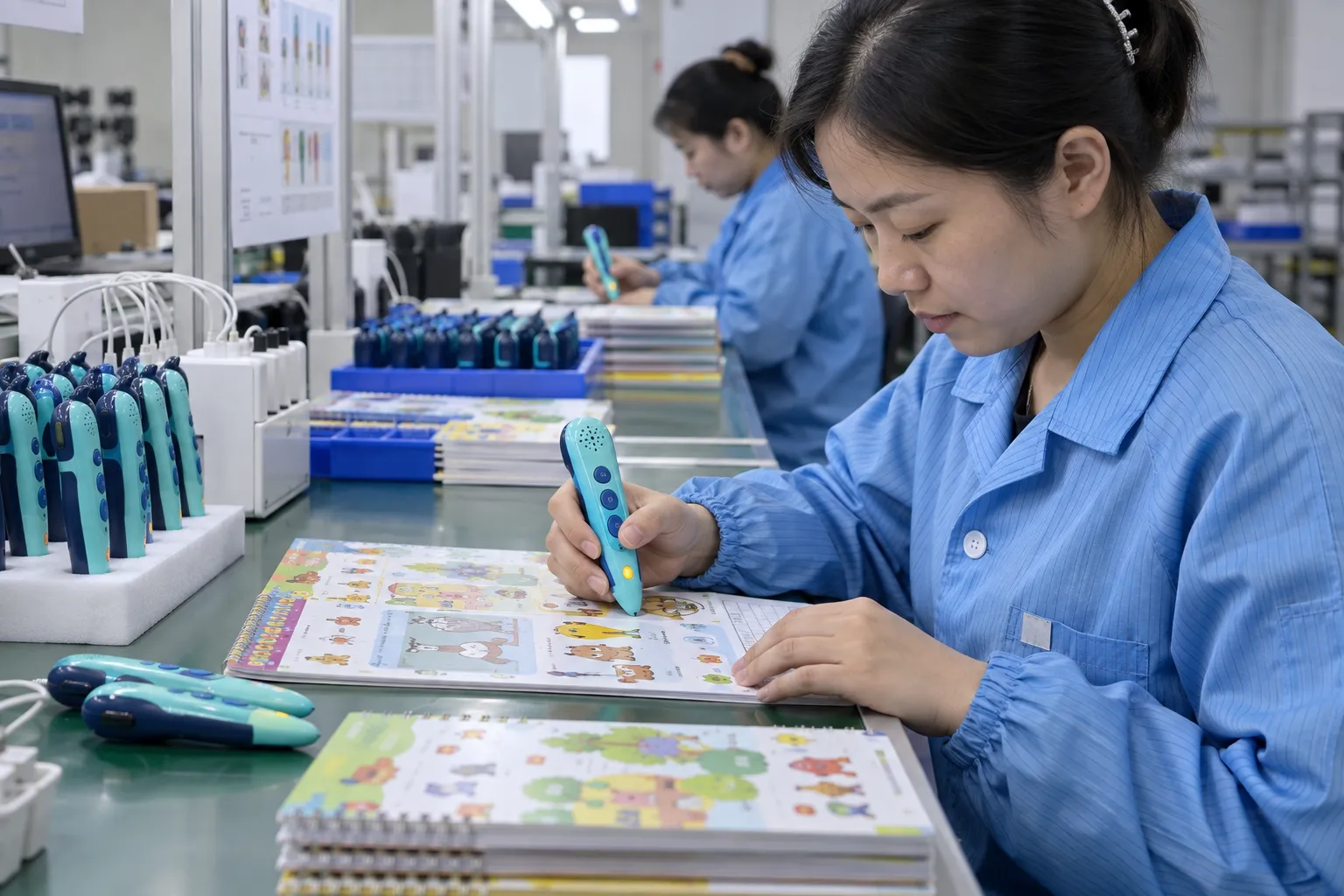
File inspection should verify both digital traceability and physical recognition. Neither one is sufficient by itself.
| Control point | Practical check | Evidence |
|---|---|---|
| Layer integrity | Confirm the correct code layer, scale, page position, visibility settings, and export preset on every production page. | Record result, defect category, and sample identity |
| Zone boundary | Touch centers and edges, adjacent objects, narrow areas, page edges, folds, and blank regions. | Record result, defect category, and sample identity |
| Print variation | Compare early, middle, and late sheets or books for recognition consistency and visible pattern changes. | Record result, defect category, and sample identity |
| Revision match | Verify the printed revision matches the mapping database, audio package, firmware, approval proof, and inspection list. | Record result, defect category, and sample identity |
| Recognition consistency | Activate representative points across pages, edges, colors, and different positions in the content library. | Record result, defect category, and sample identity |
| Audio and controls | Verify track mapping, clarity, volume steps, buttons, charging behavior, and low-power response. | Record result, defect category, and sample identity |
| Print-to-device match | Compare coded production pages, controlled mapping data, firmware, and the approved pen. | Record result, defect category, and sample identity |
| Retail pack-out | Confirm accessories, instructions, labels, inserts, protective fit, barcode placement, and carton quantity. | Record result, defect category, and sample identity |
Testing frequency should be based on risk, process capability, component history, and the consequence of a failure. Some functions may justify a 100% production check, while appearance or packaging characteristics may be evaluated through a defined sampling plan. The ISO 28590 overview explains the role of acceptance sampling by attributes, but the buyer and inspection provider still need a written defect list, sampling basis, and accept/reject rules for the actual order.
Shipment inspection should use the approved product, controlled files, packing specification, label artwork, and purchase order as references. Inspectors should test content from different parts of the library rather than replaying one demonstration item. Allow time before the shipping deadline for containment, root-cause review, corrective action, and reinspection when needed.
See Cakub’s quality-control workflow for the broader sequence from incoming materials through shipment release, or review the factory capability page when evaluating production support.
7. How should safety and compliance planning be handled?
Compliance depends on intended use, age grading, materials, electronics, power source, wireless functions, sound output, accessories, packaging, claims, and destination market. Start planning before the final design because required tests, warnings, traceability marks, battery construction, or technical documentation can affect the product itself.
- U.S. CPSC toy safety guidance — use the current official text as a starting point for the final model and market.
- European Commission toy-safety information — use the current official text as a starting point for the final model and market.
- IEC 62115 electric-toy standard overview — use the current official text as a starting point for the final model and market.
Relevant official starting points for this topic include U.S. CPSC toy safety guidance, European Commission toy-safety information, IEC 62115 electric-toy standard overview. These links do not determine the complete test plan. Ask an accredited laboratory or qualified compliance adviser to review the final configuration and the markets where the product will be placed. Keep reports, declarations, bills of materials, label approvals, and production identities connected to the exact model and revision.
8. How can buyers compare supplier quotations fairly?
Quotations should state whether code generation, mapping, preflight, coded proofs, printing, binding, firmware preparation, and final book-to-pen testing are included or supplied by separate parties.
Normalize quotations into the same structure: product configuration, included content volume, electronic functions, materials, accessories, retail packaging, master-carton basis, development charges, sample rounds, tooling, testing, documentation, quantity, currency, Incoterm, payment assumptions, and validity period. Highlight every exclusion. Two unit prices are not comparable when one includes programmed content, printed media, accessories, or inspection support and the other does not.
9. Common mistakes that create avoidable delay or rework
Adding code after final export
Flattened or compressed artwork may remove editability and make zone changes difficult to audit. The practical correction is to add an owner, reference file, approval point, and inspection method before the order enters mass production.
Moving artwork after mapping
Even small layout changes can place an identifier under the wrong object or create gaps between visual and active areas. The practical correction is to add an owner, reference file, approval point, and inspection method before the order enters mass production.
Ignoring dark and finished surfaces
Recognition behavior should be proven in high-risk colors and with the real varnish or lamination. The practical correction is to add an owner, reference file, approval point, and inspection method before the order enters mass production.
Approving files without a printed sample
A correct layer list does not prove production screening, scale, finishing, and sensor response. The practical correction is to add an owner, reference file, approval point, and inspection method before the order enters mass production.
10. Frequently asked questions
Who creates the OID code layer?
The answer depends on the platform and commercial arrangement. It may be prepared by the device supplier, a licensed workflow provider, the printer, or a trained publisher team, but ownership and revision responsibility should be explicit.
Can OID code be added to existing artwork?
Often yes, if editable production files, suitable print conditions, and stable layouts are available. A feasibility proof should test representative colors, finishes, edges, and zone sizes before converting a full title.
Does every word need a unique code?
Only if every word requires an independent response. Grouping words, sentences, illustrations, and navigation areas should follow the learning design and the practical limits of the selected platform.
How should languages be organized?
Use separate identifiers, content packages, modes, or editions according to the user flow. Keep language, filename, voice approval, and printed edition visible in the mapping table.
What should a coded proof include?
Include crowded zones, dark areas, page edges, small icons, navigation functions, representative paper, finishing, binding effects, and several parts of the identifier range.
Conclusion: approve a repeatable product system
Treat OID preparation as publishing engineering. Controlled activation zones, identifier governance, layered artwork, representative print proofs, and version-matched inspection protect both recognition quality and the publisher’s ability to expand the library.
A successful talking-pen project is not defined by a single attractive sample. It is defined by whether the approved user experience can be reproduced with controlled files, stable materials, clear workmanship criteria, suitable factory testing, traceable packaging, and a shipment-inspection method that reflects customer requirements. That is the standard buyers should use when comparing suppliers and deciding whether a project is ready for production.
Planning a custom talking-pen project?
Send your target user, product format, content scope, market, quantity range, packaging, and launch timing for a structured project review.