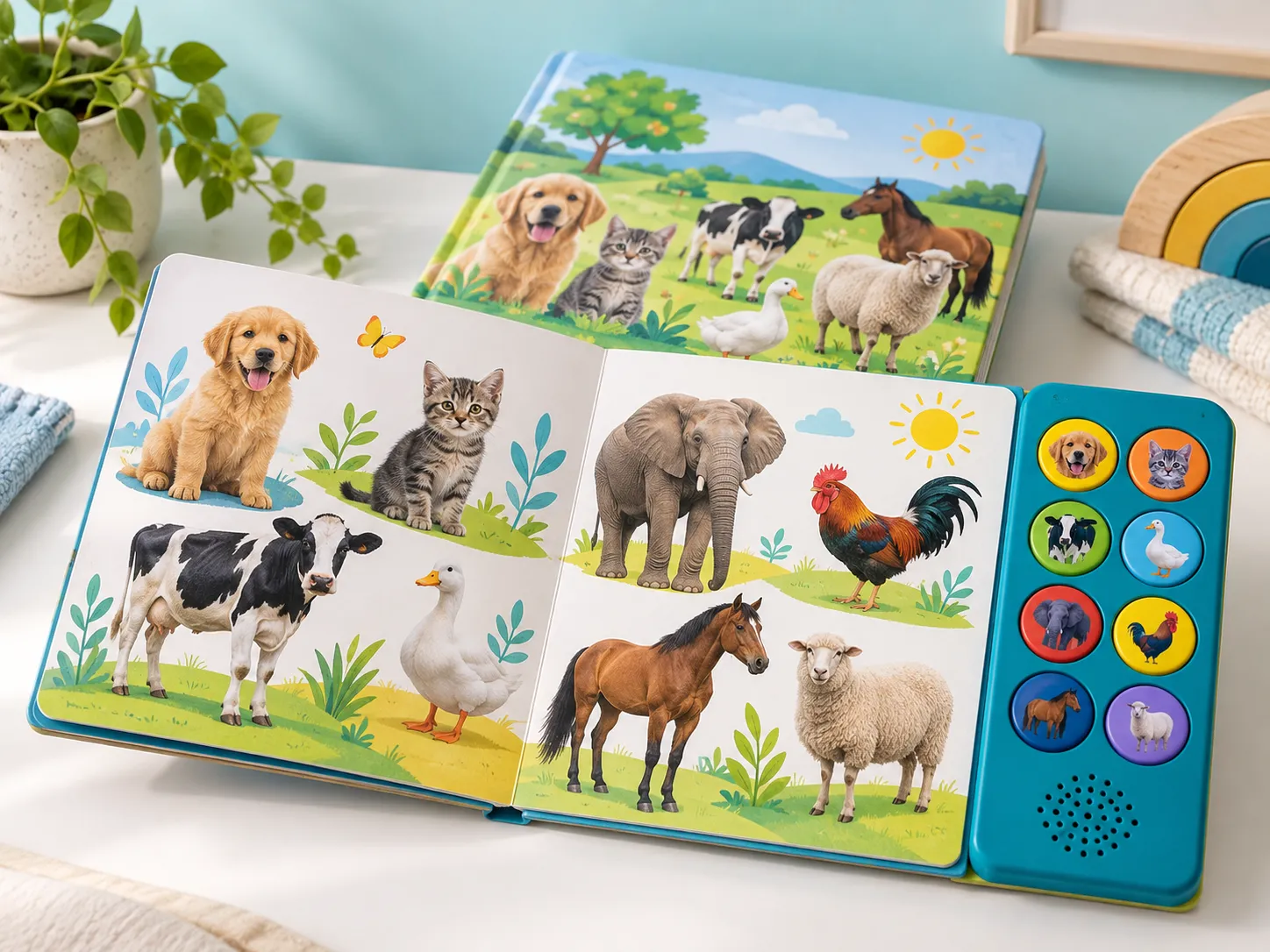
Sound Book vs Talking Pen: Which Format Fits a Publisher?: a sound book and a talking-pen publishing system solve different parts of the buyer’s objective. A sound book is self-contained and easy to demonstrate, while a talking pen can support deeper point-level interaction and a multi-title expansion library. Compare them by user action, content type, adult role, portability, update model, manufacturing system, quality controls, packaging, and lifecycle economics rather than asking which format is universally better.
Both formats connect print and audio, but they create different product lines. One integrates electronics into each book; the other separates the reusable reader from coded printed titles. A useful comparison begins with the program, not the product label. The same content may need different writing, artwork, audio, interaction, and inspection when moved between formats.
This guide is for children’s publishers, museum shops, educational brands, gift companies, retailers, and print sourcing teams. It connects product application, customer requirements, controlled content, factory testing, shipment inspection, packaging, and market documentation without treating one configuration as universal.
For an overview of the available configuration and customization direction, review Cakub’s sound books product page. Buyers who are still comparing formats can also start with the interactive learning product range.
1. What should buyers understand first?
a sound book is best understood as a printed book with an integrated sound module and fixed buttons or switches mapped to audio. a talking-pen publishing system is a reusable electronic pen that reads coded points across one or more compatible printed books. These definitions establish the primary interaction; actual configurations can add controls, audio, printed media, accessories, or expansion systems.
Practical buyer answer: Choose a sound book when one self-contained title, direct buttons, gift presentation, and simple demonstration are the priority. Choose a talking-pen publishing system when point-level interaction, multiple compatible titles, deeper audio mapping, and an expandable catalog justify a reusable platform. A coordinated portfolio may use both when each has a distinct role and shared content is managed through stable IDs and format-specific adaptation.
2. Where does this solution fit—and where does it not?
The decision should use a weighted brief based on real customer requirements. The following questions expose the most important differences.
| Decision question | Good fit when | Reconsider when |
|---|---|---|
| What is the main user action? | a sound book: turn a page and press a defined physical button associated with the page or sequence | a talking-pen publishing system: point the pen at coded illustrations, words, icons, games, or controls throughout the printed content |
| How is content organized? | a sound book: a finite button count and fixed integrated audio library approved with one book edition | a talking-pen publishing system: many hotspots, modes, books, languages, audio assets, OID data, firmware compatibility, and expansion titles |
| What operating model fits? | a sound book: each book carries its own electronics, battery, module assembly, test, pack, inventory, and reprint controls | a talking-pen publishing system: pens and books can be bundled or replenished separately, requiring catalog compatibility, programming, replacements, and platform support |
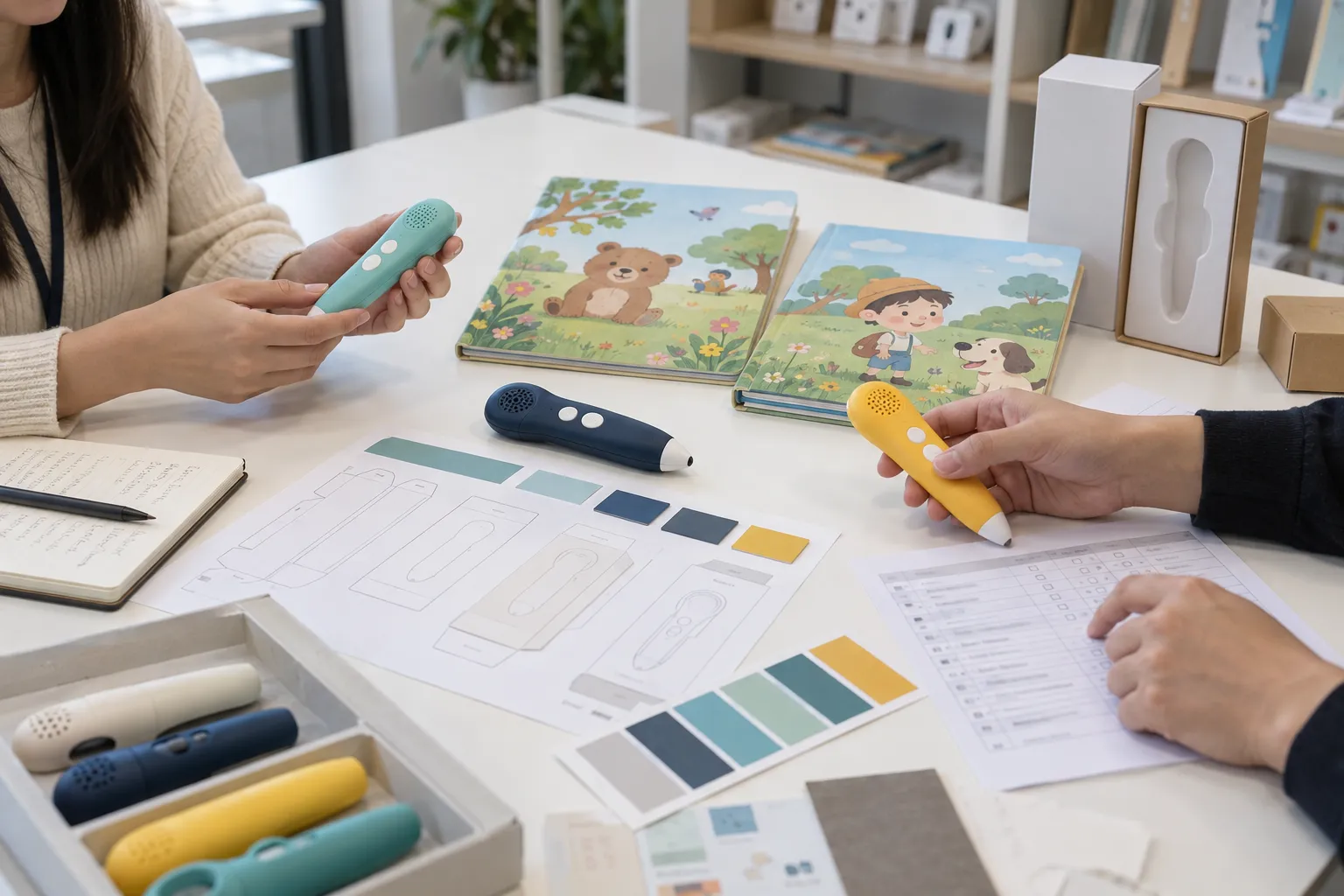
3. Which specification decisions change the project?
A comparison is only fair when both formats are evaluated against the same age, market, content, quality, packaging, quantity, and delivery assumptions.
1. User journey
Map setup, discovery, turn a page and press a defined physical button associated with the page or sequence or point the pen at coded illustrations, words, icons, games, or controls throughout the printed content, feedback, repetition, completion, reset, adult help, and storage. Record the decision, owner, approval reference, and verification method for the final sound book configuration.
2. Content depth and navigation
Compare a finite button count and fixed integrated audio library approved with one book edition with many hotspots, modes, books, languages, audio assets, OID data, firmware compatibility, and expansion titles, including sequence, discoverability, language, expansion, and update control. Record the decision, owner, approval reference, and verification method for the final sound book configuration.
3. Age and physical interaction
Evaluate grip, force, fine-motor demand, orientation, readability, page or piece handling, independent use, and likely misuse for the intended age. Record the decision, owner, approval reference, and verification method for the final sound book configuration.
4. Production system
Compare the controlled hardware, firmware, audio, print or media, mapping, assembly, fixtures, line tests, packaging, and supplier capabilities required by each format. Record the decision, owner, approval reference, and verification method for the final sound book configuration.
5. Channel and lifecycle
Review each book carries its own electronics, battery, module assembly, test, pack, inventory, and reprint controls versus pens and books can be bundled or replenished separately, requiring catalog compatibility, programming, replacements, and platform support, replenishment, replacement, returns, content releases, shelf presentation, and support. Record the decision, owner, approval reference, and verification method for the final sound book configuration.
6. Commercial comparison
Normalize development fees, tooling, content adaptation, sample rounds, MOQ by SKU, unit pack, master carton, test scope, Incoterm, and lifecycle inventory. Record the decision, owner, approval reference, and verification method for the final sound book configuration.
| Decision area | What to define | Approval evidence |
|---|---|---|
| User journey | Map setup, discovery, turn a page and press a defined physical button associated with the page or sequence or point the pen at coded illustrations, words, icons, games, or controls throughout the printed content, feedback, repetition, completion, reset, adult help, and storage. | Specification, approved sample, or controlled record |
| Content depth and navigation | Compare a finite button count and fixed integrated audio library approved with one book edition with many hotspots, modes, books, languages, audio assets, OID data, firmware compatibility, and expansion titles, including sequence, discoverability, language, expansion, and update control. | Specification, approved sample, or controlled record |
| Age and physical interaction | Evaluate grip, force, fine-motor demand, orientation, readability, page or piece handling, independent use, and likely misuse for the intended age. | Specification, approved sample, or controlled record |
| Production system | Compare the controlled hardware, firmware, audio, print or media, mapping, assembly, fixtures, line tests, packaging, and supplier capabilities required by each format. | Specification, approved sample, or controlled record |
| Channel and lifecycle | Review each book carries its own electronics, battery, module assembly, test, pack, inventory, and reprint controls versus pens and books can be bundled or replenished separately, requiring catalog compatibility, programming, replacements, and platform support, replenishment, replacement, returns, content releases, shelf presentation, and support. | Specification, approved sample, or controlled record |
| Commercial comparison | Normalize development fees, tooling, content adaptation, sample rounds, MOQ by SKU, unit pack, master carton, test scope, Incoterm, and lifecycle inventory. | Specification, approved sample, or controlled record |
Compare a sound book and a talking-pen publishing system for your program
Send the target user, content concept, market, channel, quantity range, packaging, and launch schedule for a structured comparison.
4. What should the buyer prepare before requesting a quotation?
A useful quotation pack reduces assumptions without pretending every decision is final. It should distinguish confirmed requirements, preferred options, open questions, buyer-supplied files, supplier responsibilities, and items that will be approved through sampling. For sound book, prepare the following:
- Weighted decision matrix: List mandatory and preferred criteria, importance, evidence needed, and how each format will be scored.
- Common content sample: Provide one representative lesson, story, activity, or topic so both formats can be evaluated with equivalent source material.
- Commercial scenarios: Compare launch and forecast quantities by SKU, one-time investment, packaging, freight basis, replenishment, replacement, and future content.
- Book specification: Provide trim size, page count, binding, board or paper construction, button count, module position, and target age.
- Artwork and audio index: List page, printed prompt, button or switch position, filename, language, duration, and current revision.
- Market and commercial plan: State destination countries, quantity range, retail packaging, launch timing, battery choice, and inspection expectations.
5. How should development move from concept to shipment?
Run format selection as a short discovery and prototype process rather than committing from catalogue photos or unit prices.
- Confirm the requirement brief: Define the user, application, content, market, channel, adult role, quantity, launch timing, and decision weights shared by a sound book and a talking-pen publishing system. Record the responsible party, open questions, and approval evidence.
- Create the controlled map: Map the same source content into each format’s physical action, identifier or button, response, audio, artwork, progression, completion, and reset. Record the responsible party, open questions, and approval evidence.
- Review feasibility and risk: Review usability, content limits, component and file dependencies, failure modes, manufacturing maturity, packaging, compliance planning, inventory, and support. Record the responsible party, open questions, and approval evidence.
- Build a purpose-defined prototype: Build or evaluate representative samples of both formats under equivalent content and use conditions; record evidence against the decision matrix. Record the responsible party, open questions, and approval evidence.
- Approve a production-intent sample: Combine final-style a sound book and a talking-pen publishing system samples, adapted content, audio, artwork, mappings, power systems, accessories, instructions, and packaging and close measurable comments before material release. Record the responsible party, open questions, and approval evidence.
- Release controlled production files: Freeze the bill of materials, decision matrix, common brief, format-specific content maps, sample findings, normalized quotation, risk register, and approval record, packaging artwork, test method, and approval references. Record the responsible party, open questions, and approval evidence.
- Inspect and release the shipment: Sample across the order, reproduce representative user journeys, verify pack-out, and document disposition before dispatch. Record the responsible party, open questions, and approval evidence.

6. What should factory testing and shipment inspection cover?
Comparison testing should use equivalent objectives but format-appropriate actions. Do not penalize a format for failing to imitate the other format’s core interaction.
| Control point | Practical check | Evidence |
|---|---|---|
| User-task comparison | Observe setup, discovery, intended action, response understanding, repetition, completion, adult prompts, error recovery, and storage. | Record result, defect category, and sample identity |
| Content implementation | Check equivalent meaning, language, audio, artwork, mapping, difficulty, sequence, and navigation after adapting source content to each format. | Record result, defect category, and sample identity |
| Production-risk comparison | Review parts, print or media, firmware, mapping, assembly, tolerances, fixtures, tests, defect modes, pack-out, and traceability. | Record result, defect category, and sample identity |
| Commercial normalization | Compare the same quantities, SKU split, inclusions, development, tooling, tests, packaging, Incoterm, lead-time assumptions, and exclusions. | Record result, defect category, and sample identity |
| Button-to-audio mapping | Press every button across representative books and compare page prompt, switch position, filename, and language. | Record result, defect category, and sample identity |
| Print and binding | Check color, registration, lamination, die cutting, page order, board edges, binding, warpage, and approved tolerances. | Record result, defect category, and sample identity |
| Module performance | Verify button feel, speaker clarity, volume, battery access, power behavior, component retention, and shutdown. | Record result, defect category, and sample identity |
| Pack-out and carton | Confirm instructions, labels, accessories, protective fit, barcode, retail presentation, and carton count. | Record result, defect category, and sample identity |
Set test frequency from risk and process evidence. Use written defect classes, sampling rules, and reaction plans; the ISO 28590 overview is a starting reference for acceptance sampling by attributes.
Shipment inspection should use the approved product, controlled files, packing specification, label artwork, and purchase order as references. Inspectors should test content from different parts of the library rather than replaying one demonstration item. Allow time before the shipping deadline for containment, root-cause review, corrective action, and reinspection when needed.
See Cakub’s quality-control workflow for the broader sequence from incoming materials through shipment release, or review the factory capability page when evaluating production support.
7. How should safety and compliance planning be handled?
Compliance depends on the exact use, age grading, construction, power, sound, accessories, claims, packaging, and destination market. Review it before design release.
- U.S. CPSC toy safety guidance — use the current official text as a starting point for the final model and market.
- European Commission toy-safety information — use the current official text as a starting point for the final model and market.
- IEC 62115 electric-toy standard overview — use the current official text as a starting point for the final model and market.
Relevant official starting points for this topic include U.S. CPSC toy safety guidance, European Commission toy-safety information, IEC 62115 electric-toy standard overview. These links do not determine the complete test plan. Ask an accredited laboratory or qualified compliance adviser to review the final configuration and the markets where the product will be placed. Keep reports, declarations, bills of materials, label approvals, and production identities connected to the exact model and revision.
8. How can buyers compare supplier quotations fairly?
Request format-specific quotations against one common brief. Suppliers should state what is included, what requires new tooling or content work, what uses an existing platform, and which assumptions remain open.
Normalize configuration, content, electronics, materials, accessories, packaging, development, tooling, tests, documents, quantity, currency, Incoterm, payment, validity, and exclusions before comparing prices.
9. Common mistakes that create avoidable delay or rework
Asking which product is best
Without an application and decision weights, the answer reflects supplier inventory or preference rather than buyer fit. The practical correction is to add an owner, reference file, approval point, and inspection method before the order enters mass production.
Comparing unit price only
Formats can include different content volume, printed media, components, accessories, packaging, development, inspection, and freight volume. The practical correction is to add an owner, reference file, approval point, and inspection method before the order enters mass production.
Reusing content without adaptation
The interaction, timing, artwork, prompt, feedback, and navigation need format-specific design even when the learning objective is shared. The practical correction is to add an owner, reference file, approval point, and inspection method before the order enters mass production.
Ignoring portfolio roles
Two formats may complement each other across age, channel, price point, independent use, guided instruction, and future content. The practical correction is to add an owner, reference file, approval point, and inspection method before the order enters mass production.
10. Frequently asked questions
Is a sound book better than a talking-pen publishing system?
Not universally. a sound book fits when one self-contained title, direct buttons, gift presentation, and simple demonstration are the priority; a talking-pen publishing system fits when point-level interaction, multiple compatible titles, deeper audio mapping, and an expandable catalog justify a reusable platform. Use a weighted application brief.
Can the same audio be used in both formats?
Source recordings may sometimes be shared, but track segmentation, prompts, timing, filenames, encoding, volume, mapping, and navigation often need adaptation and separate approval.
Which format usually has the lower MOQ?
There is no universal answer. MOQ depends on platform, tooling, components, printing, media, packaging, languages, SKU split, and supplier constraints.
Should buyers prototype both options?
For a material portfolio decision, a representative sample or structured evaluation of both can expose interaction, content, packaging, and cost assumptions before full investment.
Can both formats share a content system?
Yes, when stable content IDs, source assets, language records, rights, revision control, and format-specific mappings are planned from the beginning.
Conclusion: approve a repeatable product system
Choose the sound book for a focused self-contained experience and the talking pen when a managed expandable publishing platform creates enough additional value. Select the format whose complete product and operating system best supports the intended user and buyer model, then document why the alternative was not chosen or where it belongs in the portfolio.
A successful sound book project is not defined by a single attractive sample. It is defined by whether the approved user experience can be reproduced with controlled files, stable materials, clear workmanship criteria, suitable factory testing, traceable packaging, and a shipment-inspection method that reflects customer requirements. That is the standard buyers should use when comparing suppliers and deciding whether a project is ready for production.
Planning a custom sound book project?
Send your target user, product format, content scope, market, quantity range, packaging, and launch timing for a structured project review.