Offset vs Digital OID Printing for Talking Pen Books: Choose offset or digital printing only after testing the actual code layer on the intended paper, inks, finishes, artwork, and production-style equipment; price pilot and volume runs separately. For a B2B order, the decision should be supported by a print-method comparison sheet with coded proofs and recognition results, a production-intent sample, a named approval owner, and a check that can be repeated before shipment. The approach changes with the final product, customer requirements, destination market, and operating model.
A digital proof can be economical for a small content trial, whereas offset can suit an established print run. Neither label alone proves OID readability. Rasterization, scaling, ink density, finish, paper movement, and registration affect the tiny pattern the pen must recognize. The hidden cost is rarely the isolated component: it is disagreement between the child-facing experience, content files, manufacturing revision, retail promise, and after-sale support. A useful buyer guide therefore follows one real user journey from setup through repeated use, failure recovery, replenishment, and the next production order.
This guide is for educational publishers, language-learning brands, curriculum developers, toy distributors, and sourcing teams. It connects product application, customer requirements, controlled content, factory testing, shipment inspection, packaging, and market documentation without treating one configuration as universal.
For an overview of the available configuration and customization direction, review Cakub’s talking pens product page. Buyers who are still comparing formats can also start with the interactive learning product range.
1. What should buyers understand first?
OID print-method selection is the coordinated choice of interaction, content, physical construction, and support rules that lets children touching coded pages with a talking pen complete the intended activity. Here “OID print-method selection” refers to the complete operational system around the saleable product, not a feature name in a catalogue. Its boundary includes the physical product, content or media, instructions, controlled files, packaging, service expectations, and the evidence a buyer will accept.
Practical buyer answer: Produce coded test sheets by both feasible methods, run a defined point list across page edges and colors, then approve the method with the lowest practical recognition risk at the planned volume. Put the answer in a one-page decision record: who uses it, what they must do, which variation is allowed, how the supplier proves it, and what happens when codes are lost, distorted, obscured, or moved by the chosen print process. The record should be intelligible to product, editorial, factory, quality, and customer-support teams.
2. Where does this solution fit—and where does it not?
Assess OID print-method selection against the actual learning task and channel, not only against a catalogue feature list. A strong fit means the buyer can operate and maintain the choice after the first attractive sample, not merely demonstrate it once.
| Decision question | Good fit when | Reconsider when |
|---|---|---|
| Does it serve the intended user? | The approved method has readable codes across representative sheets, acceptable appearance, a retained print reference, and an agreed reprint check. | A screen preview and a single hand-held sample cannot establish production yield or future reprint equivalence. |
| Can the product be controlled? | The team can trace a print-method comparison sheet with coded proofs and recognition results to the current SKU, sample, and supplier production record. | Files or components are shared informally, making an approved version impossible to identify. |
| Can the program survive repeat orders? | The OID print-method selection decision includes replenishment, replacement, updates, and a documented handover. | The first shipment works, but no party owns the next batch, support question, or revision. |
3. Which specification decisions change the project?
The project team should resolve the following trade-offs before claiming that the coded talking-pen book is ready for the intended user. These decisions connect customer requirements to a measurable product and a sustainable operating model.
1. User task and service context
Recreate the complete user journey: touch first, middle, last, edge, dark-background, and reprinted points using retained pens from supported generations Describe children touching coded pages with a talking pen, ordinary use, foreseeable mistakes, adult or channel support, storage, and the expected response to an error. Record the decision, owner, approval reference, and verification method for the final talking-pen configuration.
2. Architecture or format choice
Produce coded test sheets by both feasible methods, run a defined point list across page edges and colors, then approve the method with the lowest practical recognition risk at the planned volume. Compare an existing platform with any custom feature, and distinguish a necessary difference from a decorative one. Record the decision, owner, approval reference, and verification method for the final talking-pen configuration.
3. Content and variant identity
Keep a print-method comparison sheet with coded proofs and recognition results aligned with language, artwork, audio, hardware, instructions, and supported edition. Link every relevant file or physical piece to a stable ID, language, edition, market, owner, and revision. Record the decision, owner, approval reference, and verification method for the final talking-pen configuration.
4. Approval evidence
Define a print-method comparison sheet with coded proofs and recognition results, the production-intent sample, review method, acceptance threshold, and who signs the decision. Record open assumptions instead of hiding them in a quotation. Record the decision, owner, approval reference, and verification method for the final talking-pen configuration.
5. Factory and shipment control
Specify Check touch first, middle, last, edge, dark-background, and reprinted points using retained pens from supported generations against a production-intent sample and the approved configuration. Decide which checks happen on every unit, which are sampled, and what must be held when a critical mismatch appears. Record the decision, owner, approval reference, and verification method for the final talking-pen configuration.
6. Lifecycle and handover
Preserve a print-method comparison sheet with coded proofs and recognition results and review it after any change that could cause codes are lost, distorted, obscured, or moved by the chosen print process. Give customer support a usable version lookup, spare or update route, escalation rule, and evidence needed for a repeat order. Record the decision, owner, approval reference, and verification method for the final talking-pen configuration.
Do not let artwork approval stand in for code approval
Proof the visible illustration and the machine-readable dot layer together. A late scale change that looks harmless to an editor can alter code geometry. The printer, content mapper, and pen programmer should sign the same edition reference.
Buyer scenario and decision record
A publisher validates a digital pilot on coated board and plans an offset reorder. It should print a new coded proof, compare recognition and color registration, and record whether a changed varnish masks the code before releasing the full quantity.
Where the evidence stops
A screen preview and a single hand-held sample cannot establish production yield or future reprint equivalence. This is a design and procurement judgment, not evidence that a child outcome is guaranteed. Record the observation method, participant context, product revision, and limitations before turning a pilot into a marketing claim.
What an approvable result looks like
The approved method has readable codes across representative sheets, acceptable appearance, a retained print reference, and an agreed reprint check. touch first, middle, last, edge, dark-background, and reprinted points using retained pens from supported generations The buyer should retain the sample and acceptance record so a later factory lot can be checked against the same reference rather than a memory of the demonstration.
Plan a OID print-method selection program
Send your user case, current product files, target market, quantity by SKU, expected service model, and the decision that remains open. We can frame a sample and specification review.
4. What should the buyer prepare before requesting a quotation?
A useful quotation pack reduces assumptions without pretending every decision is final. It should distinguish confirmed requirements, preferred options, open questions, buyer-supplied files, supplier responsibilities, and items that will be approved through sampling. For talking-pen, prepare the following:
- User and channel brief: Describe children touching coded pages with a talking pen, use environment, age grade, adult role, product claims, retail or institutional channel, support capacity, and launch timing.
- Controlled project package: Include a print-method comparison sheet with coded proofs and recognition results, current bill of materials, artwork, content or software manifest, language and SKU matrix, production-intent sample reference, and rights or supplier responsibilities.
- Decision and acceptance sheet: List the options, codes are lost, distorted, obscured, or moved by the chosen print process risk, practical test method, sample size or selection basis, inspection disposition, owner, deadline, and next-order impact.
5. How should development move from concept to shipment?
Move OID print-method selection through prototype, user observation, controlled revision, and a production-intent sample. Use visible gates so a concept demonstration is not mistaken for an approved production system.
- Confirm the requirement brief: Start from children touching coded pages with a talking pen, the actual activity, saleable set, target markets, quantity range, service model, and the outcome the buyer can realistically assess. Record the responsible party, open questions, and approval evidence.
- Create the controlled map: Build a print-method comparison sheet with coded proofs and recognition results as a controlled map from user action through product response, physical or digital media, version, packaging, and support record. Record the responsible party, open questions, and approval evidence.
- Review feasibility and risk: Review codes are lost, distorted, obscured, or moved by the chosen print process, component and file dependencies, foreseeable misuse, usability, production capability, market requirements, and inventory implications. Record the responsible party, open questions, and approval evidence.
- Build a purpose-defined prototype: Test a representative OID print-method selection sample in the intended context with realistic content and service conditions; record what works, what fails, and the corrective action. Record the responsible party, open questions, and approval evidence.
6. What should factory testing and shipment inspection cover?
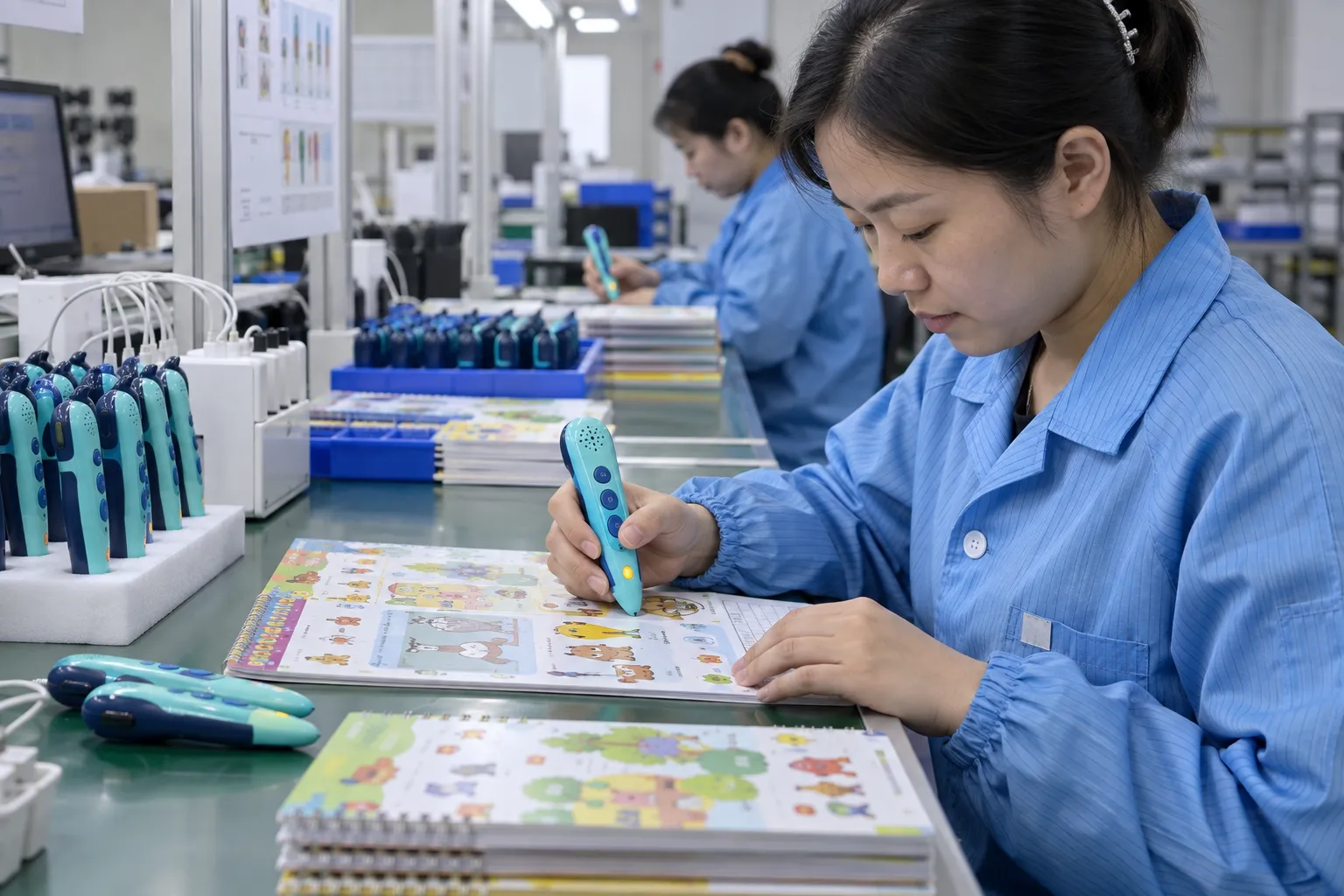
Test the complete coded talking-pen book, including ordinary handling, adult help where expected, and a realistic failure or recovery path. The check should be reproducible by a second reviewer using the same sample identity and acceptance record; avoid relying on an informal demonstration.
| Control point | Practical check | Evidence |
|---|---|---|
| Representative user journey | Recreate the complete user journey: touch first, middle, last, edge, dark-background, and reprinted points using retained pens from supported generations Run setup, intended action, wrong action, recovery, repetition, storage, and support or replacement steps on a production-intent sample. | Record result, defect category, and sample identity |
| Identity and content check | Compare a print-method comparison sheet with coded proofs and recognition results with labels, files, components, physical media, language, SKU, and revision on units from more than one production position. | Record result, defect category, and sample identity |
| Critical function and durability | Check touch first, middle, last, edge, dark-background, and reprinted points using retained pens from supported generations against a production-intent sample and the approved configuration Document any failure and repeat the check after corrective action rather than just replacing the inspected sample. | Record result, defect category, and sample identity |
| Shipment and service readiness | Verify the packed set, instructions, barcode or lot identity, accessories, carton allocation, spare or update plan, and support contact route. | Record result, defect category, and sample identity |
Set test frequency from risk and process evidence. Use written defect classes, sampling rules, and reaction plans; the ISO 28590 overview is a starting reference for acceptance sampling by attributes.
Shipment inspection should use the approved product, controlled files, packing specification, label artwork, and purchase order as references. Inspectors should test content from different parts of the library rather than replaying one demonstration item. Allow time before the shipping deadline for containment, root-cause review, corrective action, and reinspection when needed.
See Cakub’s quality-control workflow for the broader sequence from incoming materials through shipment release, or review the factory capability page when evaluating production support.
7. Which external standards and evidence should buyers check?
Lifecycle decisions can touch product safety, intellectual-property permissions, trade-item identification, materials claims, and learning use. Which sources apply depends on the exact product, age grading, construction, claim, sales market, and contract. Check applicability before design or content release; a linked source is not evidence that a particular product has been certified or licensed.
- U.S. CPSC toy safety guidance — use the current official text as a starting point for the final model and market.
- ISO 2859-1:2026 acceptance-sampling overview — use the current official text as a starting point for the final model and market.
- FSC paper and packaging chain-of-custody information — use the current official text as a starting point for the final model and market.
Relevant official starting points for this topic include U.S. CPSC toy safety guidance, ISO 2859-1:2026 acceptance-sampling overview, FSC paper and packaging chain-of-custody information. These sources are not substitutes for a project-specific decision. Use qualified product-safety, legal, standards, or certification advisers as relevant; keep the review, applicable evidence, file approvals, and production identity connected to the exact model and revision.
8. How can buyers compare supplier quotations fairly?
Ask suppliers to price the OID print-method selection configuration and show the trade-off against a simpler option. Ask suppliers to show configuration, one-time engineering, content work, samples, tooling, materials, inspection, pack-out, replenishment, service stock, Incoterm, and exclusions on the same basis.
Normalize configuration, content, electronics, materials, accessories, packaging, development, tooling, tests, documents, quantity, currency, Incoterm, payment, validity, and exclusions before comparing prices.
9. Common mistakes that create avoidable delay or rework
Approving a feature instead of a user journey
A screen preview and a single hand-held sample cannot establish production yield or future reprint equivalence. A function that works once may still be confusing, fragile, or expensive to support. The practical correction is to add an owner, reference file, approval point, and inspection method before the order enters mass production.
Losing the approved version
Without a print-method comparison sheet with coded proofs and recognition results, an attractive sample cannot reliably identify the right content, component, label, or future reprint. The practical correction is to add an owner, reference file, approval point, and inspection method before the order enters mass production.
Ignoring the failure path
When codes are lost, distorted, obscured, or moved by the chosen print process, no one knows whether to replace, repair, update, quarantine, or re-test the product. The practical correction is to add an owner, reference file, approval point, and inspection method before the order enters mass production.
Quoting only the first shipment
Preserve a print-method comparison sheet with coded proofs and recognition results and review it after any change that could cause codes are lost, distorted, obscured, or moved by the chosen print process. A low initial price may conceal replacement media, reprogramming, localization, after-sale labor, or another setup charge. The practical correction is to add an owner, reference file, approval point, and inspection method before the order enters mass production.
10. Frequently asked questions
When is OID print-method selection worth a custom development project?
When the user action, content, service need, or channel model cannot be met reliably by an existing platform. Test the difference on representative content and calculate the operating burden before tooling.
What should be approved before mass production?
Approve a production-intent sample together with a print-method comparison sheet with coded proofs and recognition results, final content and labels, component choices, acceptance method, packaging, and responsibility for open items.
How should a buyer test for codes are lost, distorted, obscured, or moved by the chosen print process?
Choose a realistic failure scenario, define the expected user and support response, reproduce it on representative samples, and record the disposition and affected version or lot.
Can the same platform support several SKUs?
Often yes, if each SKU has controlled hardware, content, packaging, barcode, market, language, and version identity. Shared parts should not erase differences important to the user or retailer.
What should be checked before shipment?
Inspect representative function, content identity, construction, labels, accessories, retail pack, master carton, lot traceability, and closure of every critical deviation against the approved reference.
Conclusion: approve a repeatable product system
The best OID print-method selection decision is one the buyer can explain, reproduce, inspect, and support after shipment. A strong OID print-method selection decision is visible in the final product, factory records, pack-out, and customer-support procedure. That traceability makes the next order easier to quote, inspect, update, and defend when a problem appears.
Planning a custom talking-pen project?
Send your target user, product format, content scope, market, quantity range, packaging, and launch timing for a structured project review.