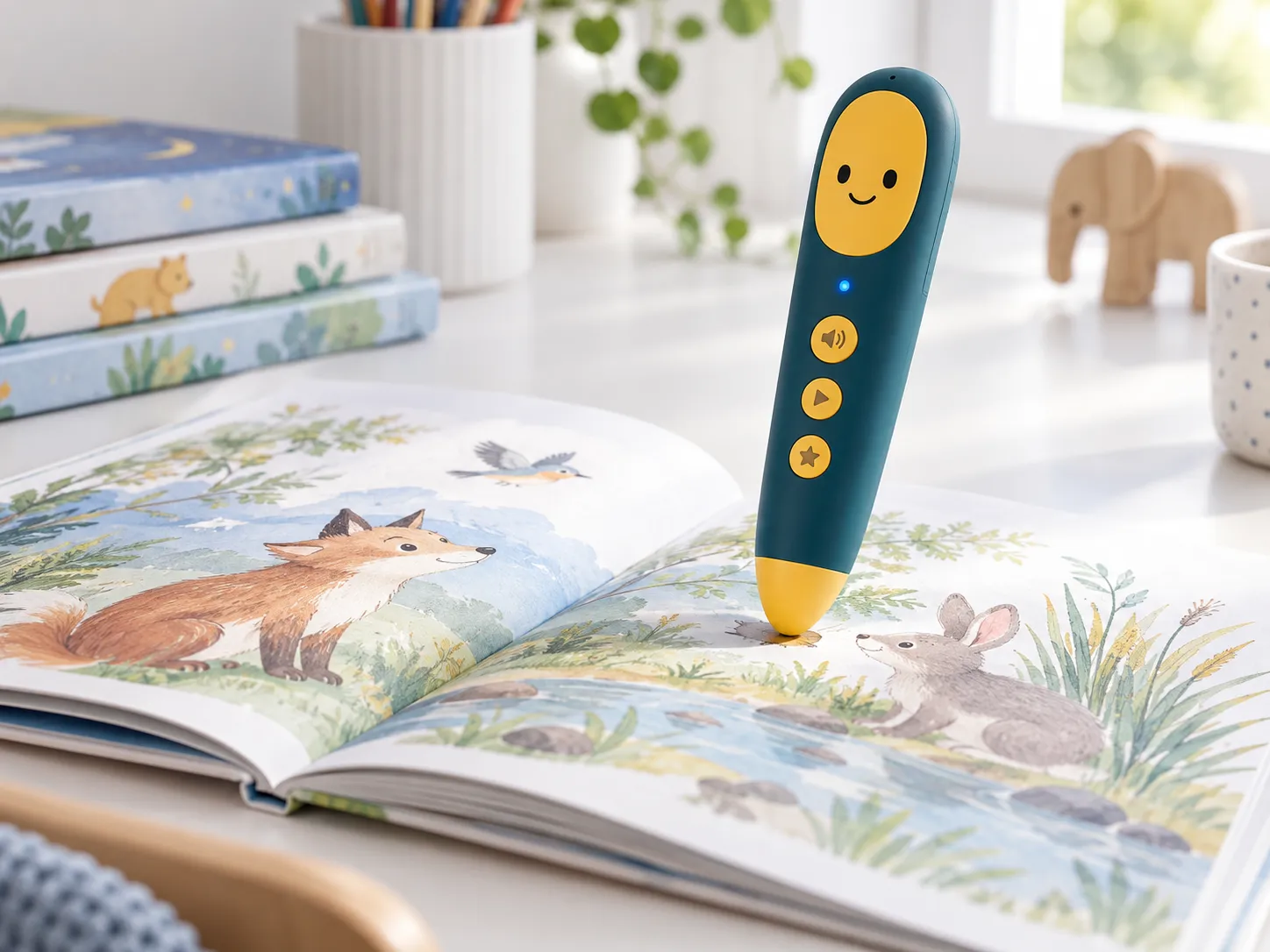
Talking pen vs sound book vs card audio player: choose a talking pen for dense, expandable page-level interaction; choose a sound book for a self-contained title with simple physical buttons; choose an insert-card player for modular stories, songs, or vocabulary packs. The right format is determined by the learning flow, content library, user age, retail model, and production workflow—not by novelty alone.
Publishers and educational brands often begin with a content idea and then search for a device. That order is sensible, but the first quotation can become misleading if the interaction model is still unclear. A talking pen, sound book, and insert-card audio player may all deliver narration, vocabulary, music, or prompts, yet they require different artwork, audio mapping, electronics, sample approvals, packaging, and replenishment plans.
This guide compares the three formats from a B2B sourcing perspective. It focuses on product application, customer requirements, factory testing, shipment inspection, and the decisions that affect total project scope. It does not assume one format is universally superior. A strong product brief explains why the chosen interaction helps the intended user complete a specific activity.
1. What is the practical difference between the three formats?
A talking pen identifies a location on compatible printed media and plays the mapped audio. A sound book integrates a sound module and physical buttons into one printed book. An insert-card audio player identifies a card and starts the linked story, song, lesson, or playlist.
The main difference is interaction granularity. A talking pen can support many activation points across many pages. A sound book typically offers a smaller number of visible buttons in one title. A card player uses one card as the primary content-selection object. That difference shapes the user experience and the buyer’s production responsibilities.
Screen-free describes the interface, not a guaranteed educational outcome. The product still needs age-appropriate content, understandable prompts, manageable controls, suitable audio levels, and activities that align with the intended learning objective. During concept review, ask what the child does, what the device does in response, and what should happen next.
2. Talking pen vs sound book vs card audio player: side-by-side comparison
| Decision area | Talking pen | Sound book | Insert-card player |
|---|---|---|---|
| Primary interaction | Point to coded areas on pages or cards | Press visible buttons built into the book | Insert or place a card to select content |
| Content granularity | High: words, pictures, sentences, games, page zones | Focused: one button normally maps to one sound or sequence | Modular: one card maps to a track, story, category, or playlist |
| Library growth | Strong fit for multiple books and future titles | Usually a separate module for each book or title family | Strong fit for starter sets and expansion card packs |
| Printed-media work | Artwork plus compatible code-layer preparation and mapping | Book artwork, dielines, button positions, module integration | Card artwork, identification logic, numbering, and storage |
| Typical buyer | Publishers, language programs, curriculum brands | Children’s publishers, gift books, museum and retail titles | Story, music, vocabulary, and subscription-content brands |
| Key risk | Recognition and file-version mismatch across a large library | Print, binding, button, and module misalignment | Wrong card-to-audio mapping or unclear library organization |
| Best when | The value comes from exploring many points and titles | The value is concentrated in one tactile book | The value comes from swapping simple content objects |
Bottom line: a talking pen is a platform decision, a sound book is an integrated publishing decision, and an insert-card player is a modular content-library decision. Quotations should be compared only after the buyer defines the media, content volume, functions, packaging, market, and approval responsibilities for the chosen format.
3. How does each audio learning format work?
Talking pens: precise interaction across printed content
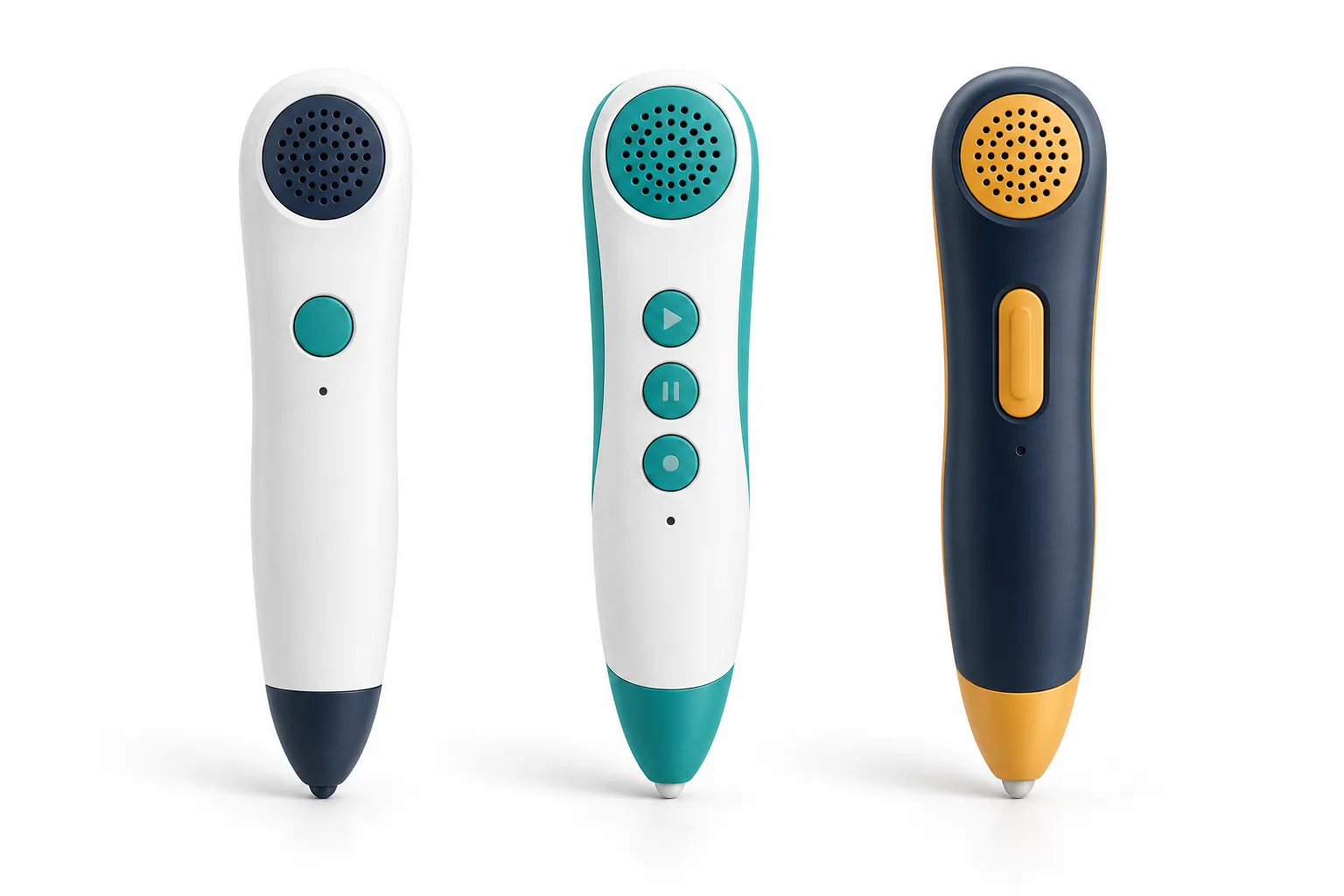
Talking pens are useful when a child should choose exactly what to hear. The printed page contains a compatible identification layer, often described in the market as optical identification or dot-code printing. When the reader detects a coded location, the device uses its content database and firmware logic to play the assigned file or perform an activity.
For buyers, the critical workflow connects activation areas, identifiers, audio filenames, language, function, and revision. A change to artwork or audio can affect that relationship. An integrated sample should therefore include representative production-style pages, the intended pen configuration, mapped content, and real controls. Testing only a loose speaker or an uncoded digital proof does not validate the complete system.
Talking pens fit multilingual publishing, phonics, vocabulary, read-aloud stories, quizzes, classroom activities, and multi-title libraries. They are less suitable when the buyer wants a single inexpensive audio moment and has no plan to manage coded print files or an expanding content database.
Sound books: print, buttons, and audio in one product
A sound book places the interaction visibly in the book. The child presses an icon or shaped button, and the integrated module plays narration, an animal sound, music, pronunciation, or another assigned track. The concept is easy to explain at retail because the book itself contains the interface and audio hardware.
The apparent simplicity moves complexity into engineering and production preparation. Page thickness, binding, button panel, speaker opening, battery access, artwork safe areas, audio duration, module shape, and retail packaging must be coordinated. Installation preparation matters: the printer, module supplier, and assembly team need the same approved dieline and button map. A late artwork shift can cause a button to sit under the wrong printed icon.
Sound books fit first-word titles, animal sounds, music, nursery rhymes, gift publishing, museum programs, and compact learning themes. They are less efficient when buyers need hundreds of selectable points or expect one device to support a large library of separate books.
Insert-card audio players: simple selection and expandable packs
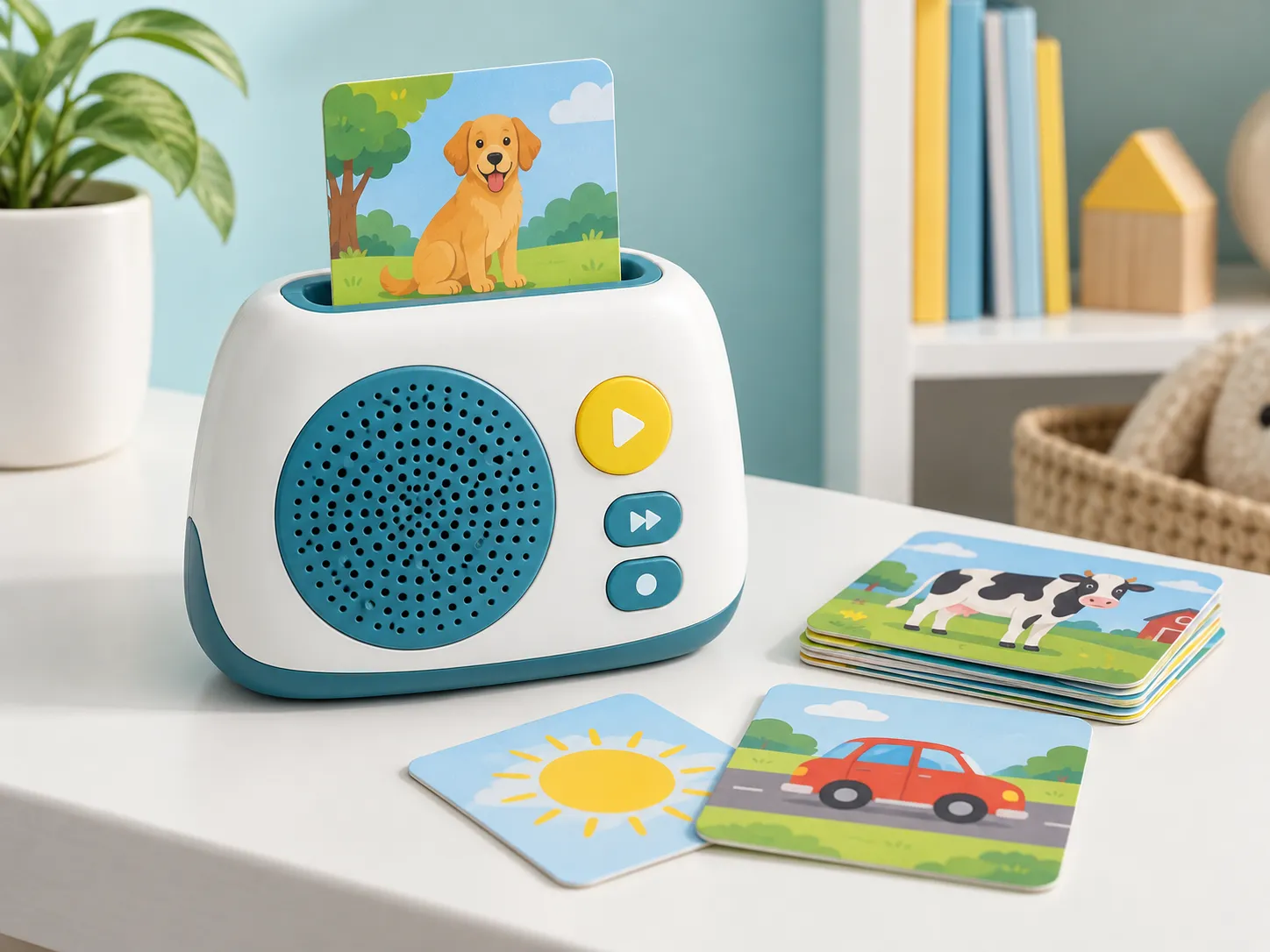
An insert-card player treats each card as a physical content key. The user inserts or places the card, the player identifies it, and the linked track or playlist begins. This can make content selection understandable for young users while keeping the audio library modular for the brand.
The buyer must define whether a card represents one word, one song, one complete story, or a collection. That choice affects navigation, memory, pause and resume behavior, track buttons, artwork, numbering, storage, and future expansion. The player and cards should be sampled together; recognition reliability and insertion feel cannot be approved from separate photos.
Card players fit story libraries, song packs, bilingual vocabulary, calming audio, cultural content, and recurring expansion products. They may be less suitable when users need to select many specific points on a detailed page or when losing a single card would remove a critical part of the learning sequence.
Unsure which format to sample first?
Send one representative activity, the target age, content volume, languages, market, and retail plan. A format review can prevent three incomparable quotations.
4. Which format fits your product application?
Choose a talking pen for exploration and repeatable page interaction
Select a talking pen when the child should control the sequence by touching words, pictures, or activity zones. This is particularly useful for pronunciation, bilingual vocabulary, reading support, and discovery-based content. It also works when the commercial plan includes multiple books that share one hardware platform.
Before choosing it, confirm who will prepare compatible print files, how audio is named and mapped, how new titles are loaded, and how customers understand book compatibility. Platform value grows with the library, but so does version-control responsibility.
Choose a sound book for a focused, self-contained title
Select a sound book when a limited set of audio moments strengthens one story or theme. A clearly illustrated button can be easier to understand than a separate device, especially when the book is purchased as a gift or impulse retail product. The format also avoids asking families to manage compatibility between a device and multiple titles.
Before choosing it, review the physical size and weight added by the module, battery access, button force, sound openings, page construction, and packaging protection. The complete book should be reviewed for handling, not just visual artwork.
Choose a card player for modular content and repeat purchases
Select a card player when the commercial model benefits from themed packs or a content subscription. Cards can separate stories, topics, languages, or age levels while keeping one familiar player. This format also makes the content object visible: a child or caregiver can choose a specific card without navigating a screen.
Before choosing it, define expansion rules. Future cards need identifiers, artwork standards, audio capacity, naming control, compatibility communication, and packaging. A starter set that cannot support the planned library may create an expensive platform change later.
5. Compare the content and production workflow—not just unit price
The three formats allocate cost differently. A talking pen may require more print-code and mapping work. A sound book combines printing, binding, electronics, and assembly in every unit. A card player separates reusable hardware from physical content packs. Buyers should compare total program scope, not one headline price.
Prepare a content inventory
List every language, track, prompt, sound effect, song, and activity. Record duration, ownership, approval status, and expected revision. This inventory reveals whether the content is ready for sampling and whether the selected format can support the planned library. It also helps the factory estimate programming and inspection work more accurately.
Control artwork and audio versions together
Use a mapping document that connects the physical trigger to the digital file. For a talking pen, that may be page and activation zone. For a sound book, it is button number and printed icon. For a card player, it is card identifier and track sequence. The file should show revision dates and approval status.
Define sample purpose before making samples
An early proof-of-concept sample can validate interaction and content flow. An appearance sample can validate color, printing, fabric, or finish. A production-confirmation sample should represent the released configuration closely enough to control manufacturing. Label each sample and record known deviations so the team does not approve the wrong basis.
Plan packaging around the real sales channel
A bookstore sound book, classroom talking-pen set, and subscription card pack need different protection and communication. Confirm accessories, manuals, language labels, restraints, card storage, trays, retail windows, carton quantities, and shipment marks. Packaging is part of the user experience and the inspection scope.
6. What should factory testing and shipment inspection cover?
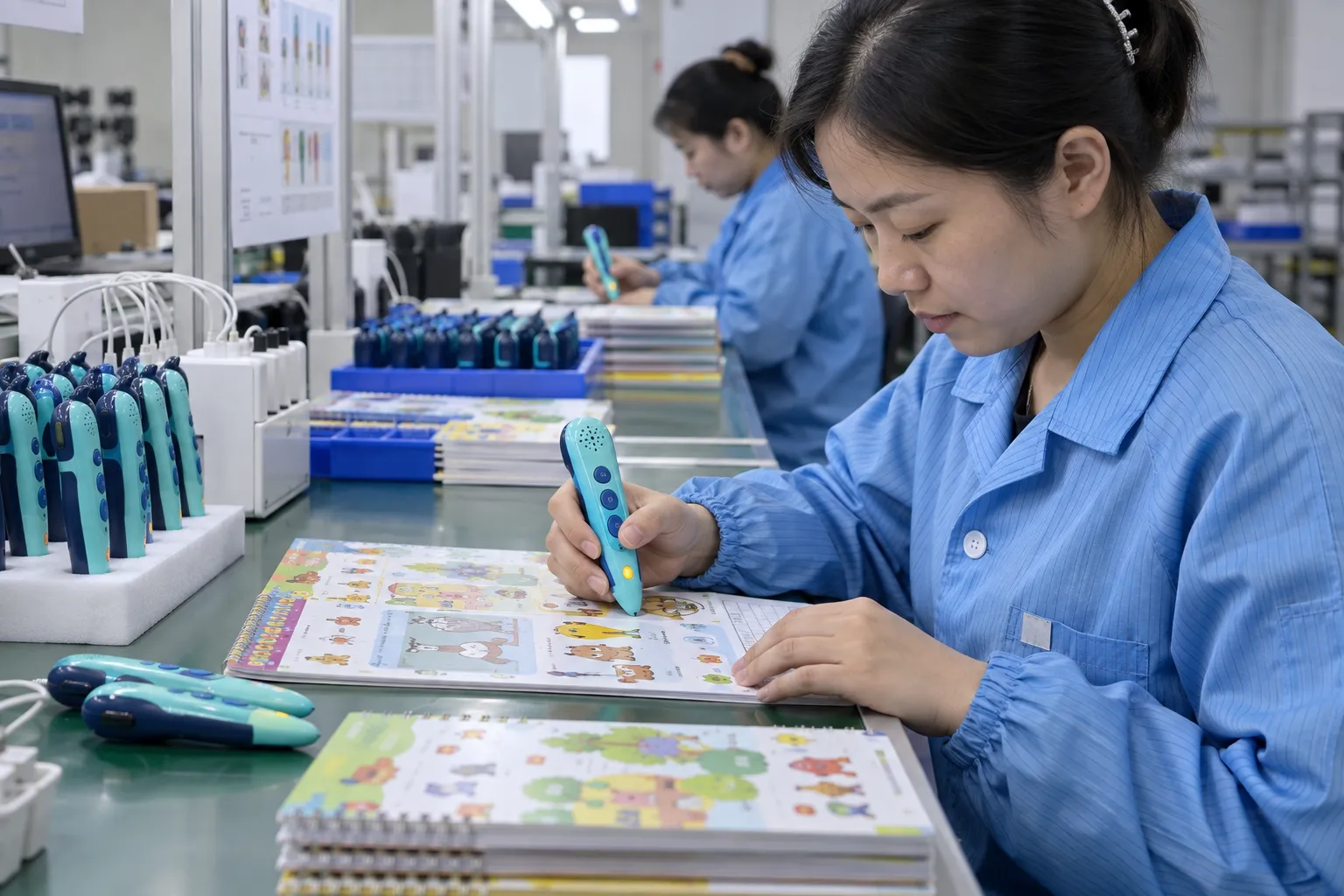
Factory testing should follow the way the complete product can fail. The exact plan depends on the model and market, but buyers should expect separate controls for materials, assembly, content loading, function, appearance, packaging, and shipment release. “QC included” is not enough unless the supplier describes the checks and acceptance basis.
| Check area | Talking pen | Sound book | Card player |
|---|---|---|---|
| Recognition | Representative points, angles, page areas, and titles | Button position, force, repeat response, correct track | Card insertion, identification, repeated swaps, wrong-card response |
| Audio | Mapped file, clarity, volume steps, modes | Track mapping, clarity, module noise, speaker opening | Track sequence, pause/resume, navigation, volume |
| Construction | Housing, tip, buttons, connector, battery security | Binding, page stack, module fit, battery access | Slot, housing, buttons, indicators, connector |
| Pack-out | Correct pen, cable, books, inserts, labels | Correct book, pull tab, wrap, labels, carton protection | Correct player, cards, storage, cable, instructions |
During shipment inspection, select content from different parts of the library instead of replaying one demonstration track. Confirm the correct language, artwork revision, accessory set, packaging version, carton marks, and quantity. Allow time for containment and reinspection before the shipping deadline.
Compliance is market and configuration specific. In the United States, buyers can begin with the official U.S. Consumer Product Safety Commission toy-safety guidance. For the European market, consult the European Commission’s current toy safety information. Electric toys may also involve the scope described by IEC 62115. These sources are starting points; an accredited laboratory or qualified adviser should confirm the plan for the final product.
Do not accept a generic statement that a product is “CE approved” or “ASTM certified.” Ask which report covers which exact configuration, materials, battery, accessories, age grading, and standard edition. Product changes after testing may require a compliance impact review.
7. A seven-question decision checklist for buyers
- What should the child physically do? Point to a detail, press a visible button, or choose a complete content card?
- How large will the content library become? Count titles, pages, activation points, cards, tracks, languages, and future releases.
- Who controls the content files? Assign ownership for scripts, recordings, artwork, mapping, translations, revisions, and final release.
- How will the product be sold? Define retail, education, subscription, gifting, or expansion-pack requirements before packaging design.
- What should the integrated sample prove? Specify user flow, recognition, audio, controls, construction, appearance, and early pack-out.
- Which market requirements apply? Confirm age grading, product classification, battery, labeling, testing, and importer responsibilities.
- How will shipment inspection reproduce the approval? Create a check plan tied to the approved sample, controlled files, packaging specification, and acceptance method.
If several formats remain plausible, request a feasibility discussion before requesting three physical samples. A supplier should be able to compare interaction, content preparation, engineering, packaging, schedule, and risk based on your brief. The goal is not to push the most complex format; it is to select the simplest system that delivers the intended experience and supports the commercial plan.
8. Frequently asked questions
Which is better: a talking pen or a sound book?
A talking pen is usually better for expandable libraries and point-level interaction, while a sound book is often better for a self-contained title with simple, visible buttons. The better choice depends on content scale, interaction density, age group, retail format, and how frequently the library will grow.
Can one product combine cards, books, and a talking pen?
Yes, if the recognition system, content database, physical media, and user flow are designed as one platform. The commercial question is whether the additional media types create real learning value or unnecessary complexity. Every added format increases artwork, mapping, sample, packaging, and customer-support work.
Do screen-free audio products still require electrical toy testing?
Potentially. A product may be treated as an electric toy or children’s product depending on its design, intended use, age grading, power system, market, and claims. Confirm the applicable plan with an accredited laboratory and qualified compliance adviser rather than relying on a report for a similar product.
Which format is easiest for a first product launch?
A self-contained sound book or focused starter card set may have fewer content-management dependencies than a large talking-pen library. However, the easiest format is the one aligned with ready artwork, approved audio, a clear user flow, and a controlled sample plan. A poorly prepared “simple” product can still create expensive revisions.
Conclusion: start with interaction, then engineer the system
Talking pens, sound books, and insert-card audio players can all support meaningful audio learning products. Their value comes from different physical interactions. A talking pen offers precise exploration, a sound book keeps the experience inside one tactile title, and a card player makes content modular and easy to select.
For a reliable sourcing decision, define the user journey, content scale, file ownership, market, packaging, quantity range, and launch timing before comparing prices. Then validate the complete system through integrated samples, factory testing, and shipment inspection. This approach produces better supplier questions, clearer quotations, and fewer surprises after artwork and tooling are committed.
Need to choose a product platform before requesting prices?
Send your target age, market, content type, interaction idea, quantity range, and launch timing. We’ll help turn them into a comparable product brief.