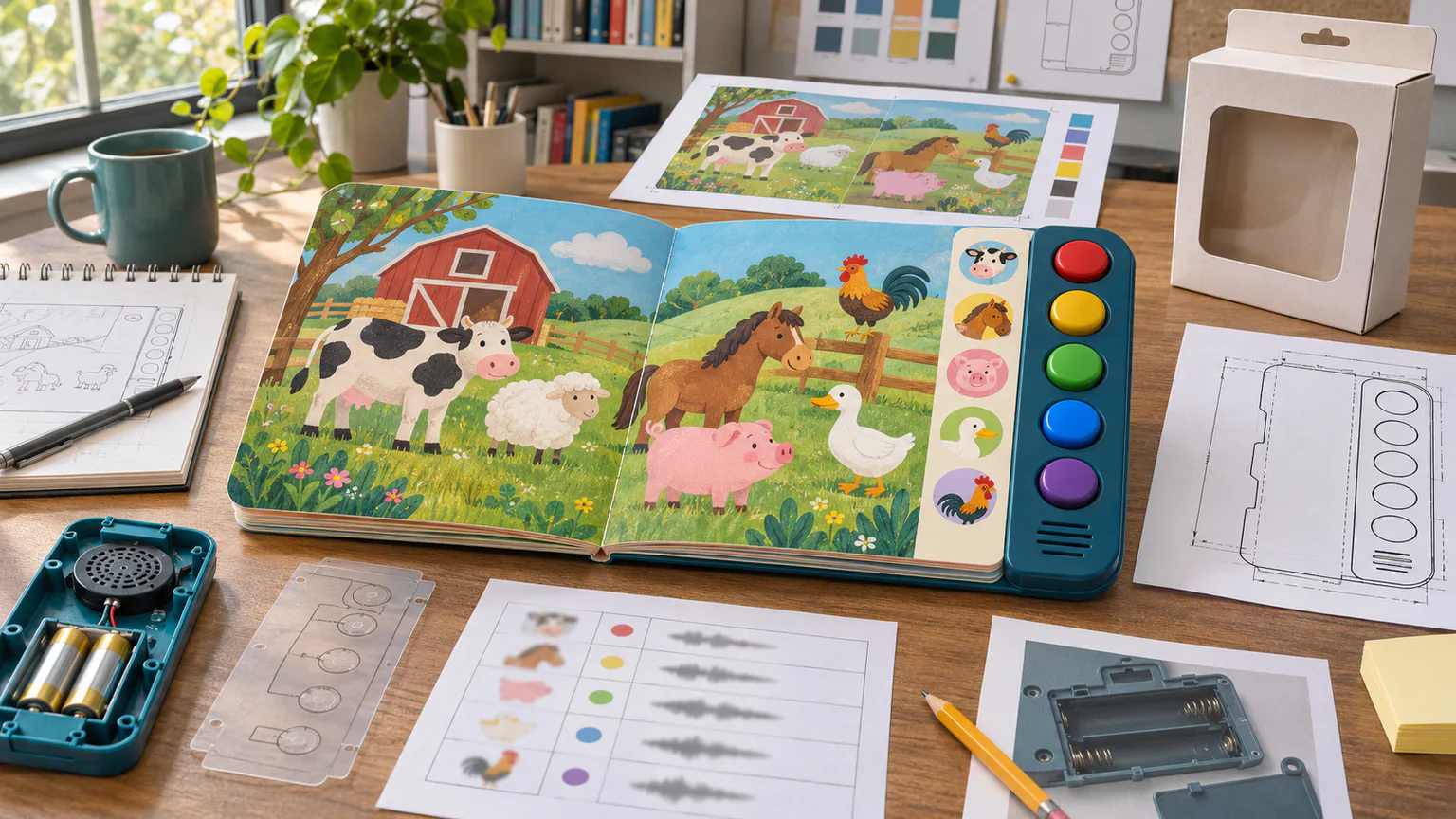
How to Evaluate an Interactive Sound Book Manufacturer: Evaluate an interactive sound book manufacturer by asking how the team integrates book structure, artwork, printing, binding, switch positions, sound module, audio mapping, speaker, batteries, labels, packaging, and final inspection. The strongest evidence is a production-intent book and controlled print-to-audio records—not a loose module demonstration or an unrelated printed sample.
Sound books sit between publishing and electronics manufacturing. Print can be visually correct while a button sits outside its activation window; electronics can work on a bench but become quiet after assembly; a bound book can look finished while repeated page flex damages an internal connection. Supplier capability is the ability to manage those interfaces.
This guide is written for children’s publishers, museum shops, educational brands, gift companies, retailers, and print sourcing teams. It addresses the questions that normally appear between the first concept discussion and a production-ready quotation: product application, customer requirements, content ownership, sample purpose, factory testing, shipment inspection, packaging, and market-specific documentation. It does not present universal specifications because sound book should be engineered around the final user, configuration, claims, sales market, and distribution plan.
For an overview of the available configuration and customization direction, review Cakub’s sound books product page. Buyers who are still comparing formats can also start with the interactive learning product range.
1. What should buyers understand first?
A press-button sound book manufacturer produces a printed and bound book with an integrated electronic module that maps visible prompts or controls to approved narration, music, pronunciation, or sound effects. The production system includes dielines, page order, switches, wiring, firmware, audio masters, power, labels, binding, assembly, packaging, and inspection references.
Practical buyer answer: Ask the supplier to trace one visible button from artwork coordinate to switch, filename, playback rule, module revision, printed proof, assembled book, test record, and packed SKU.
The most reliable starting point is a one-page use-case description. State who uses the product, what physical action starts the interaction, what the product should do, what happens next, and how success is observed. This prevents a supplier from substituting a familiar standard product for a requirement that actually needs different electronics, files, construction, firmware, or packaging.
2. Where does this solution fit—and where does it not?
A sound book fits titles with a focused set of durable audio interactions. Talking pens or other platforms may suit denser page-level interaction or expanding libraries.
| Decision question | Good fit when | Reconsider when |
|---|---|---|
| How many audio triggers are needed? | A manageable set of clear buttons supports the editorial concept and page design. | Hundreds of precise page locations need unique responses. |
| Can structure be frozen early? | Trim, page count, binding, panel, module, speaker, battery access, and switch positions can guide final artwork. | Artwork is final but no space or tolerance exists for electronics. |
| Will the book be a series? | Module, audio map, artwork, edition, and reprint records support controlled future titles. | Every reorder depends on an unmarked physical sample. |
3. Which specification decisions change the project?
Manufacturer evaluation should reveal how publishing files become a durable electronic book at production scale.
1. Book and module architecture
Define trim, page count, board or paper, binding, panel or page switches, module cavity, speaker path, battery access, controls, thickness, and balance. This decision should be closed before detailed quotation because it affects several downstream assumptions. For sound book, the useful question is not whether a feature is available in theory, but how it will be implemented, approved, repeated in production, and checked before shipment.
2. Switch and artwork registration
Control button centers, activation windows, printed prompts, tolerances, bleed, safe areas, page order, finishing, and false-trigger separation. A supplier can only validate this point when the intended user action and acceptable response are observable. For sound book, the useful question is not whether a feature is available in theory, but how it will be implemented, approved, repeated in production, and checked before shipment.
3. Audio and firmware map
Connect each button and control with filename, language, duration, playback rule, volume, interrupt, repeat, startup, shutdown, and approved master. Treat this as a controlled product requirement rather than an informal preference in an email thread. For sound book, the useful question is not whether a feature is available in theory, but how it will be implemented, approved, repeated in production, and checked before shipment.
4. Print and binding process
Specify color proofing, substrate, lamination or varnish, die cutting, board mounting, adhesives, page sequence, hinges, spine, cavities, and warpage limits. The approved sample should demonstrate this requirement with representative content and production-style materials. For sound book, the useful question is not whether a feature is available in theory, but how it will be implemented, approved, repeated in production, and checked before shipment.
5. Power and child access
Plan batteries or charging, holder, compartment, fasteners, pull tab, switches, labels, instructions, service, shelf behavior, and market review. Document the decision in the specification, sample comments, and final inspection checklist so each team uses the same reference. For sound book, the useful question is not whether a feature is available in theory, but how it will be implemented, approved, repeated in production, and checked before shipment.
6. Assembly, packaging, and reprints
Define module installation, wiring protection, function checks, cleaning, retail wrap, button protection, cartons, edition identity, retained references, and change control. If the requirement is still open, ask the supplier to quote the alternatives separately instead of hiding the difference in one price. For sound book, the useful question is not whether a feature is available in theory, but how it will be implemented, approved, repeated in production, and checked before shipment.
| Decision area | What to define | Approval evidence |
|---|---|---|
| Book and module architecture | Define trim, page count, board or paper, binding, panel or page switches, module cavity, speaker path, battery access, controls, thickness, and balance. | Specification, approved sample, or controlled record |
| Switch and artwork registration | Control button centers, activation windows, printed prompts, tolerances, bleed, safe areas, page order, finishing, and false-trigger separation. | Specification, approved sample, or controlled record |
| Audio and firmware map | Connect each button and control with filename, language, duration, playback rule, volume, interrupt, repeat, startup, shutdown, and approved master. | Specification, approved sample, or controlled record |
| Print and binding process | Specify color proofing, substrate, lamination or varnish, die cutting, board mounting, adhesives, page sequence, hinges, spine, cavities, and warpage limits. | Specification, approved sample, or controlled record |
| Power and child access | Plan batteries or charging, holder, compartment, fasteners, pull tab, switches, labels, instructions, service, shelf behavior, and market review. | Specification, approved sample, or controlled record |
| Assembly, packaging, and reprints | Define module installation, wiring protection, function checks, cleaning, retail wrap, button protection, cartons, edition identity, retained references, and change control. | Specification, approved sample, or controlled record |
Compare activation architectures before final artwork
Interactive sound books do not all use the same activation method. The best architecture depends on the number and position of prompts, book construction, reader age, acceptable pressing action, artwork freedom, tolerance, durability, and cost. Ask the supplier to show the specific structure proposed for the title rather than a generic sound-module sample.
| Architecture | Best fit | Key integration risks | Proof required |
|---|---|---|---|
| Separate side-panel buttons | Clear recurring controls or a modest list of sounds beside the page block | Panel width, button spacing, page-to-button labeling, speaker path, and accidental activation | Full-size bound mock-up with final-like panel, print, audio map, and packaging clearance |
| Membrane or switch layer | Visible prompts that need defined press zones within a structured page or panel assembly | Print-to-switch registration, pressing force, false triggers, adhesive stack, flex, and wiring | Production-style printed and assembled proof tested at centers, edges, and adjacent zones |
| Page-integrated touch or conductive approach | Titles requiring page-level touch interaction when compatible materials and electronics are available | Substrate, ink or electrode process, registration, moisture, page wear, binding, and supplier-specific limitations | Final-like printed pages tested with the intended controller across representative production variation |
| Mechanical, page-turn, or motion trigger | Simple scene changes, reveal actions, or novelty interactions | Trigger timing, wear, false activation, transport movement, alignment, and user expectation | Repeated-cycle functional sample inside the final book structure and retail pack |
Use Cakub’s detailed references for switch-matrix and ghost-press control, button activation-force testing, and print-to-switch registration before artwork approval.
Comparing sound book production options?
Send trim size, page plan, button count, audio duration, binding, age, market, quantity, artwork status, and packaging idea.
4. What should the buyer prepare before requesting a quotation?
A useful quotation pack reduces assumptions without pretending every decision is final. It should distinguish confirmed requirements, preferred options, open questions, buyer-supplied files, supplier responsibilities, and items that will be approved through sampling. For sound book, prepare the following:
- Full-size structural plan: Show trim, page stack, binding, panel, switches, speaker, module, battery access, controls, cavities, safe areas, and packaging orientation.
- Button and audio index: List page, printed prompt, coordinate, switch, filename, language, duration, playback behavior, revision, and approval.
- Publishing and commercial brief: State user age, market, print and finish expectations, rights, quantity, series or reprint plan, retail channel, pack-out, and launch date.
- Book specification: Provide trim size, page count, binding, board or paper construction, button count, module position, and target age.
- Artwork and audio index: List page, printed prompt, button or switch position, filename, language, duration, and current revision.
- Market and commercial plan: State destination countries, quantity range, retail packaging, launch timing, battery choice, and inspection expectations.
Do not send a large folder without an index. Add a requirement sheet that lists every file, its revision, language, owner, intended use, and approval status. If the project contains many tracks, cards, pages, triggers, or modes, include a mapping table that connects the physical action to the expected response. This table becomes valuable during firmware review, factory testing, and shipment inspection.
5. How should development move from concept to shipment?
Close structure and electronics before final artwork, then prove print, binding, sound, durability, and packaging through production-style samples.
- Confirm the requirement brief: Define reader, title, trim, pages, binding, buttons, audio, module, power, market, quantity, retail format, series plan, and approval owners. Record open questions, the responsible party, and the required approval evidence before moving forward.
- Create the controlled map: Connect each visible prompt and coordinate with a switch, filename, language, behavior, artwork revision, module revision, and proof status. Use controlled filenames and revision dates so artwork, audio, firmware, components, and packaging cannot drift apart.
- Review feasibility and risk: Review button pitch, pressing force, tolerance, page turning, binding, wiring, speaker path, power access, print finishing, warpage, durability, and packaging. Review the result against the intended user journey, not only against an isolated component demonstration.
- Build a purpose-defined prototype: Build a full-size structural and functional book with production-like board or paper, switches, module, representative audio, binding, labels, and pack-out. Keep one approved reference and convert every comment into a measurable acceptance point.
- Approve a production-intent sample: Combine final-style book structure, print, binding, switch positions, module, speaker, batteries, firmware, audio map, labels, instructions, and packaging and close measurable comments before material release. Confirm that buyer-supplied files and factory-prepared files use the same version before releasing materials.
- Release controlled production files: Freeze the bill of materials, dielines, artwork, page index, switch coordinates, audio masters, button map, module drawing, firmware ID, assembly and packing instructions, packaging artwork, test method, and approval references. Do not compress the schedule by removing a validation gate; resolve the cause of delay and re-plan the critical path.
- Inspect and release the shipment: Sample across the order, reproduce representative user journeys, verify pack-out, and document disposition before dispatch. Before shipment, reproduce representative user actions and compare the packed product with the signed approval set.
The workflow should have visible gates. A concept sample proves feasibility; an engineering sample closes construction and function; a production-intent sample confirms controlled files, materials, firmware, audio, artwork, accessories, and packaging. Combining those purposes into one vague “sample” makes approval comments hard to interpret and makes schedule promises unreliable.

6. What should factory testing and shipment inspection cover?
Factory checks should verify both electronic function and book construction after final assembly, handling, conditioning, and pack-out.
| Control point | Practical check | Evidence |
|---|---|---|
| Print-to-switch registration | Press centers, edges, neighboring artwork, different pages, and sampled production positions; compare printed prompt, coordinate, switch, and audio. | Record result, defect category, and sample identity |
| Module and power function | Verify every button, controls, sound clarity, volume, startup, shutdown, battery or charging, pull tab, low power, and abnormal behavior. | Record result, defect category, and sample identity |
| Book durability and appearance | Inspect page order, color, lamination, die cutting, board edges, binding, flex, hinges, cavity, adhesives, warpage, cleanliness, and repeated operation. | Record result, defect category, and sample identity |
| Packaging and shipment protection | Confirm labels, instructions, edition, wrap or box, button clearance, corner protection, quantity, cartons, compression risk, and accidental activation. | Record result, defect category, and sample identity |
| Button-to-audio mapping | Press every button across representative books and compare page prompt, switch position, filename, and language. | Record result, defect category, and sample identity |
| Print and binding | Check color, registration, lamination, die cutting, page order, board edges, binding, warpage, and approved tolerances. | Record result, defect category, and sample identity |
| Module performance | Verify button feel, speaker clarity, volume, battery access, power behavior, component retention, and shutdown. | Record result, defect category, and sample identity |
| Pack-out and carton | Confirm instructions, labels, accessories, protective fit, barcode, retail presentation, and carton count. | Record result, defect category, and sample identity |
Testing frequency should be based on risk, process capability, component history, and the consequence of a failure. Some functions may justify a 100% production check, while appearance or packaging characteristics may be evaluated through a defined sampling plan. The ISO 28590 overview explains the role of acceptance sampling by attributes, but the buyer and inspection provider still need a written defect list, sampling basis, and accept/reject rules for the actual order.
Shipment inspection should use the approved product, controlled files, packing specification, label artwork, and purchase order as references. Inspectors should test content from different parts of the library rather than replaying one demonstration item. Allow time before the shipping deadline for containment, root-cause review, corrective action, and reinspection when needed.
See Cakub’s quality-control workflow for the broader sequence from incoming materials through shipment release, or review the factory capability page when evaluating production support.
7. How should safety and compliance planning be handled?
Compliance depends on intended use, age grading, materials, electronics, power source, wireless functions, sound output, accessories, packaging, claims, and destination market. Start planning before the final design because required tests, warnings, traceability marks, battery construction, or technical documentation can affect the product itself.
- U.S. CPSC toy safety guidance — use the current official text as a starting point for the final model and market.
- European Commission toy-safety information — use the current official text as a starting point for the final model and market.
- IEC 62115 electric-toy standard overview — use the current official text as a starting point for the final model and market.
- FSC paper and packaging chain-of-custody information — use the current official text as a starting point for the final model and market.
- WHO safe-listening guidance — use the current official text as a starting point for the final model and market.
Relevant official starting points for this topic include U.S. CPSC toy safety guidance, European Commission toy-safety information, IEC 62115 electric-toy standard overview, FSC paper and packaging chain-of-custody information, WHO safe-listening guidance. These links do not determine the complete test plan. Ask an accredited laboratory or qualified compliance adviser to review the final configuration and the markets where the product will be placed. Keep reports, declarations, bills of materials, label approvals, and production identities connected to the exact model and revision.
8. How can buyers compare supplier quotations fairly?
Normalize book printing, board or paper, binding, module, buttons, speaker, memory, audio programming, batteries, assembly, artwork preparation, samples, tooling, testing, packaging, cartons, and quantities before comparing unit prices.
Normalize quotations into the same structure: product configuration, included content volume, electronic functions, materials, accessories, retail packaging, master-carton basis, development charges, sample rounds, tooling, testing, documentation, quantity, currency, Incoterm, payment assumptions, and validity period. Highlight every exclusion. Two unit prices are not comparable when one includes programmed content, printed media, accessories, or inspection support and the other does not.
9. Common mistakes that create avoidable delay or rework
Finalizing artwork before the module and dieline
Button pitch, panel width, cavities, speaker, access, binding, and tolerances can force costly layout changes. The practical correction is to add an owner, reference file, approval point, and inspection method before the order enters mass production.
Selecting a printer without electronic-book controls
Beautiful conventional print does not prove switch registration, cavity construction, module assembly, wiring protection, or function testing. The practical correction is to add an owner, reference file, approval point, and inspection method before the order enters mass production.
Approving sound before final enclosure
The assembled board, cavity, speaker opening, adhesives, page stack, and packaging can change clarity and rattling. The practical correction is to add an owner, reference file, approval point, and inspection method before the order enters mass production.
Leaving reprint data uncontrolled
A later artwork, page, audio, switch, firmware, or module change can create wrong-track books without an edition register. The practical correction is to add an owner, reference file, approval point, and inspection method before the order enters mass production.
10. Frequently asked questions
Should a publisher use one supplier for printing and electronics?
An integrated supplier can reduce handoffs, but buyers should still verify the print, module, assembly, file-control, testing, and partner responsibilities. Split supply also requires one accountable integration plan.
What should a press-button sound book sample include?
Use final-size structure, representative production materials and finishes, intended module and switches, mastered audio, binding, labels, battery access, and early packaging.
How many buttons can a sound book contain?
The practical number depends on book size, user age, button pitch, switch architecture, page design, memory, audio concept, tolerance, power, packaging, and cost.
Can existing book artwork be reused?
Often, but it must be adapted to approved dielines, safe areas, button positions, panel space, binding, page order, speaker and access requirements, labels, and packaging.
What should shipment inspection verify?
Verify sampled page and button mapping, audio and controls, power, print, binding, appearance, labels, edition, packaging, accidental activation protection, cartons, and quantities.
Conclusion: approve a repeatable product system
A dependable children’s interactive book manufacturer controls the interface between editorial intent and factory execution. Publishers should approve one traceable system of dielines, artwork, switches, audio, module, power, binding, packaging, and inspection evidence before mass production.
A successful sound book project is not defined by a single attractive sample. It is defined by whether the approved user experience can be reproduced with controlled files, stable materials, clear workmanship criteria, suitable factory testing, traceable packaging, and a shipment-inspection method that reflects customer requirements. That is the standard buyers should use when comparing suppliers and deciding whether a project is ready for production.
Planning a custom sound book project?
Send your target user, product format, content scope, market, quantity range, packaging, and launch timing for a structured project review.