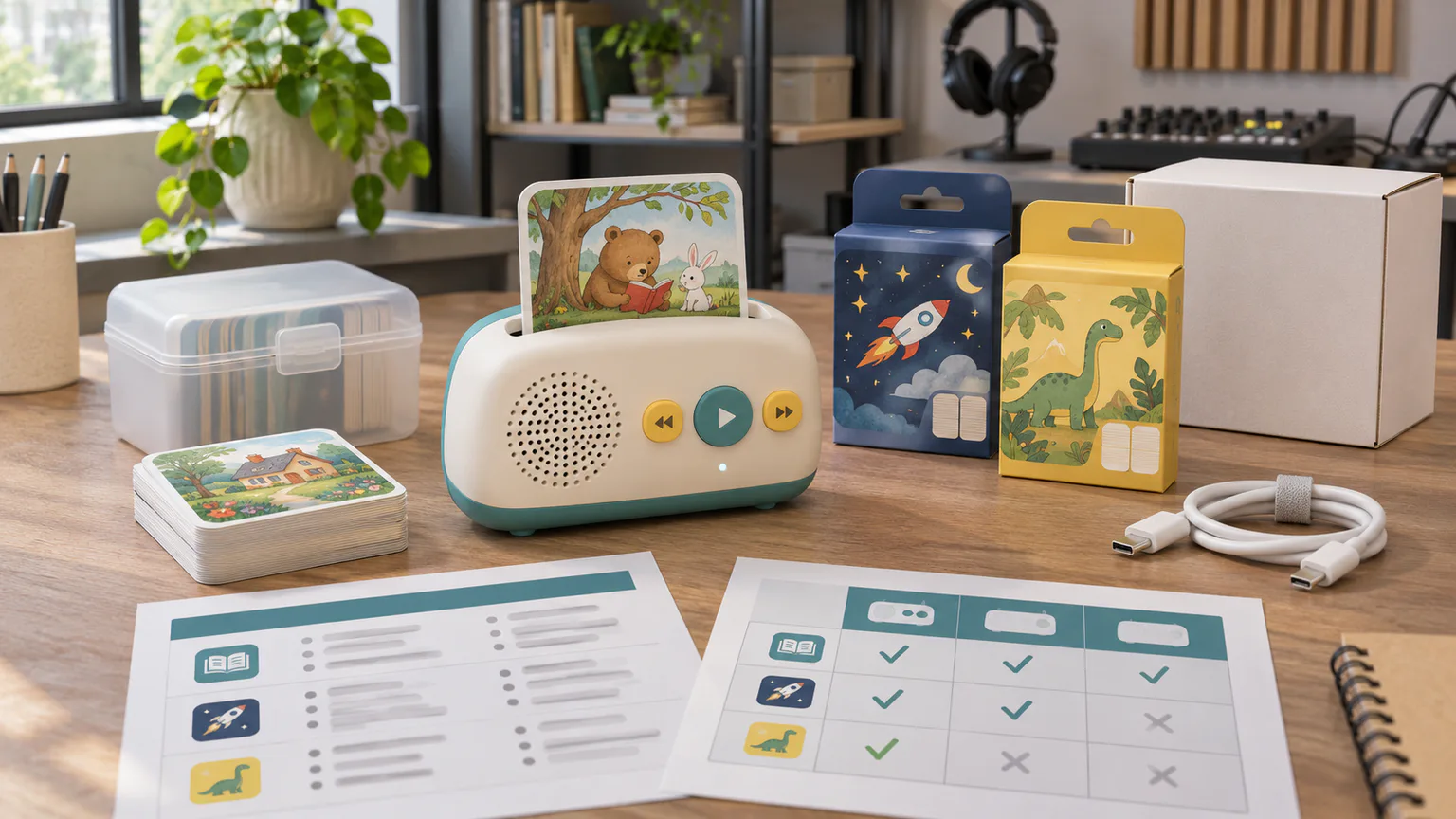
Screen-Free Story Card Player Manufacturer: Platform and Content Checklist: Choose a screen-free story card player manufacturer by evaluating the complete platform: card-identification method, offline and connected behavior, content ownership, audio storage, firmware, controls, power, speaker, expansion-pack compatibility, child handling, packaging, factory testing, and post-launch support. The starter player and future card library must be planned together.
Two players can look similar while using very different commercial and technical architectures. A card may store audio, contain only an identifier, unlock downloadable content, or select content already stored in the device. That choice affects connectivity, accounts, privacy, licensing, memory, support, card cost, and what happens when a service is unavailable.
This guide is written for story-content brands, language-learning companies, publishers, retailers, subscription programs, and toy distributors. It addresses the questions that normally appear between the first concept discussion and a production-ready quotation: product application, customer requirements, content ownership, sample purpose, factory testing, shipment inspection, packaging, and market-specific documentation. It does not present universal specifications because insert-card audio player should be engineered around the final user, configuration, claims, sales market, and distribution plan.
For an overview of the available configuration and customization direction, review Cakub’s insert-card audio players product page. Buyers who are still comparing formats can also start with the interactive learning product range.
1. What should buyers understand first?
A card-based audio player for kids is a physical audio platform in which a card, token, or similar media selects stories, songs, lessons, or prompts. The system includes the player, card identity, content database, audio masters, firmware, storage or delivery method, compatibility rules, retail packs, and release operations.
Practical buyer answer: Write the content-ownership and offline-use policy before selecting recognition technology. Then prove the complete card-to-audio journey with production-style media, final-like firmware, and representative expansion packs.
The most reliable starting point is a one-page use-case description. State who uses the product, what physical action starts the interaction, what the product should do, what happens next, and how success is observed. This prevents a supplier from substituting a familiar standard product for a requirement that actually needs different electronics, files, construction, firmware, or packaging.
2. Where does this solution fit—and where does it not?
Card players are strongest when physical selection helps children navigate a curated library independently. They are weaker when the intended experience requires complex search, frequent uncontrolled updates, or detailed visual information.
| Decision question | Good fit when | Reconsider when |
|---|---|---|
| Is physical selection valuable? | Children can identify, insert or present, store, and return cards with limited adult help. | The library is too large or changes too often for physical navigation. |
| Must playback be fully offline? | Content and authorization remain available after setup without a network or account dependency. | The proposed architecture silently requires ongoing cloud access. |
| Will expansion packs remain compatible? | IDs, firmware, player generations, regions, languages, and release tests follow a published compatibility policy. | Each new pack depends on unrecorded factory knowledge. |
3. Which specification decisions change the project?
Platform decisions made for the first starter set determine the cost and support burden of every later content release.
1. Card-recognition architecture
Compare contact, optical, RFID or NFC, magnetic, mechanical, and hybrid systems by ID capacity, orientation, wear, card cost, radio scope, and expansion. This decision should be closed before detailed quotation because it affects several downstream assumptions. For insert-card audio player, the useful question is not whether a feature is available in theory, but how it will be implemented, approved, repeated in production, and checked before shipment.
2. Content location and offline behavior
Define whether audio lives on the player, card, removable memory, downloaded cache, or cloud and what works without Wi-Fi, an app, or an account. A supplier can only validate this point when the intended user action and acceptable response are observable. For insert-card audio player, the useful question is not whether a feature is available in theory, but how it will be implemented, approved, repeated in production, and checked before shipment.
3. Library and ownership
Control rights, masters, metadata, card IDs, filenames, languages, regions, compatibility, update packages, hosting obligations, and end-of-support terms. Treat this as a controlled product requirement rather than an informal preference in an email thread. For insert-card audio player, the useful question is not whether a feature is available in theory, but how it will be implemented, approved, repeated in production, and checked before shipment.
4. Child and caregiver controls
Specify insertion, auto-start, pause, resume, navigation, replay, volume, sleep, bookmarks, language selection, startup, and unsupported-card behavior. The approved sample should demonstrate this requirement with representative content and production-style materials. For insert-card audio player, the useful question is not whether a feature is available in theory, but how it will be implemented, approved, repeated in production, and checked before shipment.
5. Hardware and service
Plan enclosure, slot, guides, speaker, headphone policy, charging or batteries, indicators, memory, drops, cleaning, repair, and replacement cards. Document the decision in the specification, sample comments, and final inspection checklist so each team uses the same reference. For insert-card audio player, the useful question is not whether a feature is available in theory, but how it will be implemented, approved, repeated in production, and checked before shipment.
6. Retail content system
Coordinate starter cards, expansion decks, artwork, numbering, storage, packaging, barcodes, compatibility claims, cartons, and release calendar. If the requirement is still open, ask the supplier to quote the alternatives separately instead of hiding the difference in one price. For insert-card audio player, the useful question is not whether a feature is available in theory, but how it will be implemented, approved, repeated in production, and checked before shipment.
| Decision area | What to define | Approval evidence |
|---|---|---|
| Card-recognition architecture | Compare contact, optical, RFID or NFC, magnetic, mechanical, and hybrid systems by ID capacity, orientation, wear, card cost, radio scope, and expansion. | Specification, approved sample, or controlled record |
| Content location and offline behavior | Define whether audio lives on the player, card, removable memory, downloaded cache, or cloud and what works without Wi-Fi, an app, or an account. | Specification, approved sample, or controlled record |
| Library and ownership | Control rights, masters, metadata, card IDs, filenames, languages, regions, compatibility, update packages, hosting obligations, and end-of-support terms. | Specification, approved sample, or controlled record |
| Child and caregiver controls | Specify insertion, auto-start, pause, resume, navigation, replay, volume, sleep, bookmarks, language selection, startup, and unsupported-card behavior. | Specification, approved sample, or controlled record |
| Hardware and service | Plan enclosure, slot, guides, speaker, headphone policy, charging or batteries, indicators, memory, drops, cleaning, repair, and replacement cards. | Specification, approved sample, or controlled record |
| Retail content system | Coordinate starter cards, expansion decks, artwork, numbering, storage, packaging, barcodes, compatibility claims, cartons, and release calendar. | Specification, approved sample, or controlled record |
Convert platform claims into shipment evidence
Product pages often describe a player as screen-free, offline, educational, or expandable. Each statement needs a defined operating condition and an inspection method; otherwise the same words can describe materially different platforms.
| Platform claim | Evidence from the supplier | Shipment check |
|---|---|---|
| Reliable card identification | Recognition method, ID register, orientation limits, slot tolerance, and unsupported-card behavior | Sample normal, partial, fast, reversed, worn, and repeated insertions across units |
| Correct content mapping | Card-to-title-to-language manifest, approved audio package, firmware identity, and checksums or controlled references | Trace sampled cards to the expected title, language, track, artwork, and pack |
| Offline use | Written first-use, authorization, download, cache, account, reset, and no-network behavior | Test a production player from initial setup through playback with the network unavailable |
| Expansion compatibility | Supported generations, regions, languages, firmware versions, ID capacity, and release test policy | Run starter and expansion cards on each supported player-and-firmware combination |
| Child-ready hardware | Control map, power design, charging, speaker limits, cleaning, drop plan, and service boundary | Verify controls, sound, power, charging, abnormal states, appearance, and handling |
| Complete content pack | Pack list, visible card numbers, language identity, storage, instructions, barcode, and carton assortment | Count sampled starter and expansion packs and reconcile them with labels and cartons |
Before RFQ release, review the guides to card-recognition technologies, offline content release QA, and content-library expansion.
Building a story player and content library?
Share card count, content duration, offline requirements, languages, expansion plan, controls, market, quantity, and packaging.
4. What should the buyer prepare before requesting a quotation?
A useful quotation pack reduces assumptions without pretending every decision is final. It should distinguish confirmed requirements, preferred options, open questions, buyer-supplied files, supplier responsibilities, and items that will be approved through sampling. For insert-card audio player, prepare the following:
- Platform behavior map: Describe first use, card insertion, recognition, download if any, playback, navigation, resume, removal, unsupported cards, errors, reset, and offline use.
- Content catalog: List starter and future titles, rights, duration, languages, metadata, master status, card IDs, pack, region, release date, and compatibility.
- Hardware and commercial brief: State age, markets, player quantity, card pack quantities, power, speaker or headphone needs, storage, packaging, launch, and support model.
- Library structure: List starter and expansion packs, card count, category, sequence, language, track duration, and future-release plan.
- Playback behavior: Define insertion response, navigation, pause, resume, repeat, volume, sleep, memory, and interruption rules.
- Market and launch plan: Provide user age, countries, forecast quantity, retail channel, packaging, launch date, and replenishment model.
Do not send a large folder without an index. Add a requirement sheet that lists every file, its revision, language, owner, intended use, and approval status. If the project contains many tracks, cards, pages, triggers, or modes, include a mapping table that connects the physical action to the expected response. This table becomes valuable during firmware review, factory testing, and shipment inspection.
5. How should development move from concept to shipment?
Prototype the player, card, firmware, audio, and library operations as one platform before committing tooling and a large content catalog.
- Confirm the requirement brief: Define the child journey, caregiver role, content model, offline policy, card count, expansion, languages, rights, hardware, markets, quantity, and support. Record open questions, the responsible party, and the required approval evidence before moving forward.
- Create the controlled map: Connect each physical card with a stable ID, title, language, audio package, artwork, pack, compatible player and firmware, region, and release status. Use controlled filenames and revision dates so artwork, audio, firmware, components, and packaging cannot drift apart.
- Review feasibility and risk: Review recognition margin, slot tolerance, card construction, memory, connectivity, privacy, rights, update recovery, backwards compatibility, power, sound, and service. Review the result against the intended user journey, not only against an isolated component demonstration.
- Build a purpose-defined prototype: Build a functional player with production-style cards, representative long and short audio, final-like controls, offline cases, storage, and early packaging. Keep one approved reference and convert every comment into a measurable acceptance point.
- Approve a production-intent sample: Combine final-style player hardware, card-identification system, firmware, audio library, content manifest, starter and expansion cards, controls, instructions, storage, and packaging and close measurable comments before material release. Confirm that buyer-supplied files and factory-prepared files use the same version before releasing materials.
- Release controlled production files: Freeze the bill of materials, player specification, card ID register, content manifest, firmware package, compatibility matrix, artwork, labels, and release checklist, packaging artwork, test method, and approval references. Do not compress the schedule by removing a validation gate; resolve the cause of delay and re-plan the critical path.
- Inspect and release the shipment: Sample across the order, reproduce representative user journeys, verify pack-out, and document disposition before dispatch. Before shipment, reproduce representative user actions and compare the packed product with the signed approval set.
The workflow should have visible gates. A concept sample proves feasibility; an engineering sample closes construction and function; a production-intent sample confirms controlled files, materials, firmware, audio, artwork, accessories, and packaging. Combining those purposes into one vague “sample” makes approval comments hard to interpret and makes schedule promises unreliable.
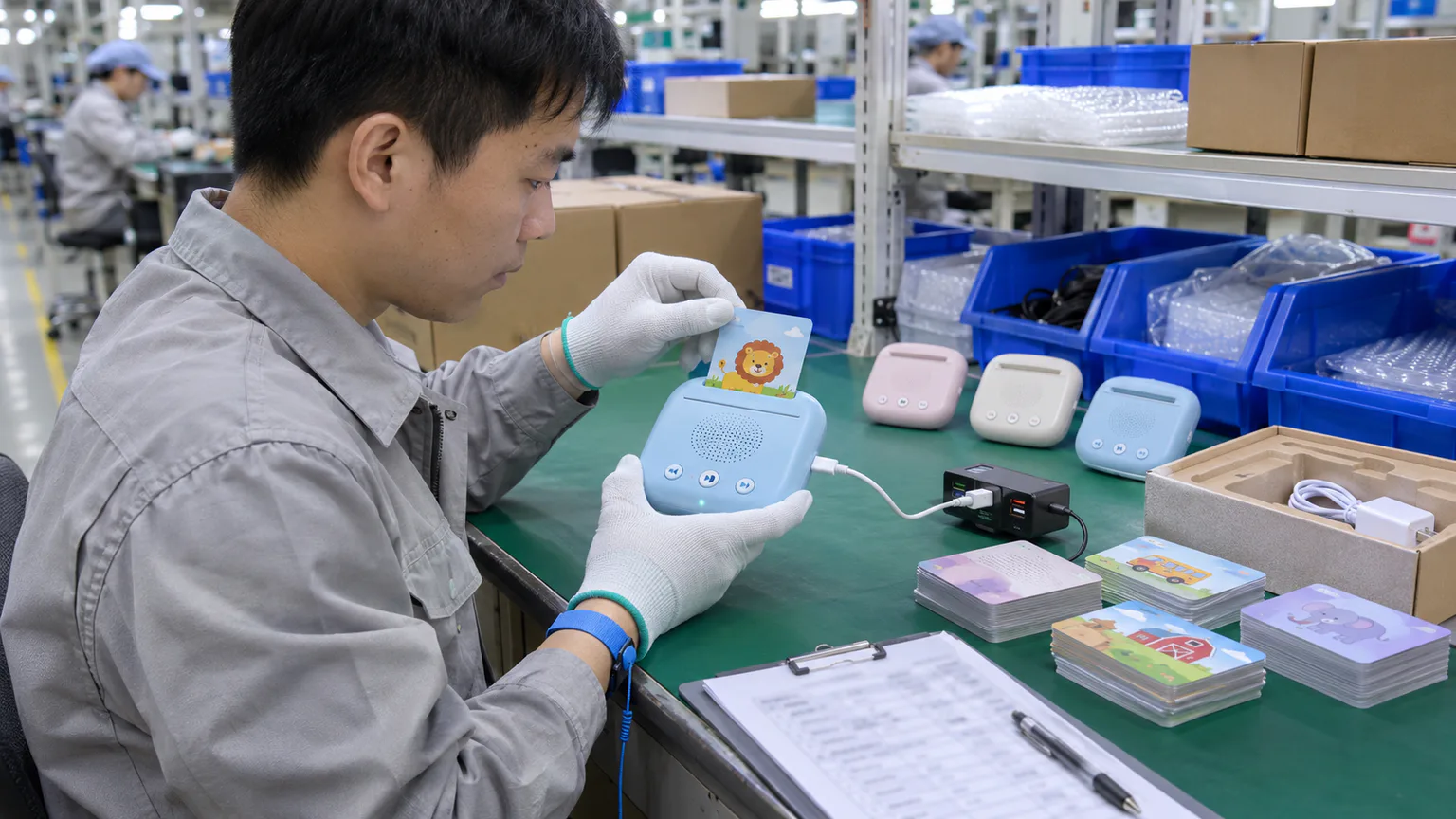
6. What should factory testing and shipment inspection cover?
Testing should cover card recognition and content identity across the platform’s normal, boundary, offline, and future-compatibility scenarios.
| Control point | Practical check | Evidence |
|---|---|---|
| Card-to-content identity | Trace sampled physical cards through ID, title, language, audio package, artwork, pack, firmware compatibility, and expected playback. | Record result, defect category, and sample identity |
| Insertion and recognition margin | Test orientation, depth, speed, partial insertion, rapid swaps, repeated use, worn cards, different production positions, and unsupported cards. | Record result, defect category, and sample identity |
| Playback and offline states | Verify first use, auto-start, navigation, resume, repeat, volume, sleep, low power, network loss if relevant, reset, and content availability. | Record result, defect category, and sample identity |
| Starter and expansion pack-out | Confirm card counts, visible numbers, player compatibility, language, storage, instructions, barcodes, retail packs, cartons, and assortment. | Record result, defect category, and sample identity |
| Card recognition | Test all card identities, orientations, insertion depths, repeated use, and samples from different production positions. | Record result, defect category, and sample identity |
| Audio mapping | Compare card artwork, ID data, filename, language, sequence, and playback behavior with the approved map. | Record result, defect category, and sample identity |
| Player controls | Verify insertion feel, buttons, speaker clarity, volume, charging or batteries, memory, and low-power response. | Record result, defect category, and sample identity |
| Set completeness | Count cards and accessories, confirm pack labels, storage solution, barcode, instructions, and carton quantities. | Record result, defect category, and sample identity |
Testing frequency should be based on risk, process capability, component history, and the consequence of a failure. Some functions may justify a 100% production check, while appearance or packaging characteristics may be evaluated through a defined sampling plan. The ISO 28590 overview explains the role of acceptance sampling by attributes, but the buyer and inspection provider still need a written defect list, sampling basis, and accept/reject rules for the actual order.
Shipment inspection should use the approved product, controlled files, packing specification, label artwork, and purchase order as references. Inspectors should test content from different parts of the library rather than replaying one demonstration item. Allow time before the shipping deadline for containment, root-cause review, corrective action, and reinspection when needed.
See Cakub’s quality-control workflow for the broader sequence from incoming materials through shipment release, or review the factory capability page when evaluating production support.
7. How should safety and compliance planning be handled?
Compliance depends on intended use, age grading, materials, electronics, power source, wireless functions, sound output, accessories, packaging, claims, and destination market. Start planning before the final design because required tests, warnings, traceability marks, battery construction, or technical documentation can affect the product itself.
- U.S. CPSC toy safety guidance — use the current official text as a starting point for the final model and market.
- European Commission toy-safety information — use the current official text as a starting point for the final model and market.
- IEC 62115 electric-toy standard overview — use the current official text as a starting point for the final model and market.
- WHO safe-listening guidance — use the current official text as a starting point for the final model and market.
Relevant official starting points for this topic include U.S. CPSC toy safety guidance, European Commission toy-safety information, IEC 62115 electric-toy standard overview, WHO safe-listening guidance. These links do not determine the complete test plan. Ask an accredited laboratory or qualified compliance adviser to review the final configuration and the markets where the product will be placed. Keep reports, declarations, bills of materials, label approvals, and production identities connected to the exact model and revision.
8. How can buyers compare supplier quotations fairly?
Compare player hardware, tooling, firmware, card recognition, memory or connectivity, content integration, card construction, starter and expansion quantities, audio programming, testing, packaging, hosting or application scope, and post-launch support.
Normalize quotations into the same structure: product configuration, included content volume, electronic functions, materials, accessories, retail packaging, master-carton basis, development charges, sample rounds, tooling, testing, documentation, quantity, currency, Incoterm, payment assumptions, and validity period. Highlight every exclusion. Two unit prices are not comparable when one includes programmed content, printed media, accessories, or inspection support and the other does not.
9. Common mistakes that create avoidable delay or rework
Choosing a card technology from unit cost alone
Reader cost, card cost, orientation, wear, ID capacity, radio scope, inspection, expansion, and support determine lifecycle value. The practical correction is to add an owner, reference file, approval point, and inspection method before the order enters mass production.
Calling a player offline without defining first use
Some systems need an account or network before content is cached; the marketed claim must match the complete user journey. The practical correction is to add an owner, reference file, approval point, and inspection method before the order enters mass production.
Launching without a compatibility policy
New packs can fail on older players when IDs, firmware, regions, language packages, and release tests are not governed. The practical correction is to add an owner, reference file, approval point, and inspection method before the order enters mass production.
Treating rights and master files as marketing tasks
Audio licensing, territory, term, voice permissions, source masters, metadata, and handover affect whether the library can be produced and supported. The practical correction is to add an owner, reference file, approval point, and inspection method before the order enters mass production.
10. Frequently asked questions
Is an app-free storytelling box always fully offline?
Not automatically. Define setup, content delivery, authorization, caching, updates, time functions, accounts, recovery, and what remains available without a phone or network.
Which card-recognition method is best?
No method is universal. Compare card count, orientation, read range, wear, card construction, reader cost, card cost, radio requirements, production tolerance, and expansion.
Can one player support several languages?
Yes, when language selection, audio packages, card IDs, prompts, firmware, memory, labels, packaging, and compatibility are designed and inspected together.
Who should own the story audio files?
The contract should identify rights, territories, terms, source masters, derived production files, metadata, card mappings, hosting obligations, and handover at launch or termination.
What should a manufacturer test before shipment?
Test sampled card identities, insertion and recognition, mapped audio, controls, offline states, power, speaker, charging, appearance, starter and expansion pack completeness, labels, cartons, and quantities.
Conclusion: approve a repeatable product system
A smart story player OEM program succeeds when the physical product and the content business are governed as one platform. Protect the card registry, audio masters, firmware compatibility, offline promise, release process, factory checks, and post-launch responsibilities before scaling the catalog.
A successful insert-card audio player project is not defined by a single attractive sample. It is defined by whether the approved user experience can be reproduced with controlled files, stable materials, clear workmanship criteria, suitable factory testing, traceable packaging, and a shipment-inspection method that reflects customer requirements. That is the standard buyers should use when comparing suppliers and deciding whether a project is ready for production.
Planning a custom insert-card audio player project?
Send your target user, product format, content scope, market, quantity range, packaging, and launch timing for a structured project review.