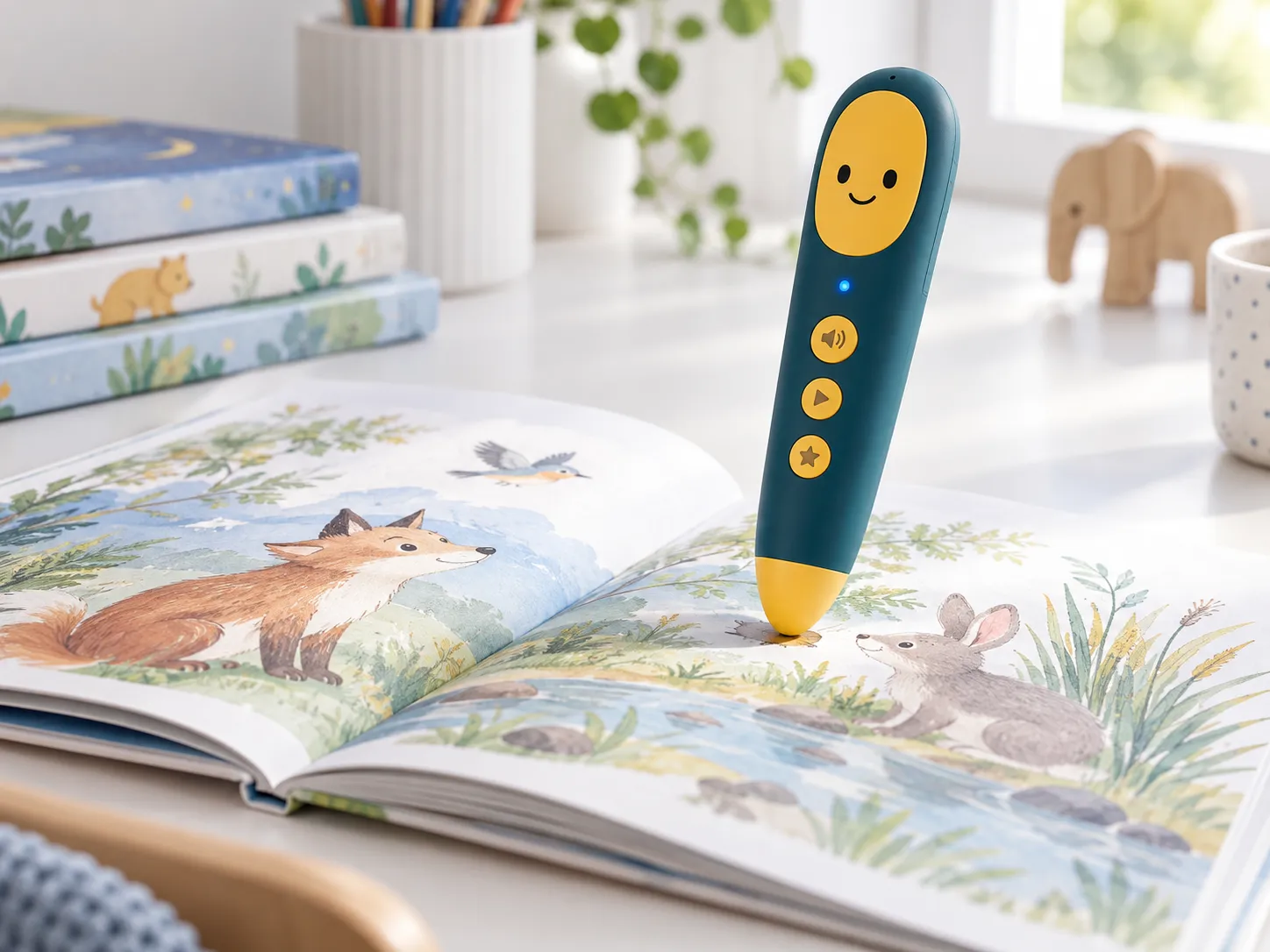
Talking Pen Manufacturer vs Trading Company: A Buyer Audit Guide: A direct talking pen manufacturer can offer close control of electronics, firmware, assembly, testing, and change execution, while a trading or integration company may add value by coordinating printing, audio, packaging, compliance, and multiple factories. Neither label guarantees performance. Buyers should verify the contracting entity, actual production sites, engineering ownership, subcontracting, quality records, file control, audit access, commercial terms, and after-sales responsibility.
Supplier websites often use factory, manufacturer, OEM, solution provider, and exporter as if they mean the same thing. In talking pen projects, one company may assemble electronics while another prints coded books, records audio, prepares OID files, molds housings, or packs the final set. The useful question is not whether an intermediary exists. It is whether the complete supply chain is visible, controlled, and accountable.
This guide is written for educational publishers, language-learning brands, curriculum developers, toy distributors, and sourcing teams. It addresses the questions that normally appear between the first concept discussion and a production-ready quotation: product application, customer requirements, content ownership, sample purpose, factory testing, shipment inspection, packaging, and market-specific documentation. It does not present universal specifications because talking-pen should be engineered around the final user, configuration, claims, sales market, and distribution plan.
For an overview of the available configuration and customization direction, review Cakub’s talking pens product page. Buyers who are still comparing formats can also start with the interactive learning product range.
1. What should buyers understand first?
A talking pen manufacturer physically performs defined production operations, such as PCB assembly, device assembly, programming, testing, or pack-out. A trading company buys and resells products. An integrator coordinates technical and production work across specialist partners. One supplier can perform more than one role, so the buyer should verify activities rather than rely on the business label.
Practical buyer answer: Ask the supplier to draw the project flow from your purchase order to shipped goods. The diagram should name the legal contracting party, engineering owner, pen assembly site, OID and audio preparation, book printer, tooling location, testing laboratory, packaging site, inspector access, payment recipient, warranty owner, and escalation path.
The most reliable starting point is a one-page use-case description. State who uses the product, what physical action starts the interaction, what the product should do, what happens next, and how success is observed. This prevents a supplier from substituting a familiar standard product for a requirement that actually needs different electronics, files, construction, firmware, or packaging.
2. Where does this solution fit—and where does it not?
Direct manufacturer engagement can be effective for technically stable projects that need close engineering and production communication. An experienced integrator can be useful when the buyer needs one party to coordinate several specialist processes. The better fit depends on capability, transparency, controls, and accountability.
| Decision question | Good fit when | Reconsider when |
|---|---|---|
| Can the supplier show actual operations? | The team can demonstrate relevant engineering, programming, assembly, testing, records, and controlled subcontractors. | The only evidence is a showroom, generic video, borrowed report, or unverified factory claim. |
| Is responsibility clear across partners? | One owner coordinates changes, defects, approvals, schedules, documents, and warranty through named sites. | Every problem is redirected to an unnamed upstream factory. |
| Does the commercial model fit the project? | Pricing, minimum order, engineering service, communication, financing, consolidation, inspection, and support are itemized. | A low unit price hides tooling, files, testing, packaging, rework, freight, or after-sales gaps. |

3. Which specification decisions change the project?
Vendor selection should test technical ownership, physical production, supply-chain control, quality evidence, commercial transparency, communication, and service. A business license alone does not prove any of these capabilities.
1. Legal entity and contract
Verify registered company name, address, bank beneficiary, export role, quotation issuer, contract signatory, invoices, and warranty obligation. This decision should be closed before detailed quotation because it affects several downstream assumptions. For talking-pen, the useful question is not whether a feature is available in theory, but how it will be implemented, approved, repeated in production, and checked before shipment.
2. Engineering capability
Identify who owns product specification, industrial design, electronics, firmware, OID preparation, audio mapping, print engineering, and change review. A supplier can only validate this point when the intended user action and acceptable response are observable. For talking-pen, the useful question is not whether a feature is available in theory, but how it will be implemented, approved, repeated in production, and checked before shipment.
3. Production and subcontracting
Map tooling, PCB work, device assembly, programming, book printing, packaging, warehousing, and any subcontracted process by site. Treat this as a controlled product requirement rather than an informal preference in an email thread. For talking-pen, the useful question is not whether a feature is available in theory, but how it will be implemented, approved, repeated in production, and checked before shipment.
4. Quality system and records
Review incoming checks, work instructions, first-article approval, line tests, content verification, defect data, corrective action, calibration, and final inspection. The approved sample should demonstrate this requirement with representative content and production-style materials. For talking-pen, the useful question is not whether a feature is available in theory, but how it will be implemented, approved, repeated in production, and checked before shipment.
5. Files, tooling, and continuity
Define ownership, access, backup, version control, source or production files, code allocation, molds, test fixtures, and transfer conditions. Document the decision in the specification, sample comments, and final inspection checklist so each team uses the same reference. For talking-pen, the useful question is not whether a feature is available in theory, but how it will be implemented, approved, repeated in production, and checked before shipment.
6. Commercial and service terms
Compare price basis, MOQ, payment, capacity, lead-time assumptions, inspection rights, change charges, spare units, warranty, claims, and escalation. If the requirement is still open, ask the supplier to quote the alternatives separately instead of hiding the difference in one price. For talking-pen, the useful question is not whether a feature is available in theory, but how it will be implemented, approved, repeated in production, and checked before shipment.
| Decision area | What to define | Approval evidence |
|---|---|---|
| Legal entity and contract | Verify registered company name, address, bank beneficiary, export role, quotation issuer, contract signatory, invoices, and warranty obligation. | Specification, approved sample, or controlled record |
| Engineering capability | Identify who owns product specification, industrial design, electronics, firmware, OID preparation, audio mapping, print engineering, and change review. | Specification, approved sample, or controlled record |
| Production and subcontracting | Map tooling, PCB work, device assembly, programming, book printing, packaging, warehousing, and any subcontracted process by site. | Specification, approved sample, or controlled record |
| Quality system and records | Review incoming checks, work instructions, first-article approval, line tests, content verification, defect data, corrective action, calibration, and final inspection. | Specification, approved sample, or controlled record |
| Files, tooling, and continuity | Define ownership, access, backup, version control, source or production files, code allocation, molds, test fixtures, and transfer conditions. | Specification, approved sample, or controlled record |
| Commercial and service terms | Compare price basis, MOQ, payment, capacity, lead-time assumptions, inspection rights, change charges, spare units, warranty, claims, and escalation. | Specification, approved sample, or controlled record |
Audit the project path, not a staged tour
Choose one representative SKU and trace it through quotation, purchase order, approved files, material receipts, programming, assembly, function test, content verification, book matching, packaging, traceability, inspection, nonconformity handling, and shipment records. Evidence from the actual process is more useful than a broad claim of many years of experience.
Prepare with the electronic toy factory audit checklist, review Cakub’s factory capabilities, and see the quality-control workflow.
Qualifying a talking pen supplier?
Send the product scope, content and book requirements, target markets, expected quantity, audit concerns, file ownership needs, test plan, and commercial assumptions for a sourcing review.
4. What should the buyer prepare before requesting a quotation?
A useful quotation pack reduces assumptions without pretending every decision is final. It should distinguish confirmed requirements, preferred options, open questions, buyer-supplied files, supplier responsibilities, and items that will be approved through sampling. For talking-pen, prepare the following:
- Supplier disclosure request: Ask for legal entity, sites, headcount by function, equipment, processes, subcontractors, certifications, capacity, references, and warranty owner.
- Project responsibility matrix: Assign specification, hardware, firmware, OID, audio, printing, tooling, testing, compliance support, inspection, shipping, and corrective action.
- Comparable RFQ pack: Give every candidate the same configuration, quantities, Incoterm, content scope, quality level, packaging, documents, schedule, and service assumptions.
- Market and age grading: List destination countries, intended user age, sales channel, product claims, and any buyer-specific compliance manual.
- Commercial range: Provide forecast quantity, launch quantity, packaging format, delivery window, and preferred shipping basis.
- Ownership and approvals: Identify who owns artwork and audio, who approves firmware behavior, and who signs the production-intent sample.
Do not send a large folder without an index. Add a requirement sheet that lists every file, its revision, language, owner, intended use, and approval status. If the project contains many tracks, cards, pages, triggers, or modes, include a mapping table that connects the physical action to the expected response. This table becomes valuable during firmware review, factory testing, and shipment inspection.
5. How should development move from concept to shipment?
Use document review, sample work, remote or on-site process evidence, and commercial due diligence together. No single audit method proves complete supplier suitability.
- Confirm the requirement brief: Screen legal identity, export and payment details, relevant products, declared sites, engineering roles, production processes, subcontractors, capacity, and market experience. Record open questions, the responsible party, and the required approval evidence before moving forward.
- Create the controlled map: Run a controlled sample task that includes hardware, content mapping, coded print, firmware, test evidence, packaging assumptions, comments, and change response. Use controlled filenames and revision dates so artwork, audio, firmware, components, and packaging cannot drift apart.
- Review feasibility and risk: Trace one product through actual records and operations, then compare the observed responsibilities with the quotation, contract, quality plan, and supply-chain map. Review the result against the intended user journey, not only against an isolated component demonstration.
- Build a purpose-defined prototype: Close gaps in ownership, files, tooling, inspection access, changes, traceability, warranty, claims, continuity, and escalation before the purchase order. Keep one approved reference and convert every comment into a measurable acceptance point.
- Approve a production-intent sample: Combine final-style contracting entity, production sites, product sample, hardware, firmware, content, book, packaging, quality plan, inspection criteria, files, and commercial terms and close measurable comments before material release. Confirm that buyer-supplied files and factory-prepared files use the same version before releasing materials.
- Release controlled production files: Freeze the bill of materials, supplier questionnaire, business records, capability matrix, site map, responsibility matrix, RFQ, quotation, audit evidence, quality agreement, and change log, packaging artwork, test method, and approval references. Do not compress the schedule by removing a validation gate; resolve the cause of delay and re-plan the critical path.
- Inspect and release the shipment: Sample across the order, reproduce representative user journeys, verify pack-out, and document disposition before dispatch. Before shipment, reproduce representative user actions and compare the packed product with the signed approval set.
The workflow should have visible gates. A concept sample proves feasibility; an engineering sample closes construction and function; a production-intent sample confirms controlled files, materials, firmware, audio, artwork, accessories, and packaging. Combining those purposes into one vague “sample” makes approval comments hard to interpret and makes schedule promises unreliable.
6. What should factory testing and shipment inspection cover?
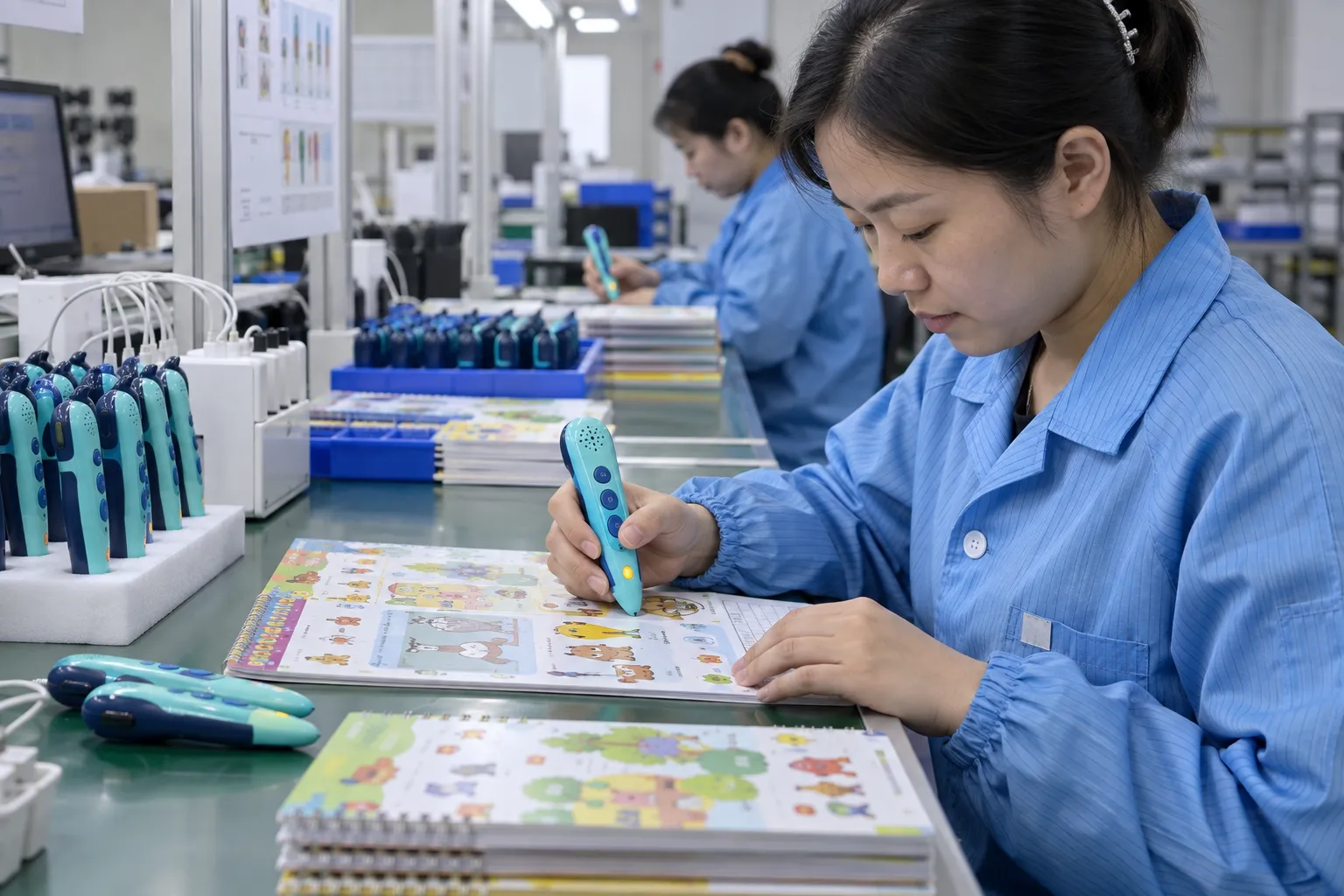
A supplier trial should evaluate both the product and the organization. Record how requirements are clarified, files are controlled, samples are identified, defects are analyzed, and changes are communicated.
| Control point | Practical check | Evidence |
|---|---|---|
| Requirement comprehension | Issue a small representative brief and assess questions, assumptions, risk identification, configuration summary, exclusions, and quotation clarity. | Record result, defect category, and sample identity |
| Technical execution | Review sample hardware, firmware, OID mapping, audio, book construction, packaging, deviations, test records, and corrective responses. | Record result, defect category, and sample identity |
| Process traceability | Select records from incoming material through programming, assembly, test, book matching, pack-out, inspection, rework, and shipment identity. | Record result, defect category, and sample identity |
| Commercial resilience | Check capacity basis, long-lead controls, alternate suppliers, file backup, tooling access, warranty workflow, spare strategy, escalation, and continuity plan. | Record result, defect category, and sample identity |
| Recognition consistency | Activate representative points across pages, edges, colors, and different positions in the content library. | Record result, defect category, and sample identity |
| Audio and controls | Verify track mapping, clarity, volume steps, buttons, charging behavior, and low-power response. | Record result, defect category, and sample identity |
| Print-to-device match | Compare coded production pages, controlled mapping data, firmware, and the approved pen. | Record result, defect category, and sample identity |
| Retail pack-out | Confirm accessories, instructions, labels, inserts, protective fit, barcode placement, and carton quantity. | Record result, defect category, and sample identity |
Testing frequency should be based on risk, process capability, component history, and the consequence of a failure. Some functions may justify a 100% production check, while appearance or packaging characteristics may be evaluated through a defined sampling plan. The ISO 28590 overview explains the role of acceptance sampling by attributes, but the buyer and inspection provider still need a written defect list, sampling basis, and accept/reject rules for the actual order.
Shipment inspection should use the approved product, controlled files, packing specification, label artwork, and purchase order as references. Inspectors should test content from different parts of the library rather than replaying one demonstration item. Allow time before the shipping deadline for containment, root-cause review, corrective action, and reinspection when needed.
See Cakub’s quality-control workflow for the broader sequence from incoming materials through shipment release, or review the factory capability page when evaluating production support.
7. How should safety and compliance planning be handled?
Compliance depends on intended use, age grading, materials, electronics, power source, wireless functions, sound output, accessories, packaging, claims, and destination market. Start planning before the final design because required tests, warnings, traceability marks, battery construction, or technical documentation can affect the product itself.
- U.S. CPSC toy safety guidance — use the current official text as a starting point for the final model and market.
- ISO 2859-1:2026 acceptance-sampling overview — use the current official text as a starting point for the final model and market.
- European Commission steps for placing toys on the EU market — use the current official text as a starting point for the final model and market.
Relevant official starting points for this topic include U.S. CPSC toy safety guidance, ISO 2859-1:2026 acceptance-sampling overview, European Commission steps for placing toys on the EU market. These links do not determine the complete test plan. Ask an accredited laboratory or qualified compliance adviser to review the final configuration and the markets where the product will be placed. Keep reports, declarations, bills of materials, label approvals, and production identities connected to the exact model and revision.
8. How can buyers compare supplier quotations fairly?
Normalize quotations across product configuration, quantity breaks, Incoterm, tooling, engineering, firmware, content work, OID preparation, printing, packaging, testing, documentation, inspection, freight, spares, warranty, and excluded items.
Normalize quotations into the same structure: product configuration, included content volume, electronic functions, materials, accessories, retail packaging, master-carton basis, development charges, sample rounds, tooling, testing, documentation, quantity, currency, Incoterm, payment assumptions, and validity period. Highlight every exclusion. Two unit prices are not comparable when one includes programmed content, printed media, accessories, or inspection support and the other does not.
9. Common mistakes that create avoidable delay or rework
Choosing by factory label alone
A company can own a facility yet lack the required firmware, print, content, quality, or program-management capability for the project. The practical correction is to add an owner, reference file, approval point, and inspection method before the order enters mass production.
Rejecting all intermediaries automatically
A transparent integrator may coordinate specialist processes better than a direct assembler that cannot manage books, content, packaging, or export requirements. The practical correction is to add an owner, reference file, approval point, and inspection method before the order enters mass production.
Auditing only equipment
Machines do not prove correct files, trained operators, effective tests, traceability, corrective action, change control, or after-sales accountability. The practical correction is to add an owner, reference file, approval point, and inspection method before the order enters mass production.
Comparing unnormalized prices
Different assumptions about content, battery, memory, print, accessories, testing, packaging, Incoterm, and warranty make unit prices misleading. The practical correction is to add an owner, reference file, approval point, and inspection method before the order enters mass production.
10. Frequently asked questions
How can I verify a talking pen manufacturer?
Check the legal entity, payment beneficiary, declared sites, relevant processes, engineering team, equipment, quality records, controlled subcontractors, and sample execution. Trace one representative product through actual production and records. Independent due diligence and inspection can supplement, but not replace, project-specific verification.
Is buying directly from a factory always cheaper?
Not always. A direct price may exclude content work, OID preparation, book printing, packaging coordination, compliance support, inspection, consolidation, financing, or after-sales service. Compare the same scope, Incoterm, quantity, quality assumptions, risks, and responsibilities before deciding.
What should a trading company disclose?
It should identify the contracting entity, production partners, responsibilities, subcontracting, markups or service basis where commercially agreed, payment route, file and tooling control, inspection access, change process, warranty owner, and escalation path. Confidential supplier details can be handled through suitable agreements.
Should buyers audit every subcontractor?
Audit depth should follow risk. Critical sites for electronics, device assembly, coded printing, battery supply, book production, and final pack-out may need direct evidence or access. Lower-risk suppliers can be controlled through qualification records, specifications, incoming checks, and performance monitoring.
What documents should be agreed before an OEM order?
Use a signed specification, approved sample and deviation record, bill of materials or controlled configuration, content and artwork release, quality plan, inspection standard, change process, tooling and file terms, compliance responsibility, packaging approval, delivery terms, warranty process, and corrective-action expectations.
Conclusion: approve a repeatable product system
The strongest talking pen supplier is not defined by a label. It is the organization that can show relevant capability, transparent production relationships, controlled files and changes, repeatable quality, clear commercial scope, and accountable support for the complete product.
A successful talking-pen project is not defined by a single attractive sample. It is defined by whether the approved user experience can be reproduced with controlled files, stable materials, clear workmanship criteria, suitable factory testing, traceable packaging, and a shipment-inspection method that reflects customer requirements. That is the standard buyers should use when comparing suppliers and deciding whether a project is ready for production.
Planning a custom talking-pen project?
Send your target user, product format, content scope, market, quantity range, packaging, and launch timing for a structured project review.