Talking Pen Buyer Hub
Research product formats, content workflows, OEM sourcing, compliance, quality control, and lifecycle support in one structured resource center.
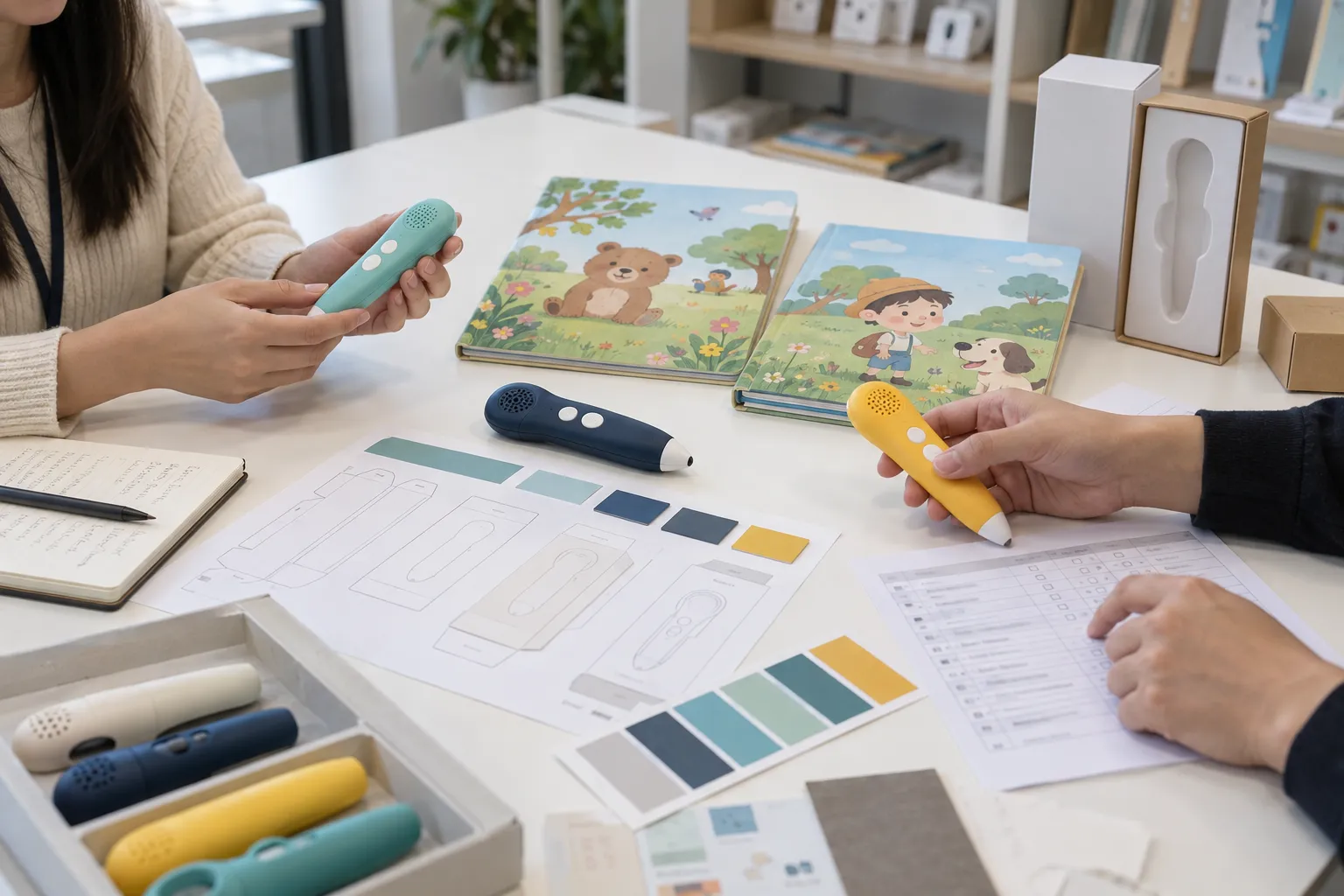
Choose your project path
Start with the solution closest to your current product brief, then use the guide map to resolve detailed buying decisions.
Talking Pen Books
Plan the pen, coded print, mapped audio, learning flow, and expansion library as one compatible product system.
Private Label OEM
Define what changes, who owns each file, how samples are approved, and which production controls support the final order.
Quran Reading Pen
Coordinate the approved edition, recitation audio, verse mapping, language modes, compatibility, and distributor support.
Explore 22 talking pen buyer guides
Each guide answers a procurement, product-development, or post-launch question and links to the next practical decision.
Product selection and learning fit
Choose the interaction model, user age, learning purpose, and product format before comparing supplier quotations.
- 01
Talking Pen Books: A Complete Buyer's Guide for Publishers
Talking pen books combine a programmed optical pen with compatible coded print, approved audio, firmware, and a controlled content map. Publishers should source the pen and books as one product system because recognition, audio identity, print quality, version control, packaging, and shipment testing depend on each other.
- 02
Speaking Pen Books vs Talking Pen Books: What Buyers Should Compare
Speaking pen books and talking pen books usually describe the same broad product category: a pen-shaped audio device activates content from compatible printed pages. The names do not define the recognition technology or compatibility. Buyers should compare the code system, book preparation, content ownership, firmware, update route, sample evidence, and supplier scope.
- 03
Reading Pen for Kids vs Talking Pen vs OCR Scan Pen
An OID talking pen plays preapproved audio when it touches coded print, while an OCR scan pen attempts to recognize ordinary printed text and generate or retrieve speech. OID suits controlled books and activities; OCR suits broader text access. Buyers should choose by content control, supported print, user age, privacy, and accuracy needs.
- 04
Smart Talking Pen vs Screen-Free Audio Player: Which Format Fits?
Choose a smart talking pen when children need precise touch access across printed pages and the publisher plans a coded book library. Choose a card audio player when content should be selected by inserting or tapping durable cards. Choose a sound book when the audio controls should remain inside one title with the simplest setup.
- 05
Educational Talking Pen Design for Phonics, Vocabulary, and Pronunciation
An educational talking pen should connect each printed touch point with a clear learning action such as hearing a phoneme, comparing pronunciation, repeating a word, choosing an answer, receiving feedback, or switching language. The learning flow, audio, OID map, firmware, page design, and testing must be developed together.
Technology, books, and product architecture
Compare recognition systems and plan age grading, starter sets, expansion books, and language-learning architecture.
- 01
OID Pen vs RFID vs QR Code: Choosing Interactive Print Technology
OID, RFID, and QR are different identity systems. An OID pen optically reads tiny prepared identifiers at point level on a printed surface. RFID reads an embedded or attached tag through radio frequency and usually identifies an item, card, or zone. A QR code is a visible two-dimensional code commonly scanned by a camera. The best choice depends on interaction granularity, user action, hardware, visibility, media construction, content updates, environment, and commercial model.
- 02
Talking Pen Age Grading: Design for Toddlers, Preschoolers, and Primary Learners
Talking pen age grading should follow the intended users, learning task, physical construction, foreseeable use, accessories, book format, and destination-market rules. A toddler product usually needs simpler interaction and stricter control of detachable parts than a primary-school product, but an older label cannot be used to avoid hazards created by the actual design and marketing.
- 03
Talking Pen Starter Sets and Expansion Books: A Product-Line Guide
A talking pen starter set should give a new customer one validated path from unboxing to successful use. Expansion books should reuse the approved platform while carrying clear edition, language, code-range, and compatibility identities. The product line needs one item master that connects retail SKUs with books, firmware, programmed content, accessories, and support status.
- 04
Talking English Book Pen Production Guide for Educational Publishers
A talking English book pen combines an approved English-learning sequence with coded print, mapped audio, pronunciation review, firmware behavior, and a compatible pen. Publishers should control the language variety, phonics method, scripts, filenames, touch zones, feedback, book editions, and production proofs before mass production.
OEM sourcing, samples, and compliance
Audit the real delivery structure, define customization scope, use clear sample gates, and prepare market-specific evidence.
- 01
Talking Pen Manufacturer vs Trading Company: A Buyer Audit Guide
A direct talking pen manufacturer can offer close control of electronics, firmware, assembly, testing, and change execution, while a trading or integration company may add value by coordinating printing, audio, packaging, compliance, and multiple factories. Neither label guarantees performance. Buyers should verify the contracting entity, actual production sites, engineering ownership, subcontracting, quality records, file control, audit access, commercial terms, and after-sales responsibility.
- 02
Private Label Talking Pen OEM Guide: Logo, Housing, Packaging, and MOQ
A private label talking pen can range from logo and packaging changes on an existing platform to a new housing, electronics, firmware, content system, and accessory set. MOQ, tooling, sample time, testing, and unit cost depend on which parts change, who owns the files, and whether the final configuration needs new evidence.
- 03
Talking Pen Sample Development Timeline: From Concept to Production Approval
A reliable talking pen sample timeline is built around decision gates, not a fixed promise of days. A concept proof validates the interaction, an engineering sample validates hardware and firmware, a production-intent sample validates released files and materials, and a pilot or first-lot review confirms that the factory can repeat the approved result. Timing depends on content readiness, industrial design, tooling, electronics, book construction, testing, and review speed.
- 04
Talking Pen Certification and Compliance Documents for Global Buyers
There is no single worldwide talking pen certificate. The required evidence depends on product classification, intended age, design, battery, radio functions, accessories, claims, sales market, and the legal role of each operator. A defensible file links the exact production configuration to applicable requirements, laboratory reports, risk assessment, declarations, labels, traceability, instructions, supplier records, and change control.
Content, localization, ownership, and support
Control rights, translations, source files, platform access, warranty rules, replacements, and spare-parts planning.
- 01
Talking Pen Content Licensing: Rights Checklist for Publishers
A talking pen project can require separate rights for text, illustrations, characters, translations, adaptations, narration performances, music, sound effects, trademarks, packaging, and digital source files. Publishers should document permitted products, territories, languages, term, channels, edits, subcontracting, updates, and ownership of final masters before production.
- 02
Talking Pen Book Localization: Translation, Voice, Layout, and SKU Control
Talking pen book localization requires more than translating visible text. Publishers must control source strings, language variants, pronunciation, voice recordings, audio duration, page layout, touch zones, filenames, mapping, firmware prompts, labels, instructions, packaging, and SKU identity. Each language should be tested as a complete physical product.
- 03
Talking Pen Platform Ownership: OID Codes, Source Files, Firmware, and Update Rights
Talking pen platform ownership should be defined asset by asset. The contract should state who owns, licenses, controls, stores, updates, and can transfer OID ranges, source artwork, mappings, audio masters, firmware, programming packages, update tools, industrial design, molds, test fixtures, documentation, and production records.
- 04
Talking Pen Warranty, Replacement, and Spare-Parts Planning
A talking pen after-sales plan should distinguish setup problems, book incompatibility, content mismatch, charging faults, hardware defects, damage, lost units, and unsupported editions. Warranty rules, replacement SKUs, spare parts, evidence requests, retained references, repair boundaries, and supplier responsibilities should be agreed before the first shipment.
Quran reading pen programs
Plan the OEM release, SKU structure, audio approval, setup support, and shipment inspection for an edition-specific system.
- 01
Quran Reading Pen OEM Guide for Publishers and Distributors
A Quran reading pen OEM project connects an approved printed edition with licensed recitation and optional translation through controlled OID mapping. Publishers must manage text rights, audio approval, verse identity, language modes, memory, firmware, print proofs, product testing, packaging, and edition compatibility as one release.
- 02
Quran Reading Pen Only vs Complete Book Set: A Distributor SKU Guide
A pen-only Quran SKU is suitable when distributors can prove compatibility with a named book edition and content package. A complete set is safer for a new launch because the pen, book, firmware, audio, instructions, and packaging are approved together. Replacement sales need stricter version identification than full sets.
- 03
How to Use and Troubleshoot a Quran Reading Pen: Distributor Support Guide
To set up a Quran reading pen, first confirm the correct book edition and content package, charge the device with the specified input, power it on, select the intended language or reciter, and test a coded starter point. Troubleshooting should separate power, compatibility, print recognition, audio, controls, and update faults.
- 04
Quran Pen Recitation Audio Approval and Verse Mapping Workflow
A Quran pen audio approval workflow connects each printed verse or function with a licensed, reviewed audio asset and a stable mapping ID. The release should record reciter, language, translation, script reference, filename, duration, revision, reviewer, approval status, mastering package, firmware, and printed proof.
- 05
Quran Reading Pen Quality Control and Shipment Inspection Checklist
Quran reading pen quality control should verify the exact edition, verse mapping, reciter and translation modes, OID print recognition, audio identity, firmware, memory package, controls, charging, battery behavior, labels, accessories, packaging, and carton identity. Shipment samples should come from different cartons and production positions.
Connect research with the product and production evidence behind it.
Talking pen configurations
Compare product functions, controls, accessories, and customization directions.
View productsFactory workflow
Follow sample approval, file release, assembly, testing, packing, and shipment preparation.
Review the factoryQuality-control framework
Connect incoming checks, functional testing, inspection evidence, and release decisions.
Review quality controlTurn your requirements into a workable product brief
Share your target market, age group, product format, languages, content status, quantity range, and launch timing. Cakub can use those inputs to identify the next questions for configuration and sampling.
Send your requirements